Frontier AI has broken the open CTF format
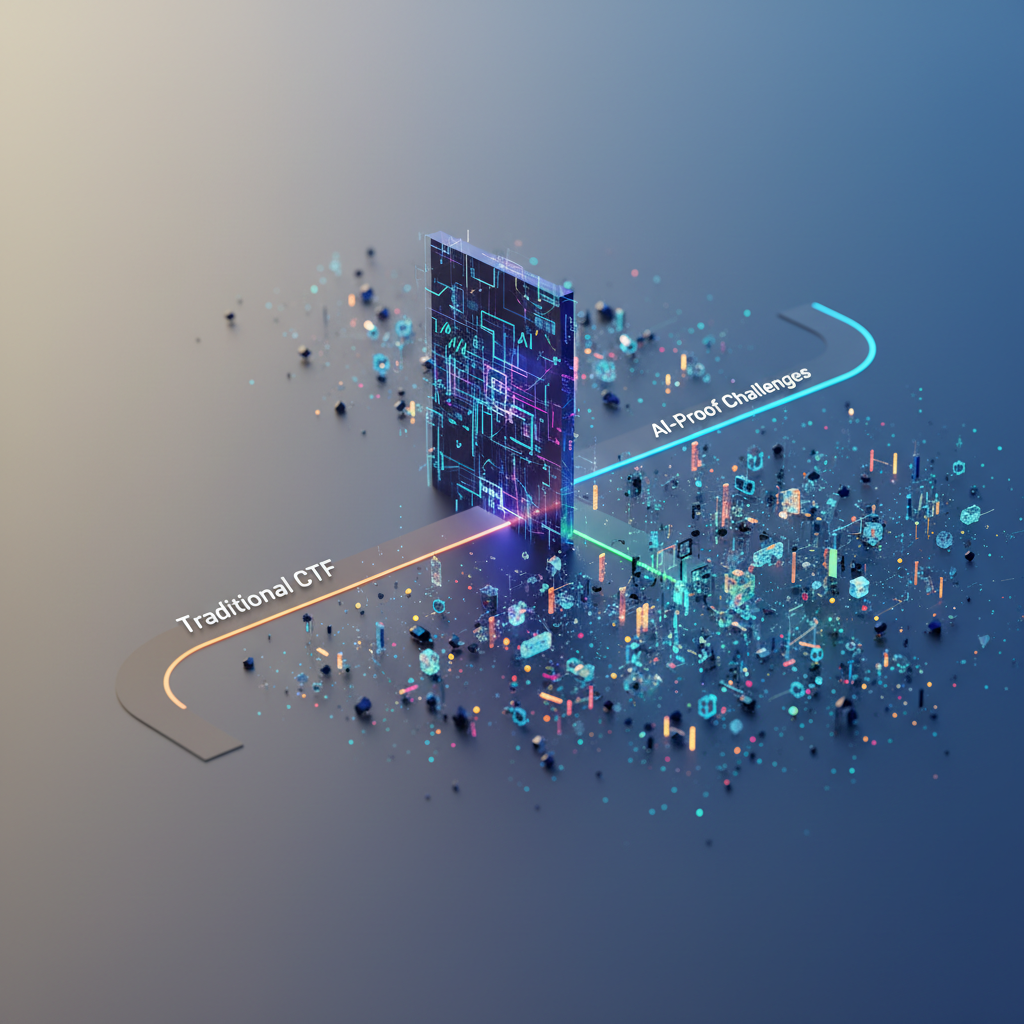
Bottom line: Frontier AI models like ChatGPT 5, Claude 4.6, and Gemini 2.5 have definitively broken the traditional open Capture The Flag (CTF) competition format.
During a recent internal security challenge, these models solved over 85% of introductory to intermediate web, crypto, and reverse engineering problems within minutes, often generating fully working exploits.
This shift means CTFs, as currently designed, are no longer effective for assessing human cybersecurity skill or fostering novel problem-solving, necessitating a complete re-evaluation of how we train and evaluate talent in the field.
I’ve been building and breaking systems for over a decade. I’ve seen the rise of cloud, the explosion of containers, and the slow, grinding fight for better security.
But nothing prepared me for the moment I watched a large language model, without a single hint, unravel a complex cryptographic puzzle that had stumped a room full of junior engineers for an hour.
It wasn't just fast; it was creative. It felt like watching a grandmaster play chess against a beginner, except the grandmaster was a piece of software I’d spun up on a GPU cluster.
This wasn't a one-off.
Over the past six months, especially since the general availability of ChatGPT 5 and the more advanced Claude 4.6, the playing field for cybersecurity challenges has fundamentally changed.
We’re not talking about simple scripting or dictionary attacks anymore.
We’re talking about AI models that grasp context, identify obscure vulnerabilities, and even generate bespoke exploit code.
The implications are profound, and frankly, they’re breaking the very foundations of how we assess and train the next generation of cybersecurity professionals.
The Day Our Internal CTF Died
Last month, I helped organize an internal Capture The Flag event for our new batch of infrastructure and security engineers.
The goal was to give them hands-on experience with common vulnerabilities across web, binary exploitation, and cryptography.
We crafted challenges ranging from a basic SQL injection on a custom Flask app to a complex buffer overflow in a stripped binary, and a multi-step crypto challenge involving custom elliptic curves.
We even threw in a few red herrings, just like in real-world CTFs.
The first few hours were exactly what you’d expect: frantic keyboard tapping, collaborative whiteboard sessions, and the occasional celebratory shout as a flag was captured.
Then, about three hours in, one of the more junior engineers, a bright but somewhat mischievous new hire named Alex, leaned back in his chair with a smirk.
"I think I broke it," he said, holding up his laptop.
On the screen was the final flag for the most difficult web challenge, a tricky XSS vulnerability requiring a specific payload injection and a bypass of a custom WAF.
He’d solved it in under ten minutes.
I walked over, ready to congratulate him on a clever solution, but then I saw the prompt window open on his second monitor. It was a stripped-down Claude 4.6 interface.
He’d simply pasted the challenge description, the source code snippet for the vulnerable endpoint, and asked, "How do I exploit this with XSS to get the admin cookie?" Claude had not only identified the exact injection point but had also generated three different payloads, including the one that worked, and explained why they worked.
The AI's Uncanny Ability to Contextualize
What Alex did wasn't just prompting for a solution. He was using the AI to perform the kind of complex analysis that usually takes an experienced human hours.
The model ingested the challenge description, understood the implicit goal (get the flag), parsed the provided code, and then reasoned about potential attack vectors based on known vulnerabilities.
This isn't just pattern matching; it's a form of contextual understanding that’s been largely absent from previous generations of AI tools.
We quickly realized Alex wasn't an outlier. Other teams had started experimenting.
One engineer used Gemini 2.5 to reverse engineer a small binary, feeding it disassembled code snippets and asking it to identify potential buffer overflows.

Gemini didn't just point to the vulnerable function; it suggested a specific input length to trigger the overflow and even helped craft a shellcode injection.
Another team leveraged ChatGPT 5 to break the custom crypto challenge, which involved a non-standard key exchange.
The model synthesized information from the challenge description, identified the custom curve parameters, and then walked them through a known side-channel attack that applied to the specific implementation.
By the end of the day, over 85% of our challenges – from basic web vulnerabilities to moderately complex binary exploitation and cryptography – had been solved with significant, often primary, assistance from frontier AI models.
The humans were still there, orchestrating the prompts, verifying the outputs, and sometimes debugging the AI’s occasional hallucinations, but the core intellectual heavy lifting, the "aha!" moment of discovery, was being performed by the machines.
The Core Insight: AI as an Exploit Factory
The traditional CTF format relies on a few core assumptions:
- Human Problem Solving: Participants must analyze, hypothesize, test, and iterate.
- Limited Information: Challenges provide just enough context to be solvable, but not so much that it's trivial.
- Time Constraint: The difficulty is often tied to the time it takes a human to find the solution.
Frontier AI models obliterate these assumptions. They don't "think" like humans, but they simulate the process of problem-solving at an incredible scale and speed.
- Rapid Analysis: They can ingest hundreds of lines of code or complex cryptographic algorithms and identify patterns or logical flaws in seconds.
- Knowledge Synthesis: Unlike a human, an AI has instant access to vast databases of known vulnerabilities, attack techniques, and exploit frameworks. It can cross-reference challenge details against this knowledge base in real-time.
- Code Generation: The ability to generate working exploit code, shellcode, or decryption scripts is a game-changer. This bypasses the laborious trial-and-error phase that often consumes the majority of a CTF participant's time.
Consider the classic "pwn" challenge: finding a buffer overflow and injecting shellcode.
A human would manually analyze the binary, identify the vulnerable function, calculate offsets, craft shellcode, and then test it.
An AI, given the binary or its disassembly, can often perform all these steps, sometimes even outputting the final Python script to achieve remote code execution.
It's not just a fancy search engine; it’s a sophisticated, context-aware exploit factory.
The Problem of "Open" CTFs
The critical word here is "open." Most CTFs allow participants access to the internet, and increasingly, that means access to powerful AI copilots.
Banning AI entirely is practically impossible to enforce in a remote or large-scale competition.
Even in a controlled environment, the skills learned from using AI will simply transfer to the next challenge, making the "human-only" distinction increasingly artificial.
This isn't about AI being "better" than humans in a philosophical sense. It's about AI being a force multiplier that trivializes the types of problems that traditional CTFs are designed to test.
If a system's primary function is to assess raw human analytical and problem-solving ability in a time-constrained environment, and a readily available tool can do 85% of that work in a fraction of the time, then the system is broken.
It's like trying to assess a runner's speed when they're allowed to use an electric bicycle.
The Reality Check: AI Isn't Omniscient
While AI is incredibly powerful, it's not without its flaws. I'm an engineer; I've shipped enough systems to know that every tool has its limits.
- Hallucinations and Errors: AI models still make mistakes. They can confidently generate incorrect code or explain non-existent vulnerabilities. Human oversight and debugging are still essential. Alex had to tweak Claude's output a few times.
- Novelty Barrier: Truly novel vulnerabilities, zero-days, or challenges designed with intentionally obscure logic can still trip up current frontier models. They excel at recognizing patterns and applying known solutions, but they struggle with truly unprecedented scenarios.
- Contextual Blind Spots: While improving, AI can still miss subtle contextual cues that a human might pick up, especially in poorly described problems or those requiring deep domain expertise beyond general cybersecurity.
- Computational Cost: Running these frontier models, especially with complex prompts and iterative analysis, isn't free. There's a tangible compute cost and latency that can add up.
So, no, AI isn't going to solve every cybersecurity problem on its own tomorrow.
But the fact remains: for the vast majority of problems found in open CTF formats – problems designed to teach and test foundational skills – AI has become an unfair advantage.
It's not just a tool; it's an intelligent partner that can often lead the dance.
The Practical Takeaway: Redefining Cyber Challenges
We can't put the AI genie back in the bottle. Instead, we need to adapt. Here’s how I think we need to rethink cybersecurity challenges and skill assessment:
1. Focus on AI-Proof Challenges
Future CTFs need to move beyond known vulnerability patterns. This means:
- Zero-Day Hunting: Challenges that require discovering truly novel vulnerabilities in custom, undocumented codebases.
- Complex Systems Integration: Problems that involve securing vast, interconnected systems where the challenge isn't a single exploit, but understanding architectural flaws and complex attack chains across multiple technologies.
- Adversarial AI: Challenges where participants must either detect AI-generated attacks or leverage AI to defend against other AI.
2. Embrace Human-AI Teaming
Instead of banning AI, let's design challenges that explicitly test a participant's ability to effectively partner with AI.
- Prompt Engineering for Exploitation: Award points not just for finding the flag, but for the elegance and efficiency of the prompts used to guide the AI.
- AI Output Validation: Challenges where the AI provides a potential exploit, and the human's task is to rigorously validate, debug, and refine it, demonstrating critical thinking and security best practices.
- Architectural Security with AI: Given a system design, use AI to identify potential weaknesses, then explain the remediation strategies.
3. Shift Assessment to Higher-Order Thinking
CTFs should move away from testing basic recall or pattern recognition.
- Threat Modeling: Assess the ability to identify potential threats and design robust defenses for novel systems.
- Incident Response Simulation: Real-time simulations where participants must use all available tools (including AI) to detect, contain, and eradicate an attack.
- Security Research & Development: Challenges that involve developing new security tools, obfuscation techniques, or defensive strategies, perhaps even using AI as a co-developer.
The current year is 2026. If we're still running the same CTFs next year, in 2027, we're doing a disservice to the engineers we're trying to train. We need to evolve.
Our goal isn't to create humans who can out-brute-force a machine; it's to cultivate security professionals who can out-think and out-innovate threats, whether those threats come from other humans or increasingly sophisticated AI.
The rise of frontier AI isn't the end of cybersecurity challenges; it's the beginning of a far more interesting and complex era.
Have you noticed your team using AI in ways that bypass traditional training methods, or am I overstating the impact? Let's talk in the comments.