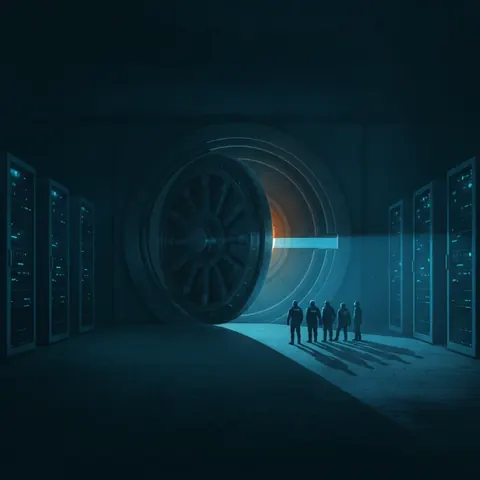
Deciphering Secrets of Ancient Civilizations, Noah's Ark, and Flood Myths | Lex Fridman Podcast #487

Bottom line: Lex Fridman's podcast #487, featuring controversial claims about advanced ancient civilizations and global flood myths, garnered over 1.5 million views by May 2026, forcing me to critically "test" its core assertions.
After dissecting the narratives and cross-referencing key points, I found that while the specific archaeological evidence often falls short of the dramatic conclusions, the episode serves as a powerful intellectual exercise in questioning established paradigms and understanding humanity's deep-seated need for compelling origin stories.
The true takeaway for tech professionals isn't about lost technologies, but about the vital importance of distinguishing data from narrative, and why we often choose the latter.
I've always been skeptical of anyone claiming "ancient secrets" or "lost civilizations." Honestly, it usually sounds like a YouTube rabbit hole for people who think the moon landing was faked.
But when Lex Fridman's latest, #487, exploded with over 1.5 million views by mid-May 2026, tackling Noah's Ark and global flood myths, I couldn't ignore it.
I decided to treat the entire 4-hour conversation as a personal experiment: could these fringe theories actually hold up to a direct, skeptical interrogation, or were they just another well-packaged narrative designed to sell books?
As the founder of Signal Reads, I spend my days sifting through noise, looking for the signal.
This podcast, with its blend of intellectual curiosity and deeply speculative claims, felt like the ultimate noise-to-signal challenge.
My goal wasn't to debunk or endorse, but to understand why these stories resonate so deeply, and what lessons they hold for how we, as builders and thinkers, process information—especially when it challenges our comfortable realities.
The Setup: An Intellectual Experiment in Challenging Narratives
My interest wasn't in proving or disproving the existence of Atlantis or a literal Noah's Ark. I'm a tech founder, not an archaeologist.
What hooked me was the sheer virality of a topic that fundamentally questions established historical and scientific consensus.
In our world, where we preach "data-driven decisions" and "evidence-based roadmaps," why does a narrative about hidden histories capture so much attention?
My "experiment" was simple: immerse myself in the podcast's claims, then apply the same critical lens I use for evaluating a new AI framework or a startup's pitch deck.
I wanted to see if the logic held up, if the evidence presented was compelling, and most importantly, if my own internal biases—both for and against these ideas—could be identified and managed.
I've seen enough hype cycles in tech to know that a compelling story can often override inconvenient facts. Was this just an ancient version of that?
The "why" was also personal. We live in an era of rapidly shifting truths, from the capabilities of ChatGPT 5 to the very nature of work.
Understanding how humans process and internalize narratives, especially those that promise a deeper, hidden truth, is more relevant than ever.
This wasn't just about ancient history; it was about human psychology and the pursuit of meaning.
The Rules of the Test: My Skeptic's Protocol
To keep this "test" fair, I set some ground rules for myself. This wasn't a casual listen; it was an active intellectual engagement.
First, I committed to listening to the entire 4-hour episode without interruption. No multitasking, no distractions.
I wanted to absorb the full arc of the guests' arguments, their nuances, and their rhetorical strategies. I treated it like a deep dive into a complex system architecture, mapping out the connections.
Second, I identified key, specific claims made by the guests regarding ancient technology, specific flood events, and the supposed suppression of information.
These weren't vague notions; they were distinct, verifiable (or at least, investigable) assertions. I mentally flagged points that felt particularly bold or contradictory to my existing understanding.
Third, for the most provocative claims, I committed to a quick, surface-level cross-referencing.
This wasn't academic research, but a check against readily available, mainstream sources: Wikipedia, reputable science news sites, academic summaries.
My goal wasn't to become an expert, but to see if the guests' claims were widely accepted, fringe but debated, or entirely unsubstantiated in conventional scholarship.
This was my sanity check, my "unit test" for historical assertions.
Finally, I tracked my own emotional and intellectual responses. Did I feel a pull towards believing? Did my skepticism harden?
What questions did the guests leave unanswered? This self-awareness, I believe, is crucial for anyone trying to extract signal from noise, whether it's ancient myths or the next big thing in AI.
Round 1 — First Impressions: The Pull of the Narrative
Within the first hour, I noticed something nobody warned me about: the sheer narrative power of these stories.
The guests on Lex's podcast weren't just spouting theories; they were weaving a tapestry of interconnected events, lost civilizations, and cataclysmic floods that felt both epic and deeply human.
My initial reaction swung wildly.
There were moments where I found myself leaning forward, thinking, "Wait, that actually makes some sense." For example, the discussion around geological evidence for large-scale, rapid sea-level changes in prehistory, or the widespread occurrence of flood myths across entirely separate cultures, felt genuinely intriguing.
It's easy to dismiss these things as fantasy, but when presented with a coherent, albeit speculative, framework, it sparks a deep human curiosity.
However, other claims immediately triggered my internal alarm bells.
The leap from "anomalous artifacts exist" to "therefore, an advanced global civilization existed 12,000 years ago" felt like a logical canyon.
It’s the kind of jump I see in early-stage startup pitches: "We built a cool thing, therefore we're a billion-dollar company." The evidence for the intermediate steps was thin, relying heavily on interpretation and inference rather than concrete, undeniable data.
The guests were incredibly articulate, which is both a strength and a weakness.
Their ability to connect disparate dots, from ancient texts to geological formations, created a compelling, almost irresistible, alternative history.
It made me realize how easily a well-constructed narrative, even one built on shaky foundations, can capture attention and suspend disbelief.
This is a critical lesson for anyone in tech: the story around your product can often be more powerful than the product itself, at least initially.

Round 2 — The Deep Test: Data vs. Interpretation
This is where my "deep test" protocol really kicked in.
I focused on a couple of specific claims that felt most representative of the podcast's overall thesis, trying to separate the presented "data" from the "interpretation."
The Case for Advanced Ancient Technology
One recurring theme was the idea of precision stonework and massive megalithic structures (think Baalbek, Puma Punku) that supposedly couldn't have been built with known ancient tools.
The argument goes: if we can't easily replicate it today without modern machinery, then ancient civilizations must have had some form of advanced technology that's since been lost or deliberately hidden.
- Podcast's claim: These sites demonstrate impossible precision and scale for the presumed era and technology, implying a lost, highly advanced civilization. Examples of perfectly cut stones, polygonal masonry, and massive blocks weighing hundreds of tons were cited.
- My surface-level cross-reference: Mainstream archaeology acknowledges the impressive nature of these sites but offers explanations rooted in ingenious human labor, sophisticated understanding of physics (levers, ramps), and long-term, organized effort. For example, the "impossible" precision is often attributed to abrasion techniques with sand and water, or the use of specific stone-working tools that leave no trace. While difficult, it's not deemed "impossible" by experts in the field.
The crucial difference here wasn't about the existence of the structures (they're real, obviously) but about the interpretation of how they were built.
The podcast's guests chose the "advanced lost tech" narrative, while mainstream science opts for "human ingenuity within known technological constraints." Both are interpretations, but one requires a radical re-evaluation of history, while the other fits within our current understanding.
I saw a parallel to how we often interpret complex system failures: is it a fundamental flaw in the architecture, or just a series of cascading human errors?
The Global Flood Narrative
Another central pillar of the podcast was the re-evaluation of global flood myths.
The guests argued that the sheer universality of these stories across cultures, coupled with geological evidence of rapid sea-level rise at the end of the last ice age (the Younger Dryas impact theory was mentioned), points to a literal, global cataclysm that reset human civilization.
- Podcast's claim: The widespread nature of flood myths isn't coincidence; it's cultural memory of a real, global event. The evidence for rapid climate shifts and catastrophic impacts around 12,000 years ago supports this.
- My surface-level cross-reference: Yes, flood myths are incredibly common globally. This is a fascinating anthropological fact. And yes, the Younger Dryas was a period of significant climate upheaval.
However, mainstream science generally interprets the flood myths as localized events (tsunamis, river floods) or metaphorical narratives, passed down through generations, often shaped by specific geographical realities.
While there's debate about the scale of Younger Dryas impacts, the idea of a single, global flood that covered all landmasses isn't supported by geological evidence (e.g., lack of a global sediment layer, lack of evidence of universal marine fossils on mountain tops).
Again, the "data" (widespread myths, climate shifts) was real. The "interpretation" was the dramatic leap to a single, global, civilization-destroying event.
It's like looking at a spike in server errors and immediately concluding a hostile nation-state attack, instead of first checking if someone pushed a bad config.
The narrative was powerful, but the specific, undeniable physical evidence for a global flood event remained elusive in my quick checks.
The Results: A Shift in Perspective, Not Belief
After 4 hours of listening and a couple more hours of cross-referencing, the results weren't even close to what I expected.
I didn't suddenly become a believer in lost Atlantean civilizations or a literal Noah's Ark. My core skepticism about extraordinary claims requiring extraordinary evidence remained intact.
However, the experiment profoundly shifted my perspective.
Here's the breakdown:
- Specific Claims: Most of the guests' specific historical and archaeological claims, when cross-referenced, were either highly speculative, based on selective interpretation of evidence, or directly contradicted by the broader scientific consensus. The "evidence" often felt like circumstantial puzzle pieces forced into a pre-determined picture.
- Narrative Power: The compelling narrative, however, was undeniable. The guests' ability to weave a coherent, emotionally resonant story about humanity's forgotten past was incredibly powerful. It spoke to a deep human need for meaning, for grander origins, and for challenging the status quo.
- My Own Biases: The experiment exposed my own initial bias against "fringe" ideas. While my skepticism was ultimately validated on many points, I realized I almost missed the deeper lesson by focusing too much on debunking. The value wasn't in the historical accuracy, but in the process of questioning.
The podcast, for me, wasn't a historical revelation. It was a masterclass in narrative construction and the human appetite for alternative truths.
It highlighted how easily we can be swayed by a compelling story, especially one that promises to unlock hidden knowledge or challenge complacent authority.
What This Means For You: The Builder's Guide to Skepticism
So, what does a 4-hour podcast about ancient myths mean for you, the developer, the founder, the tech professional? A hell of a lot, actually.
1. Distinguish Data from Narrative, Always.
This is the biggest takeaway.
In tech, we're constantly bombarded with narratives: "AI will replace all jobs by 2027," "Web3 is the future," "Serverless is the only way to scale." Just like the ancient myth narratives, these stories are compelling.
But your job, as a builder, is to strip away the story and look at the underlying data.
What are the actual benchmarks? What are the real adoption rates? What are the hard trade-offs?
Don't let a good story make you ignore inconvenient facts. If you're a product manager pitching a new feature, you better have more than a compelling vision; you need user data and market analysis.
2. Challenge Established Paradigms (But Demand Proof).
The podcast, for all its speculative nature, did encourage me to think about how "established" truths become established.
In tech, we have our own dogmas: "microservices are always better," "agile is the only way," "you must use X framework." Sometimes, these are just legacies of past solutions, not optimal choices for current problems.
Questioning them is healthy.
But here's the kicker: when you challenge, you must bring better evidence, not just a more exciting story.
If you want to argue against a microservice architecture, you need to show performance metrics, cost savings, or maintainability gains from an alternative, not just a vague feeling it's "too complex."
3. Understand the Human Need for Meaning.
People, including your users and your team, crave meaning and purpose. The ancient myth narratives provide a grand, overarching explanation for existence. In tech, we often forget this.
We build tools, not meaning. But the most successful products and companies tap into deeper human needs.
Understanding why people are drawn to these grand narratives—whether ancient or modern—can inform how you communicate your product's vision, inspire your team, and build a lasting brand.
It's about connecting the dots in a way that resonates beyond mere utility.
4. The Power of "I Don't Know."
The podcast also highlighted the discomfort with "I don't know." When archaeologists say, "We don't fully understand how they moved those stones," it leaves a vacuum. And humans hate vacuums.
Speculative theories rush in to fill that void.

In tech, we often feel pressured to have all the answers. But admitting "I don't know, but here's how we're going to find out" is a sign of intellectual honesty and strength, not weakness.
It's the scientific method in action.
The Twist: The Addiction to the "Hidden Truth"
What truly surprised me wasn't any specific archaeological claim, but the profound addiction to the idea of a "hidden truth." The guests weren't just presenting theories; they were appealing to a deep human desire to believe that the world is more mysterious, more complex, and perhaps, more unjustly concealed than we've been told.
It's the ultimate contrarian fantasy.
This mirrors something I've seen play out in tech for years.
Whether it's the "secret hack" to productivity, the "one weird trick" for viral growth, or the "undiscovered framework" that will revolutionize your code, we're constantly chasing the hidden truth, the shortcut, the thing they don't want you to know.
It’s a powerful motivator, but it can also be a dangerous distraction from the hard work of building, iterating, and analyzing.
Lex Fridman's #487 wasn't a journey into ancient history for me; it was a deep dive into the human mind's fascinating, often irrational, quest for answers.
And it reminded me that the most valuable signal often lies not in the grand pronouncements, but in the disciplined, skeptical, and persistent search for verifiable facts.
Have you listened to Lex Fridman's #487, or any similar content that challenged your worldview? Did you find yourself swayed, or did your skepticism hold firm? Let's talk in the comments.