This DIY Datacenter is NUTS - Hetzner Tour
In this article
Bottom line: A recent viral YouTube tour of Hetzner's server farms revealed an infrastructure model that radically challenges the cloud-first orthodoxy.
By emphasizing extreme efficiency, custom hardware, and vertically integrated operations, Hetzner delivers bare-metal performance at prices often 5-10x cheaper than hyperscalers.
This "DIY at scale" approach exposes how much many companies overpay for cloud convenience, highlighting a critical opportunity for builders to reclaim control, optimize costs, and achieve superior performance by mid-2028.
I've been building on cloud platforms for over a decade, just like everyone else.
AWS, Azure, GCP — I've deployed to them all, bought into the "serverless nirvana" and the promise of infinite scalability. I thought I knew what modern infrastructure looked like.
Then I watched a viral YouTube tour of Hetzner's datacenters, and it felt like someone had pulled the rug out from under everything I believed. I'm serious.
What I saw wasn't just impressive; it exposed a fundamental flaw in how most of us approach infrastructure, and it’s costing companies millions.
The tour wasn't about flashy AI or bleeding-edge quantum computing. It was about something far more foundational: raw, efficient, incredibly well-engineered computing power.
It was like seeing a master craftsman in an era of mass-produced plastic. And it made me question every assumption about what "building smart" truly means in 2026.

The Cloud Convenience Tax is Crippling Us
For years, the mantra has been "cloud-first." Abstract away the hardware, scale on demand, pay for what you use.
It sounds great on paper, and for many early-stage startups, it’s a necessary evil to get off the ground quickly. But that convenience comes with a hidden, and often crippling, tax.
We’ve become accustomed to paying it, accepting it as the cost of doing business, without truly understanding the alternatives.
The reality is, as soon as you hit any kind of scale, those cloud bills become astronomical. I've seen startups with fantastic products get kneecapped by their AWS spend.
Developers spend more time optimizing YAML files and navigating complex IAM policies than actually building product.
The allure of infinite resources often leads to inefficient architecture, where a few bloated services chew through budgets that could be fueling innovation.
We’ve traded control for perceived simplicity, and that trade-off is increasingly looking like a bad deal.
This isn't just about money; it's about engineering focus, operational overhead, and ultimately, who truly owns your infrastructure.
The shift from CAPEX to OPEX was supposed to be liberating; instead, it's often a slow bleed of recurring costs that many founders struggle to contain.
Why Hetzner's "DIY at Scale" Model Changes Everything
The Hetzner tour wasn't just a peek behind the curtain; it was a masterclass in operational efficiency and vertical integration.
What they've done is take the core principles of a well-run, optimized "DIY" server setup and scaled it to an industrial level, without compromising on control or cost-effectiveness.
This isn't a small-time operation; they’re a major player, but their philosophy feels almost contrarian to the hyperscalers.
While AWS, Azure, and GCP are busy building layers of abstraction, proprietary services, and complex ecosystems designed to keep you locked in, Hetzner is focused on delivering raw, powerful compute and storage with unparalleled transparency.
They design their own racks, optimize their cooling systems, and even manage their own power generation.
This vertical integration allows them to squeeze every ounce of efficiency out of their operations, passing those savings directly to the customer.
We’re talking about dedicated servers that can cost a tenth of what a comparable virtual machine or container setup would run you on a hyperscaler.
This isn't a marginal improvement; it's a paradigm shift for anyone managing significant workloads.
The implications for profitability, especially for businesses with predictable, high-volume traffic, are immense.
The Bare-Metal Renaissance: A New Framework for Infrastructure
The cloud isn't going away, but the Hetzner model, and the broader trend it represents, signals a "Bare-Metal Renaissance." It's not about abandoning the cloud entirely, but about intelligently leveraging the right tool for the job.
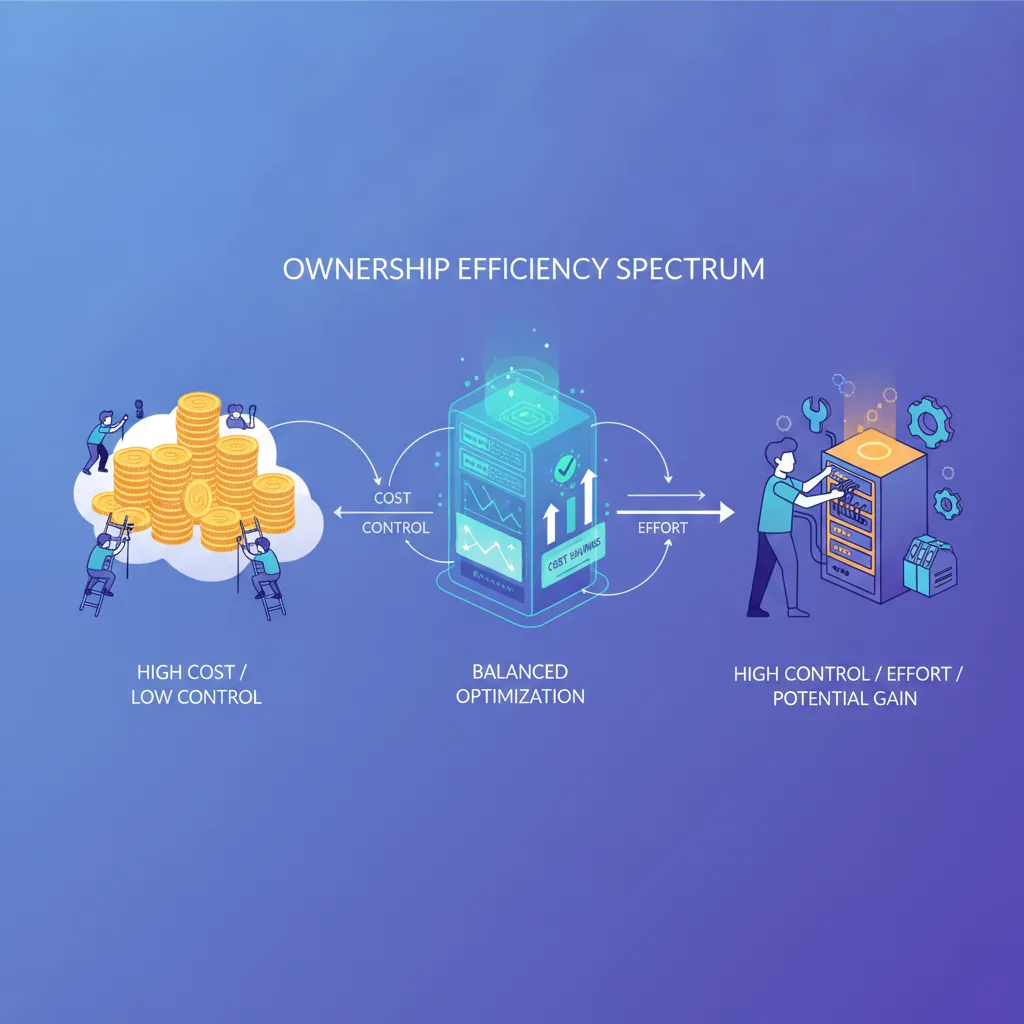
I’ve developed a framework — I call it The Ownership Efficiency Spectrum — to help builders navigate this evolving landscape.
The Cloud Convenience Trap
This is where most teams start. You spin up a VM, deploy a managed database, use a serverless function. It's fast, easy, and requires minimal upfront hardware knowledge.
The trap lies in its escalating cost and opaque billing as you scale.
While perfect for rapid prototyping and unpredictable spikes, relying solely on this model for sustained, high-volume workloads becomes a significant drag on margins.
You’re paying for convenience and abstraction, often at a premium that masks underlying inefficiencies. It’s like leasing a car for life when you could own one outright for less.
The Bare-Metal Bargain
This is the Hetzner sweet spot. Dedicated physical servers, often with custom configurations, leased at incredibly competitive rates.
You get direct access to hardware, predictable performance, and transparent pricing.
This model is ideal for stable, resource-intensive applications like databases, high-traffic web servers, game servers, or machine learning workloads where predictable performance and cost are paramount.
The trade-off is a higher degree of operational responsibility – you manage the OS, security, and networking, but you also gain unparalleled control and eliminate the "noisy neighbor" problem common in shared cloud environments.
The Hybrid Horizon
This is the future for many mature companies. It's about intelligently blending the best of both worlds.
Use hyperscalers for burstable workloads, serverless functions for event-driven tasks, or regions where you need extreme global distribution.
But for your core, high-performance, predictable workloads, leverage bare-metal providers like Hetzner. This approach maximizes efficiency, minimizes lock-in, and optimizes costs.
It requires a more sophisticated infrastructure strategy and skilled DevOps teams, but the long-term cost savings and performance gains are undeniable.
Think of it as owning your primary residence but renting a vacation home when needed.
The DIY Imperative
For some specific, niche applications — or for those with extreme privacy/control requirements — building and managing your own on-premise datacenter (or even a robust co-located setup) still makes sense.
This is the ultimate expression of control and cost efficiency, but it comes with the highest operational burden and upfront capital expenditure.
It’s not for everyone, but for specific industries or highly specialized workloads, it remains a viable, powerful option.
The Hetzner tour underscores that the principles of DIY — meticulous planning, custom solutions, and relentless efficiency — are scalable and applicable across the spectrum.
Real-World Implications for Builders and Businesses
This isn't just an academic exercise; the implications of this Bare-Metal Renaissance are immediate and profound for anyone building in tech.
If you're a startup founder, this changes your runway calculations.
Moving core services from a hyperscaler to a provider like Hetzner could literally extend your cash runway by months, giving you more time to find product-market fit or secure your next funding round.
In today's tightened VC market, every dollar saved on infrastructure is a dollar invested in product or growth.
You need to start asking your engineering leads about your cloud egress fees, not just your compute costs.
For mid-level backend engineers and DevOps specialists, this means a shift in required skills.
While cloud certifications are still valuable, a deeper understanding of Linux system administration, networking, hardware optimization, and even basic electrical engineering (for power consumption) will become increasingly critical by mid-2028.
You'll be asked to evaluate server specs, not just VM sizes.
Knowing how to secure and manage a bare-metal server, or integrate it into a Kubernetes cluster, will differentiate you from those who only know how to click buttons in a cloud console.
For enterprises already deep in cloud environments, this offers an exit strategy or at least a negotiation leverage point.
The fear of vendor lock-in is real, and the ability to port significant workloads to a bare-metal provider gives you options.
It allows you to pressure your existing cloud vendors on pricing or strategically offload your most expensive, stable workloads to more cost-effective platforms.
This isn't about a mass exodus from the cloud, but a strategic rebalancing. It’s about building resilient, diversified infrastructure that gives your business options, not just dependencies.
The Hetzner tour reminded me that at the end of the day, all our fancy cloud abstractions still run on physical hardware.
The companies that master the art of efficiently managing that hardware, and passing those savings and control to their users, are the ones who will define the next decade of infrastructure.
We've been so busy chasing the shiny objects of serverless and AI that we've forgotten the foundational principles of good engineering. It’s time to get back to basics, but at scale.
Have you ever considered moving a significant workload off a hyperscaler, or are you still fully committed to the cloud-first approach? What's holding you back, or what successes have you found?