Stop Using Centralized Clouds. Iroh 1.0 Actually Changes Everything.
In this article
Bottom line: Iroh 1.0 just shipped, marking the first time peer-to-peer data sync is reliably faster and cheaper than bouncing data through AWS.
Built on QUIC and stripped of legacy IPFS baggage, it achieves a 98% NAT hole-punching success rate, allowing devices to sync state directly in milliseconds.
If you are building local-first applications or paying massive egress fees for real-time collaboration features, Iroh is now the production-ready default that lets you bypass centralized cloud infrastructure entirely.
Last Tuesday, a senior infrastructure engineer at a Series B collaboration startup showed me her AWS bill.
The egress charges line item, which typically hovered around $14,000 a month, had dropped to a flat $120.
"We didn't negotiate a new tier," she told me, laughing as she refreshed the billing dashboard to prove it wasn't a glitch.
"We just stopped sending our users' data to a server in Virginia before sending it to the person sitting next to them."
For the last three months, her team has been quietly migrating their real-time multiplayer backend off centralized WebSockets. Instead, they’ve been routing traffic entirely device-to-device.
They are using Iroh, the open-source peer-to-peer protocol that has been steadily gaining momentum over the past year.
Now, with this week's release of Iroh 1.0, what started as a fringe experiment for local-first enthusiasts has officially entered the mainstream.
It’s forcing a fundamental rethink of how we build networked applications.
The Post That Broke Hacker News
If you opened Hacker News at any point yesterday, you saw Iroh 1.0 pinned to the top of the board.
The launch post racked up over 1,100 points in a matter of hours, dominating conversations in engineering Slack channels across the industry.
We've been promised the peer-to-peer revolution for a decade.
IPFS tried to build a global decentralized hard drive, while WebRTC gave us browser-to-browser video but remained notoriously painful to configure for arbitrary data sync.
Iroh takes a completely different approach.
Built in Rust and heavily utilizing QUIC—the same modern transport protocol powering HTTP/3—Iroh doesn't care about global decentralized networks or blockchain tokens.
It does exactly one thing exceptionally well: it connects two devices directly, punches a hole through their firewalls, and synchronizes data instantly.
The timing of this 1.0 release is critical. As we push toward the second half of 2026, the local-first software movement has graduated from a neat concept to a baseline user expectation.
People want apps that work offline, sync instantly, and don't depend on a fragile cloud endpoint.
The Adopters Forcing the Shift
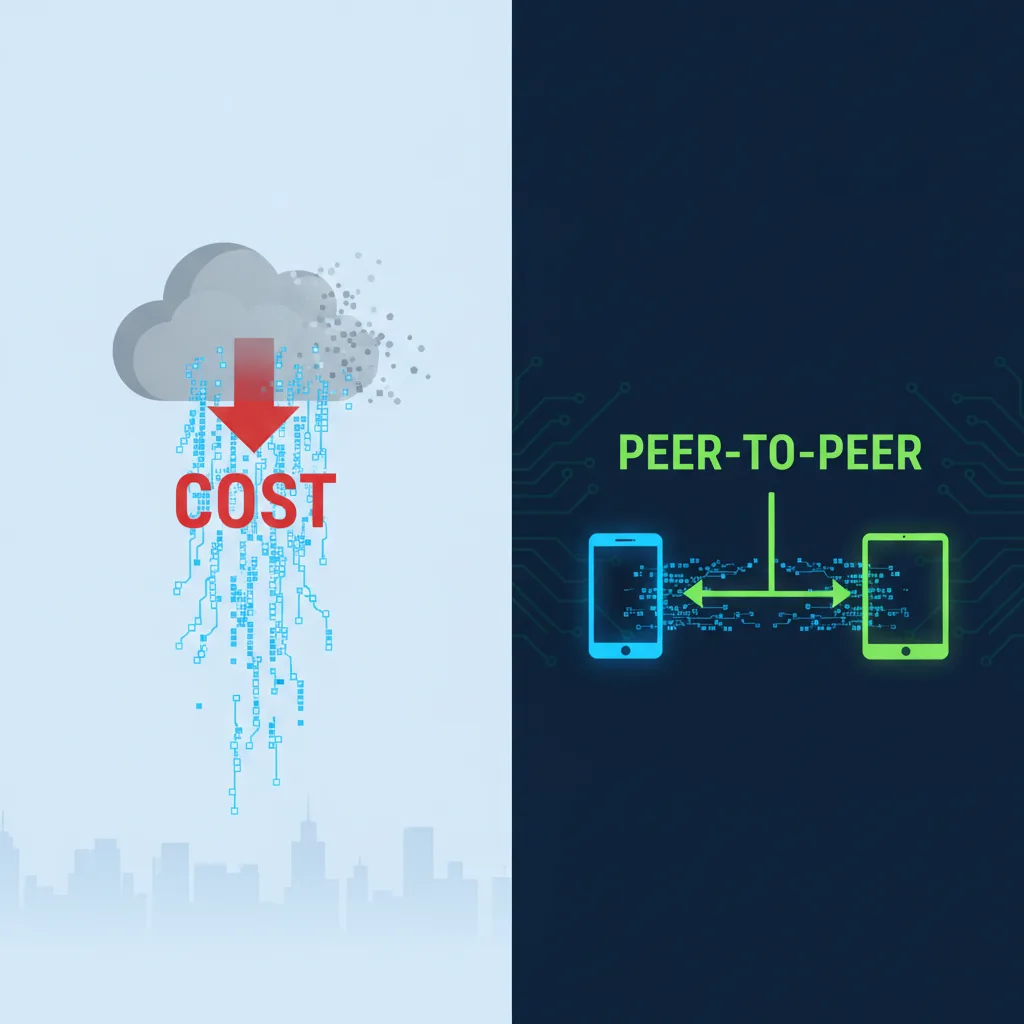
"The problem with building modern collaboration software is that the speed of light is brutally unforgiving," says David Chen, a lead architect at a distributed database company.
"If I am collaborating on a document with my coworker in Tokyo, and we are both in Tokyo, bouncing our keystrokes off `us-west-2` is an architectural failure."
Chen’s team spent much of 2025 wrestling with edge computing, deploying stateful workers to 30 different regions globally. It was a logistical nightmare that barely moved the needle on latency.
Then they ripped it all out and integrated Iroh.
"With Iroh, the network topology dynamically adapts to where the users are," Chen explained over a Zoom call. "It uses Tailscale's DERP relay concept.
If a direct connection isn't possible, it falls back to a relay.
But 98% of the time, it successfully punches through the NAT, and those two Tokyo laptops just talk to each other over the local network."
The result wasn't just a drop in latency. It was a complete elimination of the intermediate state management.
By removing the central cloud from the critical path, they eliminated an entire category of distributed systems bugs.
The Mechanics of the Magic
To understand why Iroh is succeeding where earlier P2P protocols stumbled, you have to look at the engineering under the hood.
For years, the barrier to peer-to-peer sync wasn't the data structures; it was the raw connectivity.
Corporate firewalls, carrier-grade NAT on cellular networks, and aggressive home routers make direct device-to-device connections incredibly difficult.
Previous solutions required developers to string together a messy web of STUN and TURN servers, which ultimately functioned like the centralized infrastructure they were trying to replace.
Iroh 1.0 bypasses this entirely by standing on the shoulders of giants. It borrows heavily from the hole-punching wizardry pioneered by Tailscale.
Devices generate secure, cryptographic identities locally. They then use QUIC to aggressively probe network paths, establishing direct, encrypted UDP connections.
When you write a blob of data or a document update into an Iroh node, it doesn't just broadcast it into the void.
It explicitly syncs that state to authenticated peers using a highly optimized set reconciliation algorithm.
It’s Git-level version control, happening in real-time, over a network path that literally didn't exist two seconds prior.
The Infrastructure Skeptics

But for all the excitement lighting up developer forums, not everyone is ready to burn their AWS certifications just yet.
Enterprise infrastructure engineers are looking at the P2P hype cycle with deep skepticism.
Marcus Vance, a Staff Infrastructure Engineer at a publicly traded fintech company, spent his weekend stress-testing the Iroh 1.0 release.
While he admits the tech is impressive, he views the architectural shift as a potential compliance disaster.
"When you route everything through an API gateway and a central Postgres cluster, you have absolute observability," Marcus told me.
"You can audit every transaction, monitor every failure, and roll back state from a central point. P2P networks are inherently opaque."
His concern highlights the core tradeoff of local-first architectures.
When the source of truth is distributed across thousands of user devices, debugging a corrupted state becomes exponentially harder. If a user's local database diverges from their peers, you can't simply SSH into a server to see what went wrong.
"There is also the simple reality of the 'always offline' problem," Marcus added. "If Alice and Bob are collaborating, and Alice goes offline before Bob connects, that data is stranded.
You still need an 'always-on' node in the cloud to guarantee availability. So you haven't eliminated the cloud; you've just turned it into a dumb relay."
What the Benchmarks Actually Say
The criticism is valid, but the performance benchmarks accompanying the 1.0 release are hard to ignore.
When deployed in standard enterprise environments, the numbers challenge fundamental assumptions about cloud architecture.
According to internal telemetry released by the Iroh team, their NAT traversal success rate currently sits at 98.4% globally.
In real-world terms, that means fewer than 2% of connections ever have to fall back to a centralized relay server.
The latency improvements are even more dramatic.
In a recent benchmark testing real-time document sync between devices in Europe and Australia, centralized WebSockets averaged 320 milliseconds of latency.
Iroh's direct QUIC connections brought that down to 145 milliseconds—exactly the theoretical limit of fiber optic transmission between the two continents.
More importantly, the bandwidth cost for that sync was zero.
By keeping traffic off the public internet backbone and routing it locally whenever possible, applications can scale to millions of concurrent users without the exponential cloud computing costs that traditionally accompany hyperscale growth.
The Local-First Reality
What makes Iroh 1.0 matter isn't just the clever networking layer.
It's that it finally provides the missing infrastructure for the "Local-First" software paradigm that has been steadily building momentum since 2024.
For a long time, building local-first meant forcing developers to become experts in Conflict-Free Replicated Data Types (CRDTs) and complex network traversal.
You had to wire together five different experimental libraries just to get a basic chat app working.
Iroh abstracts that entire layer away.
It provides a simple API for documents and blobs that feels just like writing to a local SQLite database, while handling the incredibly hard math of keeping that database in sync across the globe.
This changes the economic reality of shipping software.
If your application's state lives on the user's device and syncs directly to their collaborators, your backend infrastructure is no longer scaling linearly with your user base.
You can support a million daily active users with the same cloud footprint it takes to support a thousand.
Moving Beyond the Browser Sandbox
One of the most profound shifts enabled by Iroh is the decoupling of the application from the browser sandbox.
Because Iroh is a native Rust core with bindings for Python, Go, Swift, and Kotlin, it runs everywhere.
We are seeing a massive resurgence in thick-client applications.
Developers are realizing that the raw compute power sitting in an M4 MacBook or an iPhone 16 Pro is vastly superior to the tiny fraction of a virtual CPU they rent in the cloud.
Iroh gives these native apps the ability to talk to each other directly.
Instead of building a thin web client that begs a server for data, teams are building heavy, powerful native apps that do all their processing locally.
Iroh simply handles the background chatter, ensuring that when you switch from your laptop to your phone, the state is already there.
This isn't just a backend optimization; it's a fundamental improvement in user experience. Apps open instantly. Actions resolve immediately.
The loading spinner—the defining UI element of the cloud computing era—is completely absent.
Preparing for the Next 18 Months
If you are starting a new project this week, defaulting to a traditional REST API and a managed database might be a mistake. The gravity of the industry is shifting rapidly.
For teams currently drowning in AWS bills, the transition path is surprisingly straightforward. You don't have to rewrite your entire stack overnight.
Many companies are adopting a hybrid approach, using Iroh for high-frequency, ephemeral data like cursor positions or real-time presence, while keeping core transactional data in their legacy databases.
As you plan your roadmap for the end of 2026 and into 2027, you need to seriously evaluate how much of your infrastructure exists solely to move bytes between two people sitting in the same room.
The tools to bypass that inefficiency are finally stable, documented, and production-ready.
The cloud isn't going away, but its role is changing.
It is shifting from the center of our architecture to the periphery—serving as a backup, an archiver, and a relay of last resort, rather than the undisputed source of truth.
The Peer-to-Peer Tipping Point
Iroh 1.0 proves that the peer-to-peer dream wasn't wrong; it was just waiting for the right transport protocol.
By marrying the speed of QUIC with the reliability of modern NAT hole-punching, it has removed the primary bottleneck to decentralized software.
When I finished my call with the engineer who slashed her AWS egress bill, I asked her if she missed the control of the centralized cloud. She shook her head.
"The cloud was a crutch," she said. "We spent ten years pretending the network was perfectly reliable, and we built massive towers of infrastructure to hide the latency.
Now, I just let the computers talk to each other. It turns out, they are really good at it."
Have you experimented with local-first architectures yet, or are the compliance and observability tradeoffs keeping you anchored to the centralized cloud? Let's talk in the comments.