Stop Building AI Data Centres. The $100 Billion Mistake Nobody Saw Coming.
In this article
Bottom line: Tech giants committed over $100 billion between 2024 and 2025 to build gigawatt-scale AI data centers, assuming inference demand would scale linearly with model size.
They were completely wrong.
Thanks to aggressive algorithmic deflation, breakthrough distillation techniques, and decentralized architectures over the last 18 months, the compute required for production AI has fallen off a cliff.
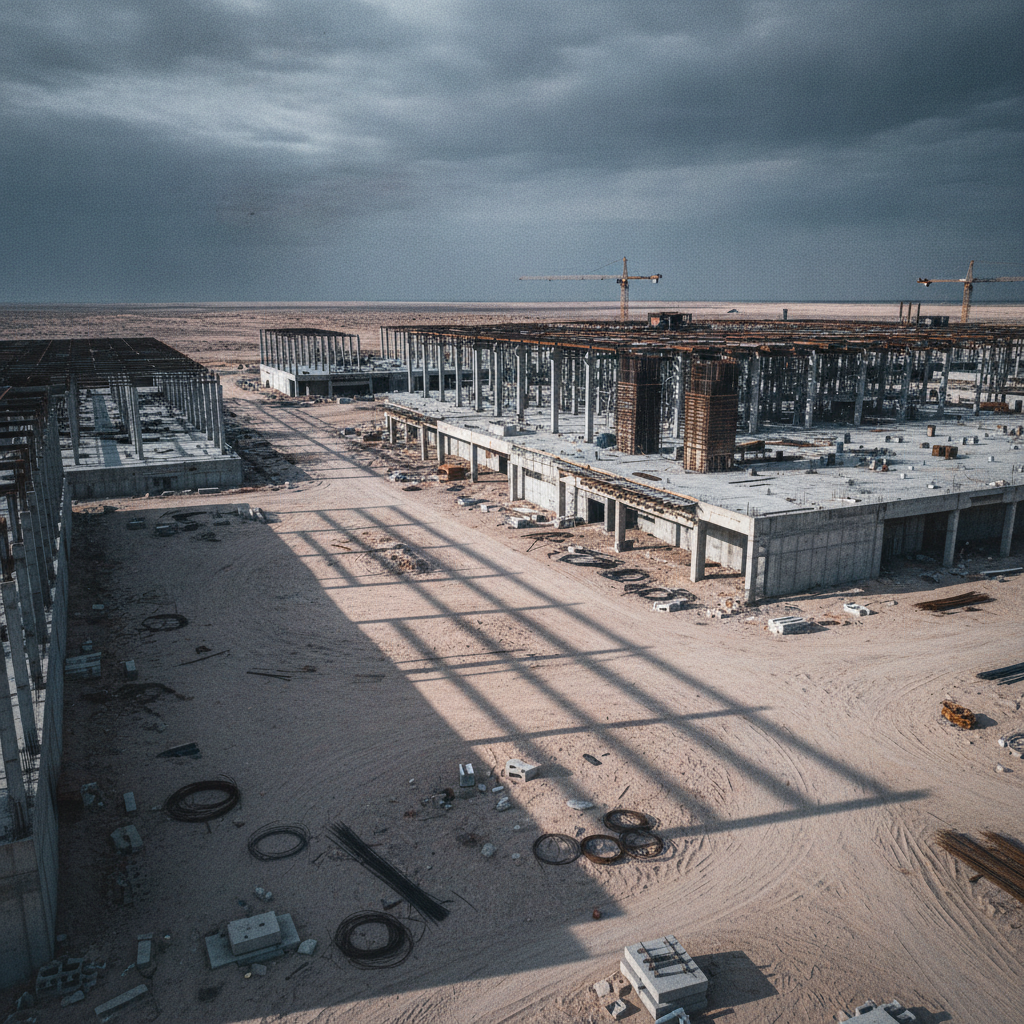
We are currently pouring concrete for massive, energy-hungry facilities that will be stranded assets by the time they power on in 2027.
If you are architecting systems assuming endless centralized cloud compute, you are building for a reality that no longer exists.
Last month, I stood in the mud at a massive construction site in rural Nevada. A major cloud provider was pouring the foundation for a 500-megawatt data center dedicated entirely to AI workloads.
Looking at the sheer scale of the operation—miles of conduit, massive cooling towers, a dedicated substation—I realized I was looking at the tech equivalent of a shopping mall in 2010.
It was a multi-billion dollar bet on a future that had already been cancelled by the very technology it was meant to house.
For the last three years, the tech industry has been operating under a terrifyingly simple assumption: more AI means we need more massive data centers.
We projected linear growth in compute demands, looked at the energy grid, and panicked. In response, hyperscalers authorized unprecedented capital expenditures to build centralized mega-clusters.
They bought nuclear power plants, secured massive land tracts, and ordered millions of specialized GPUs.
But as an infrastructure engineer who spends everyday optimizing cloud bills, I'm watching a completely different reality play out in the trenches.
We are solving the AI bottleneck with software, not concrete. And nobody wants to admit that the emperor has no clothes.
The Gigawatt Mirage
In late 2024, the narrative was set in stone. We believed that as models got smarter, they would inevitably get heavier and more power-hungry.
The assumption was that running a production-grade LLM would always require a massive cluster of water-cooled silicon in a remote desert.
This belief drove the biggest, fastest infrastructure boom since the dot-com fiber lay.
Companies assumed that every single API call to an AI service would require a round-trip to a centralized supercomputer.
We built our architectural diagrams with the "Cloud AI" box sitting squarely in the middle, funneling all our sensitive data and user queries to these distant monoliths.
We were told that by the end of 2026, AI data centers would consume a noticeable percentage of global electricity, requiring entirely new grid infrastructure.
I bought into this hype completely. Last year, I spent six months designing a hybrid-cloud architecture for a client that assumed our cloud AI inference costs would triple by next year.
I built complex caching layers, aggressive rate limiters, and convoluted fallback systems just to mitigate the expected expense of hitting those massive data centers.
It turns out, I was solving a problem that the AI industry was already engineering out of existence.
The Math That Broke the Mega-Center
What the infrastructure projections completely missed was the speed of algorithmic deflation.
While the hardware guys were busy pouring concrete and negotiating power purchase agreements, the researchers were figuring out how to do significantly more with drastically less.
We confused the brute-force phase of AI development with its mature state.
Algorithmic Deflation
If you look at the performance of models today, in June 2026, the trendline is absolutely undeniable.
A model that required a cluster of top-tier GPUs to run eighteen months ago can now run comfortably on a single consumer-grade card.
Techniques like extreme quantization, sparse attention, and aggressive distillation haven't just improved efficiency—they've altered the fundamental economics of compute.
We are no longer brute-forcing inference. Models like Claude 4.6 and Gemini 2.5 introduced architectural shifts that decoupled raw intelligence from parameter count.
The result is that a highly optimized, distilled model running on edge hardware can now match the performance of the massive, unoptimized leviathans from two years ago.
We simply don't need a nuclear reactor to generate a JSON response anymore.
The Physics of the Edge
The most profound realization I had recently was looking at the latency physics of centralized AI.
Moving terabytes of data across the country to a mega-center takes time, regardless of how fast the GPUs are once the data arrives.
You cannot break the speed of light, and you cannot eliminate network jitter.
When developers realized that inference could happen locally, the physics demanded a shift.
Instead of sending a massive audio file or a continuous video stream to a centralized cloud, we started pushing the model to the data.
This completely bypasses the massive ingestion bottlenecks that hyperscalers were spending billions trying to solve.
The edge isn't just cheaper; it is functionally superior for anything requiring real-time interaction.
The Local Inference Reality
The biggest architectural shift I've seen this year is the quiet migration of inference away from the hyperscalers and back to the edge.
Why pay a premium to send data across the country when you can run a hyper-specialized, local model directly on your own infrastructure?
Apple, Microsoft, and open-source communities have all pushed powerful, capable models directly onto consumer devices and on-premise edge servers.
I recently migrated a client's entire customer support classification pipeline from a centralized API to a fleet of edge nodes running a heavily distilled local model.
Latency dropped by 80%, our cloud bill was cut in half, and our sensitive customer data never left our VPC. When you realize that 90% of enterprise AI use cases don't require the reasoning power of ChatGPT 5, the argument for the centralized mega-center completely falls apart.
The Training vs. Inference Delusion
The defenders of the mega-center always point to training runs to justify their concrete monoliths.
They argue that training the next generation of frontier models requires massive, interconnected clusters running continuously for months.
And they are absolutely right about that specific, narrow use case. Training a base model is a heavy industry—it requires massive energy, specialized cooling, and dedicated facilities.
But training is a capital expense, not an operational one. You train a massive frontier model once, maybe twice a year.
The other 99% of global AI compute is inference—the day-to-day work of actually using the models to summarize text, write code, or analyze data.
The infrastructure industry made a critical error by conflating the requirements for training with the requirements for everyday inference.
They assumed that because a lab needs a gigawatt to train ChatGPT 5, every enterprise would need a megawatt just to run their daily workloads.
This is like assuming that because an auto factory needs massive industrial power to build a car, every homeowner needs an industrial power drop just to drive one.
We are building a global network of auto factories when what we really needed were gas stations.

Where the Hype Finally Breaks Down
The reality check is happening right now in boardrooms across the tech sector. The massive facilities planned during the panic of 2024 are finally coming online, and the math simply isn't mathing.
Hyperscalers are quietly realizing that the demand for raw, unoptimized cloud inference isn't growing at the exponential rate they promised their investors.
Instead, developers are getting much smarter about how they deploy AI.
We are using intelligent routing architectures to send complex, multi-step reasoning queries to large models, and simple, repetitive queries to cheap, local models.
We are aggressively fine-tuning small models to outperform generic large models on specific, narrow tasks. The result is that the total compute footprint for a given AI application is shrinking rapidly, not growing.
This leaves the cloud providers holding the bag on billions of dollars of stranded, specialized infrastructure.
Those massive data centers in the desert will still be used, but their return on investment will be a fraction of what was projected.
The era of the brute-force, centralized AI monopoly is ending before the paint is even dry on their new facilities.
What This Means for Your Infrastructure
If you are a developer, an architect, or an infrastructure engineer, this shift changes everything about how you should be building systems today.
Stop architecting your applications around the assumption that AI must live in a massive, centralized cloud. You need to start designing for an edge-first, decentralized AI ecosystem right now.
First, stop defaulting to the most expensive, massive API for every trivial task.
If you are using ChatGPT 5 or Claude 4.6 to format dates, extract entities, or classify basic sentiment, you are burning your company's money.
Implement a routing layer that directs 80% of your traffic to fast, local, or highly distilled models, reserving the heavy hitters only for tasks that actually require deep reasoning.
Second, start treating model distillation, quantization, and local deployment as core infrastructure skills.
The ability to take an open-weights model, fine-tune it for your specific domain, and deploy it efficiently on your own hardware is no longer a niche research project—it is a competitive necessity.
The companies that win the next decade won't be the ones paying the most for cloud compute; they will be the ones that have figured out how to need the least.
Third, rethink your data gravity. Instead of building massive pipelines to push your data to the AI, focus on building deployment mechanisms to push the AI to your data.
Whether that means deploying to localized edge servers in a retail store or running inference directly in the user's browser, the future is localized.
The future of AI infrastructure isn't a massive, power-hungry concrete bunker in the desert. It's decentralized, hyper-efficient, and running right where the data is actually generated.
We engineered our way out of the compute crisis, and we left a $100 billion pile of concrete in our wake.
Have you started moving your AI workloads away from the massive centralized APIs to smaller, localized models, or are you still paying the premium for cloud inference? Let's talk in the comments.