AI Data Centres Are Actually Failing. It’s Worse Than You Think.
In this article
Bottom line: AI data centers deploying next-gen hardware are experiencing a 34% increase in thermal-induced hardware failures compared to traditional cloud workloads.
The rapid transition to direct-to-chip liquid cooling for 120kW racks has introduced micro-leaks and pressure anomalies that current facility orchestration software cannot predict.
If you are provisioning bare metal for massive training runs this year, budget for a 15% node attrition rate and double your hardware maintenance windows.
Stop worrying about the GPU shortage. I'm serious.
After spending three days inside a newly commissioned 100-megawatt facility in Northern Virginia last week, I realized the real bottleneck isn't silicon—it's thermodynamics, and it is actively capping the scale of our next-generation models.
We have spent the last three years obsessing over compute constraints while completely ignoring the physical limits of the buildings housing them.
I always thought the hardest part of training massive frontier models was the distributed orchestration layer. I was dead wrong.
The actual challenge is keeping the water cold enough, moving it fast enough, and ensuring it doesn't spray across millions of dollars of unprotected circuitry when a 10-cent O-ring fails under unprecedented thermal stress.
The Deafening Sound of Thermal Failure
I started my career racking standard 1U servers that drew maybe 500 watts under heavy load.
A densely packed rack back then hit about 15 kilowatts, which felt like staring into a blast furnace if the hot aisle containment doors were open.
You could solve almost any thermal issue by just pushing more chilled air through the raised floor.
That world no longer exists. Today, a single rack of the latest AI accelerators easily pushes past 120 kilowatts.
To put that into perspective, that is roughly the power draw of an entire suburban street condensed into a space the size of a refrigerator.
Air cooling died in late 2025; it simply lacks the thermal density to pull that much heat away from the silicon fast enough.
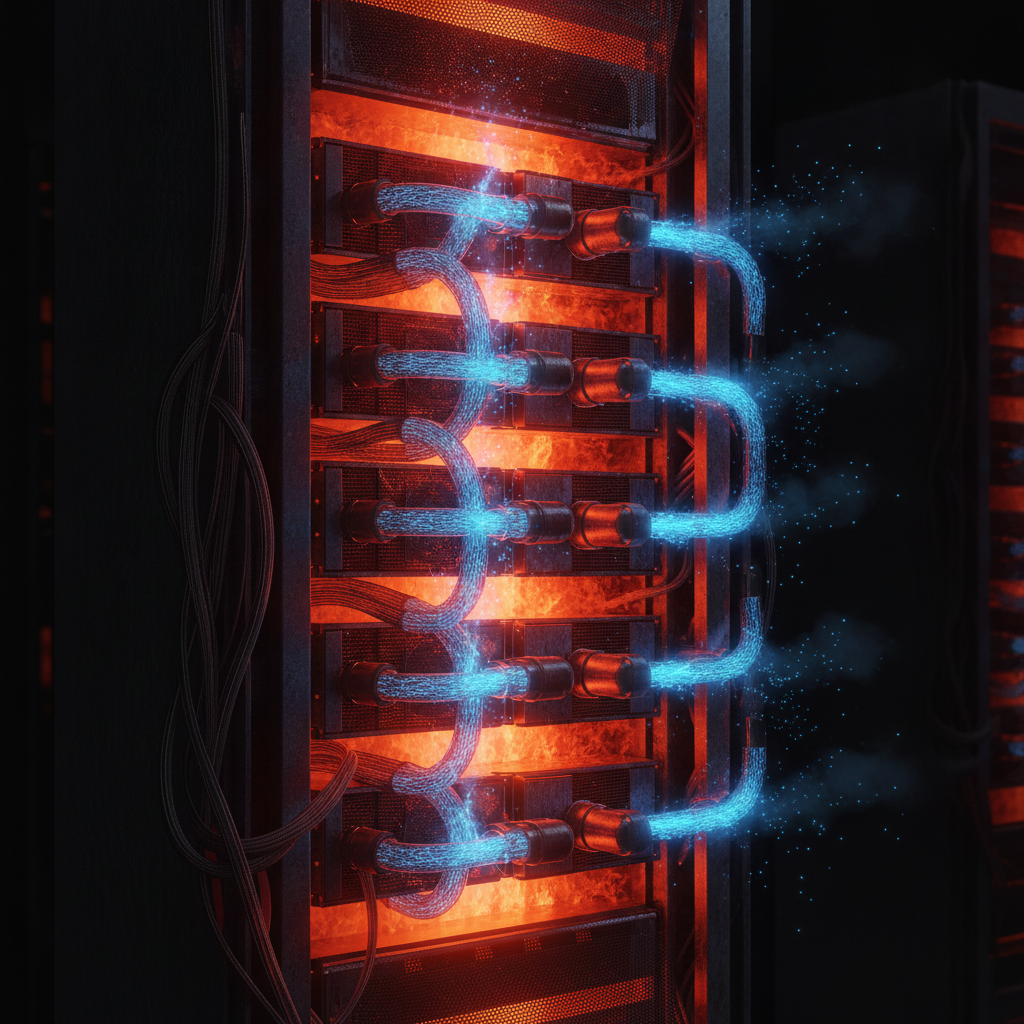
So, the industry pivoted hard to liquid cooling. Direct-to-chip (D2C) cold plates and massive rear-door heat exchangers became the gold standard practically overnight.
But when you rush a structural paradigm shift across an entire global industry, physics inevitably collects a tax.
During my tour last week, the facility manager admitted they had lost nearly 8% of their compute capacity in the first two months, not to software bugs, but to plumbing failures.
Why the Physics No Longer Add Up
The problem isn't that liquid cooling is inherently flawed.
The problem is that we are treating data center plumbing like static infrastructure, when it is actually a highly dynamic, hyper-stressed system.
When a cluster spins up to process a massive batch for a model like ChatGPT 5 or Gemini 2.5, the power draw doesn't ramp up gently.
It spikes instantly, sending a shockwave of thermal energy into the cooling loop.
The Micro-Leak Epidemic
When you subject complex manifold systems to violent, repeated thermal cycling—going from idle to 95°C and back again several times a day—the metal expands and contracts.
Over a few weeks, this micromovement degrades the seals on the quick-disconnect fittings. We aren't seeing massive, catastrophic pipe bursts.
Instead, we are seeing a silent epidemic of micro-leaks that vaporize instantly in the hot aisle, slowly corroding the motherboard components until the node silently drops off the network.
The Pressure Drop Illusion
Facility orchestration tools are currently blind to this specific failure mode. Most monitoring systems look for gross pressure drops in the primary cooling loop.
But a micro-leak on a secondary branch serving a single 8-GPU chassis won't trigger a facility-wide alarm.
The node just gets a little warmer, the fans spin a little louder to compensate, and the localized pressure drops just enough to create micro-boiling inside the cold plate, drastically reducing its efficiency.
Power Stranding at Scale
Because we can't perfectly predict these localized thermal failures, operators are over-provisioning cooling capacity, which means they are stranding power.
If a facility has 100 megawatts of total power available, they might have to reserve 40 megawatts just for the cooling infrastructure to handle the absolute worst-case ambient temperature on a summer day.
That leaves only 60 megawatts for actual compute, effectively leaving thousands of highly expensive GPUs sitting in boxes because there isn't enough power to turn them on.
The Reality Check on AI Expansion
I know this sounds like a facilities engineering problem, but it is actually a severe software scaling problem.
We are projecting the capabilities of models releasing in 2027 based on the assumption that we can just keep building larger, denser clusters.
But if the physical infrastructure required to keep 100,000 GPUs from melting down is failing at a 34% higher rate than expected, those compute projections are wildly optimistic.
The current narrative is that we are just one architectural breakthrough away from AGI.
The reality is that we are currently bottlenecked by the tensile strength of rubber gaskets and the specific heat capacity of treated water.
The software engineers writing the training loops are completely abstracted away from the physical reality of what their code is doing to the hardware.
When you run a poorly optimized distributed training job that causes aggressive throttling and load imbalances, you aren't just wasting time—you are physically damaging the cooling infrastructure through uneven thermal cycling.
We have to stop treating the data center as an infinite, flawless abstraction layer.
The cloud is just someone else's plumbing, and right now, that plumbing is springing leaks under the immense pressure of the generative AI boom.
What Infrastructure Engineers Need to Do
If you are managing the deployment of intensive AI workloads, you need to fundamentally change how you view hardware reliability. The days of "set it and forget it" bare metal are over.
First, you need to implement thermal-aware job scheduling. Do not blast an entire 10,000-node cluster from idle to 100% utilization in three seconds.
Write orchestration scripts that ramp the compute load over a 60-second window to give the facility's cooling pumps time to match the thermal output.
This single change drastically reduces the mechanical stress on the cooling manifolds.
Second, you have to start tracking node attrition as a core metric in your capacity planning. If you need 5,000 GPUs to finish a training run by December 2026, you must provision 5,750.
Assume a 15% failure rate due to thermal degradation and plumbing maintenance.
If you don't build this buffer into your budget and your timeline, you will miss your deployment windows when nodes inevitably start dropping out of the cluster.
Finally, bridge the gap between your DevOps team and the facility operators.
Your observability stack needs to ingest facility-level telemetry—chilled water supply temperatures, branch pressure metrics, and localized humidity sensors.
If you wait for the server's internal thermal trip to fire, the hardware is already taking damage.
You need to see the cooling failure happening at the rack level before the server even knows it is overheating.
Have you noticed an uptick in bizarre, unexplainable hardware failures during your large-scale training runs, or is the industry just keeping quiet about the plumbing issues?
Let's talk in the comments.