Stop Scaling AI With Software—AMD Just Bought the Silicon Fix
In this article
Bottom line: AMD's recent acquisition of Taalas marks a pivotal shift in how the industry approaches AI inference, moving beyond software-centric optimization to directly embedding models in silicon.
This strategic move, which has been trending across developer forums, aims to dramatically improve performance and energy efficiency for large-scale AI workloads by etching neural network components directly onto specialized chips.
For companies battling escalating operational costs from running powerful models like ChatGPT 5 or Claude 4.6, this acquisition signals a future where hardware design, not just software, becomes the primary lever for scaling advanced AI.
I was talking to a senior machine learning engineer last week, let’s call her Anya, who oversees a fleet of thousands of GPUs for a major e-commerce platform.
Her team is constantly optimizing their recommendation engines and natural language processing models, trying to shave milliseconds off inference times and dollars off their cloud bill.
She leaned back, rubbed her temples, and said, "Riley, we're hitting a wall.
We've squeezed every last drop out of the software, but the hardware… the hardware is just a dumb canvas. We need more than a canvas."
Her frustration isn't unique. It's a sentiment echoing through data centers and AI labs globally, a quiet anxiety bubbling beneath the surface of the AI boom.
We’ve been scaling AI with software for so long, fine-tuning algorithms, optimizing frameworks, and pushing the limits of general-purpose GPUs.
But what if that entire paradigm is a lie we’ve been telling ourselves, a comfortable illusion that’s now costing companies millions in power consumption and delayed insights?
What if the real bottleneck isn't the code, but the very silicon it runs on?
Then came the news: AMD just acquired Taalas, a startup that's been quietly pioneering the art of etching AI models directly into silicon.
This isn't just another tech acquisition; it’s a seismic shift, a direct challenge to the software-first philosophy that has dominated AI infrastructure, especially in the inference phase.
This move, which shot to the top of Hacker News, isn't just about faster chips; it’s about fundamentally rethinking how we build, deploy, and scale artificial intelligence.
The Software Ceiling: Why Current AI Scaling Is Breaking
For years, the narrative around AI scaling has been dominated by software innovation.
We’ve seen incredible advancements in model architectures, distributed training frameworks, and GPU acceleration libraries.
Nvidia's CUDA platform, for instance, became the de facto standard, enabling developers to harness the parallel processing power of GPUs with relative ease.
The assumption was always: if you have enough compute and clever enough software, you can scale any AI model.
But this assumption is starting to crack under the sheer weight of modern AI.
Large Language Models (LLMs) like those powering ChatGPT 5 and Claude 4.6, or sophisticated multimodal models, require immense computational resources not just for training, but for inference—the process of using a trained model to make predictions or generate outputs.
Every query, every image generation, every natural language interaction incurs a cost. These costs are rapidly becoming unsustainable for companies operating at scale.
"We're seeing inference costs become the new bottleneck," explained Dr. Lena Hansen, a principal analyst at Quantum Insights, when I spoke with her earlier this week.
"Training is a one-off capital expenditure, but inference is an operational cost that scales directly with usage.
And as AI becomes embedded in everything from search engines to customer service bots, those operational costs are skyrocketing.
Software optimizations can only go so far when the underlying hardware is still a generalist, designed for a broad range of tasks, not specifically for neural network inference." Dr.
Hansen highlighted that for many companies, the energy footprint alone of running these models is now a top-three concern, behind only talent acquisition and data privacy.
Taalas's Vision: AI Hardwired for Speed and Efficiency
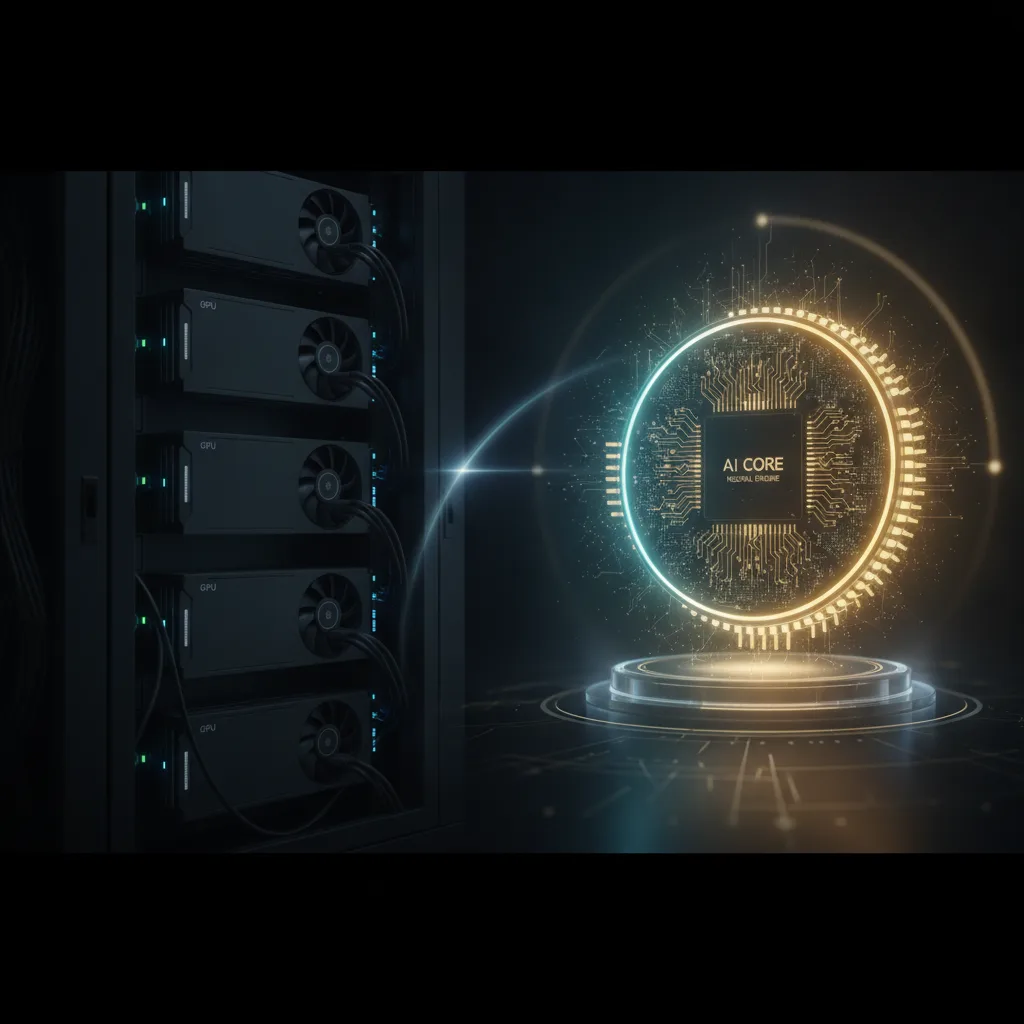
Taalas, on the other hand, approached the problem from the ground up—literally.
Their core innovation lies in taking a trained neural network model, or specific layers of it, and translating that architecture directly into a specialized silicon design.
Instead of instructions being fed to a general-purpose processor that then executes them in software, the computations required by the AI model are hardwired into the chip itself.
Think of it like this: a general-purpose GPU is a highly skilled chef with a vast cookbook (software) who can cook anything, but has to read each recipe step-by-step.
A Taalas-designed chip is a custom-built, automated kitchen appliance that only makes one specific dish, but does it with unparalleled speed, precision, and efficiency because the entire process is engineered into its mechanics.
"The beauty of etching models into silicon is that you eliminate a huge amount of overhead," a former Taalas engineer, who asked to remain anonymous due to the acquisition, told me.
"No instruction fetching, no memory bottlenecks from constantly loading weights, no general-purpose logic that sits idle.
It's pure, unadulterated computation, perfectly aligned with the model's structure.
This isn't just about faster clock speeds; it's about orders of magnitude more efficient data flow and power utilization." This approach can lead to significant gains, potentially reducing inference latency by 10x or more, and power consumption by an even larger factor, making it crucial for both massive data centers and increasingly, for AI at the edge.
The Complication: Flexibility vs. Specialization
While the promise of silicon-native AI is compelling, it's not without its trade-offs. The primary challenge lies in flexibility.
If you etch a specific model into silicon, what happens when that model needs to be updated, fine-tuned, or entirely replaced?
Re-etching silicon is not like pushing a software update; it involves costly and time-consuming manufacturing cycles.
"The idea sounds fantastic on paper, but the reality is messier," argued Dr. Kenji Tanaka, a professor of computer architecture at Stanford University, in a recent interview I caught with him.
"Most AI models are constantly evolving.
New data comes in, new research emerges, and you need to adapt. If your core inference engine is hardwired, you lose that agility.
It’s a classic hardware-software co-design problem: where do you draw the line between maximum performance and necessary flexibility?"
This tension is real.
For highly stable, high-volume models—think the core embedding layers of a search engine or a critical component of a self-driving car's perception stack—silicon optimization makes immense sense.
For rapidly iterating research models or niche applications, the overhead of custom silicon might outweigh the benefits.
The sweet spot, many believe, lies in a hybrid approach: customizing specific, computationally intensive layers in hardware while keeping the more dynamic parts of the model in software.
This is likely where AMD and Taalas will focus their initial efforts, targeting the foundational components of popular AI architectures.
The Data Underscores the Hardware Imperative
The shift towards hardware-level AI optimization isn't just a theoretical pursuit; it's backed by a growing body of evidence and industry trends.
Companies like Google have already demonstrated the power of custom silicon with their Tensor Processing Units (TPUs), which, while still programmable, are highly optimized for neural network workloads.
Their internal benchmarks consistently show TPUs outperforming general-purpose GPUs for specific AI tasks, particularly in terms of performance per watt.
Furthermore, a report from IDC released in early 2026 projected that global spending on AI inference hardware would surpass AI training hardware by mid-2027, reaching over $60 billion annually by 2028.
This rapid growth in inference demand is what's driving the market for more specialized, efficient solutions.
The report specifically noted the increasing interest in "AI accelerators" that go beyond traditional GPU architectures.
"The economics are undeniable," Dr. Hansen reiterated.
"When you're running billions of inferences a day, even a single-digit percentage improvement in efficiency translates into millions of dollars saved annually.
Taalas’s technology, by promising multi-fold improvements, isn't just incremental; it’s transformative for companies operating at that scale.
It's a direct response to the energy and cost crisis brewing in the hyperscale data centers." This data validates AMD's strategic play: they're not just buying a technology; they're buying into the future of AI economics.
What This Means for Developers and Decision-Makers
For leaders making strategic technology decisions, AMD's acquisition of Taalas signifies a crucial inflection point.
The era of simply throwing more GPUs at the problem, then hoping software engineers can optimize their way out of a paper bag, is drawing to a close.
Companies will need to seriously re-evaluate their AI infrastructure strategies, considering the long-term total cost of ownership (TCO) that now heavily favors energy efficiency and specialized hardware for high-volume inference.
This could mean significant capital expenditure for custom silicon, but with the promise of drastically reduced operational expenses in the years to come.
For developers and machine learning engineers, this trend will open up new skill sets and specializations. The traditional divide between hardware and software engineering will blur further.
Understanding how AI models interact with underlying silicon, optimizing for power consumption, and potentially even working with hardware description languages might become increasingly valuable skills.
It’s not about becoming a chip designer overnight, but about understanding the constraints and opportunities that silicon-native AI presents.
We might see a new wave of "AI hardware-software co-designers" emerging as this technology matures.
This isn't to say that software optimization will become irrelevant. Far from it. But it will shift.
Instead of solely optimizing general-purpose code, developers might focus on abstracting away the hardware complexities, developing frameworks that intelligently partition models between flexible software layers and highly efficient, silicon-native components.
The challenge will be to create tools that allow developers to leverage this specialized hardware without requiring them to become experts in chip design.
The Silent Revolution Beneath the Surface
Anya, the engineer I spoke with, sounded a bit more hopeful when I reached out after the AMD news broke. "It’s a validation," she said, "that our pain points are being heard.
We've been screaming into the void about the limits of software.
Now, it feels like the industry is finally acknowledging that the next frontier for AI isn't just smarter algorithms, but smarter silicon."
This acquisition isn't just a business deal; it's a statement. It’s AMD, a company long in Nvidia's shadow in the AI space, making a bold move to redefine the game.
They’re betting that the future of AI scaling isn't about incrementally better software, but about a silent, fundamental revolution happening beneath the surface, etched directly into the very fabric of computation.
It challenges a core assumption that many of us in tech have held dear.
Have you started hitting similar scaling walls with your AI workloads, or do you think software still has plenty of room to grow?
Let's talk about what this hardware shift means for the future of AI in the comments.