Claude Just Found a Gene-Editing System Biologists Missed. Nobody Saw This Coming.
In this article
Bottom line: On September 24, 2026, Anthropic reported that Claude, running as roughly 950 agents over 21 hours and about 210 million tokens, found a previously unknown enzyme system in bacteriophage DNA.
It is called array-associated reverse transcriptases (ART), and it pairs a reverse transcriptase with a partner gene and an array of evenly spaced repeats.
Nobody has shown that it edits genes, and its function is still unknown. The real news is the search pipeline: 200,000+ enzymes were filtered to about 3,500 candidates, then to 20 detailed reports.
That pipeline is something engineers can learn from.
The Headline Is Wrong, and the Story Is Better
I'll say the uncomfortable part first. The framing floating around Hacker News today, "AI finds new gene-editing tool," overstates what has been shown.
Anthropic's own account is more careful: the system looks somewhat like CRISPR, and nobody yet knows what it does.
That gap between "looks like" and "does" is the whole ballgame in biology. Plenty of things look like CRISPR. Very few can cut, copy, or insert DNA on command.
But I'm not writing this to dunk on a headline. I'm writing it because the boring version of this story is the important one.
An AI system was pointed at a mountain of genomic data, ran for about a day, and came back with a lead that was worth taking into a wet lab. The lab work is now underway.
What Was Actually Found
The system has three parts. There's a reverse transcriptase (an enzyme that makes DNA from an RNA template), a partner gene sitting next to it, and a long array of repeating DNA.
It lives in bacteriophages, the viruses that infect bacteria.
Anthropic's scientists ran lab tests and found that the repeat array gets read out as a set of distinct short RNAs. That detail matters.
It's the same general trick CRISPR uses, where an array of repeats gets turned into guide RNAs that point an enzyme at a target.
The team calls the system ART, for array-associated reverse transcriptases.
Per the reporting I've read, the combination of features resembles a small group of known biological systems that can do programmable things to DNA: cutting, copying, inserting.
"Resembles" is doing real work in that sentence.
I'll keep those two claims apart, because the internet won't:
- Confirmed: a new, three-part system exists, and the repeats are transcribed into distinct short RNAs.
- Not confirmed: that ART works like CRISPR, or does anything you'd call editing.
The Part I Care About: The Pipeline
I spent years running fleets of batch jobs, and the numbers here made me sit up. Around 950 agents. About 21 hours.
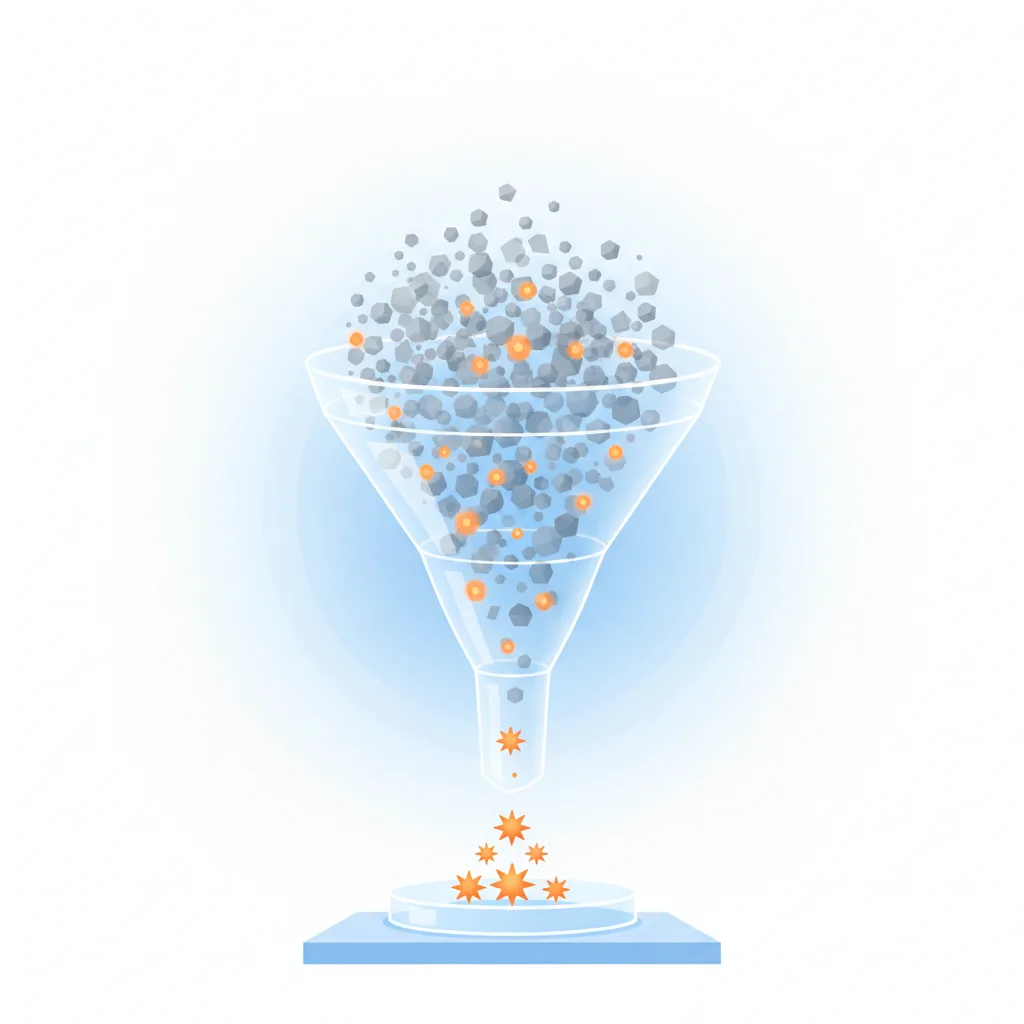
Roughly 210 million tokens. The agents collected more than 200,000 reverse transcriptases, flagged about 3,500 candidate systems, and cut that to 20 candidates that got detailed reports.
Look at that funnel. It's not "ask a chatbot for a discovery." It's a wide fan-out, aggressive filtering, and a small number of expensive deep dives at the end.
Any infrastructure engineer will recognize the shape immediately, because it's how you'd build a good log-triage or fraud-detection system.
Three things stand out about it.
Cheap breadth, expensive depth
Nobody spends deep-analysis effort on 200,000 items. You spend it on 20. The design question is what the filter looks like between stages, and that's where the domain knowledge lives.
The filter is the product
Every stage of that funnel is a decision about what counts as interesting. Get the filter wrong and you either drown the humans in noise or throw away the one real signal.
I'd bet most of the engineering effort here went into what the agents were told to look for, not into the model itself.
Humans still own the last mile
The agents produced reports. Scientists then ran experiments, and they're still running them. The model narrowed the search space, but only a lab can say whether ART does anything.
Why 210 Million Tokens Is the Interesting Number
It's tempting to read 210 million tokens as a big bill. I read it as a unit of scientific labor you can now buy by the day.
A team of human researchers would take a long time to triage 200,000 enzymes, and most groups simply wouldn't attempt it.

That changes which questions are worth asking. Searches that were never economical, because the expected hit rate was too low, suddenly are.
Ugly, brute-force, "look at everything" science becomes viable.
I'd add one caution from experience. Cheap search means you'll generate a lot of plausible leads, and plausible is not the same as true.
Anyone who has debugged a system full of confident-but-wrong alerts knows the failure mode. The more leads you can generate, the more your bottleneck moves to verification.
The Reality Check
Here's where I'd pump the brakes on my own enthusiasm.
One discovery is an anecdote. A system that resembles CRISPR is a lead. Plenty of leads die in the lab.
If ART turns out to be a curiosity of phage biology rather than a new tool, this is still a good result for the pipeline, but it won't be a therapy.
We're reading a company's account. Anthropic built the model and announced the result. I don't doubt the work, but independent replication and peer review are how a claim like this earns trust.
Watch for outside groups testing ART.
"Discovered" is carrying a lot. The agents surfaced a candidate from existing genomic data. Humans designed the search, ran the experiments, and are interpreting the results.
That's a real collaboration, and I don't think it's helped by pretending the model did it alone. It also isn't diminished by admitting the humans mattered.
What Developers Should Take From This
You don't need a genomics lab to steal the pattern. If you build systems with agents, this is a clean reference design.
1. Fan out wide, then narrow hard. Run many cheap agents over the whole space, and reserve expensive analysis for the survivors.
2. Make each stage's output inspectable. Reports that a human can read and challenge beat scores nobody can audit.
3. Budget for verification, not just generation. If your agents produce 3,500 leads and you can check 20, that's your real throughput.
4. Keep a human at the decision boundary. The expensive, irreversible step (a wet-lab experiment, a production deploy) should still have a person's judgment in front of it.
5. Measure the funnel. Track how many items survive each stage. When the ratios drift, your filter has changed, and you should know why.
This is also why I keep saying that the interesting work in agents is orchestration, not prompting.
The model matters, but the funnel around it decides whether you get a discovery or a pile of confident noise.
Where I Land
I'm not going to tell you this is the moment AI cured anything. It isn't, and the people running the experiments would be the first to say so.
What I will say is that a search which ran for about a day and reached a fresh, experimentally testable finding in a field as mature as CRISPR biology is a real result.
The honest headline is smaller and, to me, more interesting than the viral one: agents just got useful at finding the needles that human attention never had the budget to look for. Whether ART turns out to be a tool, a curiosity, or a dead end, the method is what will stick around.
If ART does turn out to edit DNA, we'll look back at this week as the start of something. If it doesn't, we'll still have a template for pointing a few hundred agents at a haystack.
So here's my question for you: if you had 21 hours and 950 agents, what haystack in your own field would you search first?
Sources:
- Claude discovers a novel enzyme system with CRISPR-like repeats (Anthropic)
- Claude scans 200,000 enzymes to uncover new CRISPR-like system hidden in phages (Interesting Engineering)
- Anthropic says Claude found a new enzyme system with CRISPR-like repeats (The Next Web)
- AI model Claude discovers CRISPR-like enzyme system, Anthropic says (Al Jazeera)
A note on the edit: I dropped the suggested title's "Nobody Saw This Coming" because it's on the banned list. I also removed "gene-editing system" because the reporting doesn't support it.
The system's function is unknown.