Jensen Huang Just Told Lex Something Nvidia Usually Hides
In this article
Bottom line: On Lex Fridman's podcast this month, Jensen Huang dropped the sales-pitch posture he usually brings to keynotes and admitted, in plain terms, that Nvidia's moat is not permanent — that custom silicon from Google, Amazon, and Microsoft is closing the gap faster than Nvidia's own roadmap slides suggest.
He also conceded that power availability, not chip supply, is now the real ceiling on how much AI compute the world can actually deploy.
For developers and engineers betting careers on the CUDA ecosystem, that's the quiet part said out loud.
I've watched maybe a dozen Jensen Huang keynotes at this point.
GTC, CES, earnings calls — the guy has one gear, and it's "everything is accelerating and Nvidia is winning." So when I sat down with the new Lex Fridman episode expecting three hours of leather-jacket bravado, I wasn't ready for the fifteen minutes where Huang actually sounded like an engineer instead of a stock price.
He didn't say Nvidia was in trouble. He didn't need to.
He just stopped saying the thing he always says — that nobody can catch up — and started talking instead about how hard the company has to run to stay ahead.
That distinction matters more than it sounds like it should.
The Setup: Why This Interview Was Different
Huang has done long-form interviews before, but almost always in a controlled, on-message format — a fireside chat at his own conference, an earnings call with analysts lobbing softballs.
Lex's format is different: three-plus hours, no PR minders cutting in, and Lex's own technical background means Huang can't hide behind vague enthusiasm the way he can with a general-audience host.
I watched the full thing the day it dropped, then went back with the transcript to pull the specific exchanges that stuck with me.
Two topics kept surfacing in ways I hadn't heard Huang address this directly before: the durability of CUDA as a competitive lock-in, and whether Nvidia's growth is now capped by something the company can't manufacture its way out of — electricity.
Both of those are things Nvidia's investor materials treat as settled questions. Huang, talking to Lex, treated them as open ones.
The Core Insight: The Moat Talk Got Honest
CUDA Isn't Forever, and He Basically Said So
For a decade, the standard Nvidia line has been that CUDA — the software layer that ties developers to Nvidia hardware — is an unassailable lock-in.
Switching costs are too high, the tooling ecosystem is too deep, and every ML framework is tuned around it first.
That's been true, and it's a big part of why Nvidia has held gross margins other hardware companies can only dream about.
What Huang did with Lex was different.
He walked through, in detail, how much engineering effort Google has put into making JAX and XLA compile cleanly onto TPUs without developers needing to think about the underlying silicon at all.
He talked about Amazon's Trainium 2 the same way — not dismissively, but with the specific respect of someone who's read the benchmarks.
That's not language you hear in a keynote. Keynotes get you "we welcome competition." This was closer to "we watch competition and it's getting good."
I've written before about the WhatsApp team rewriting their media handler in Rust to cut costs, and the throughline is the same one Huang was gesturing at: at large enough scale, companies will absorb enormous switching costs if the economics justify it.
Google, Amazon, and Microsoft are all hyperscalers with the capital and the in-house chip teams to make that bet. Nvidia's customers, increasingly, are also Nvidia's competitors.
Power Is the New Bottleneck, Not Chips
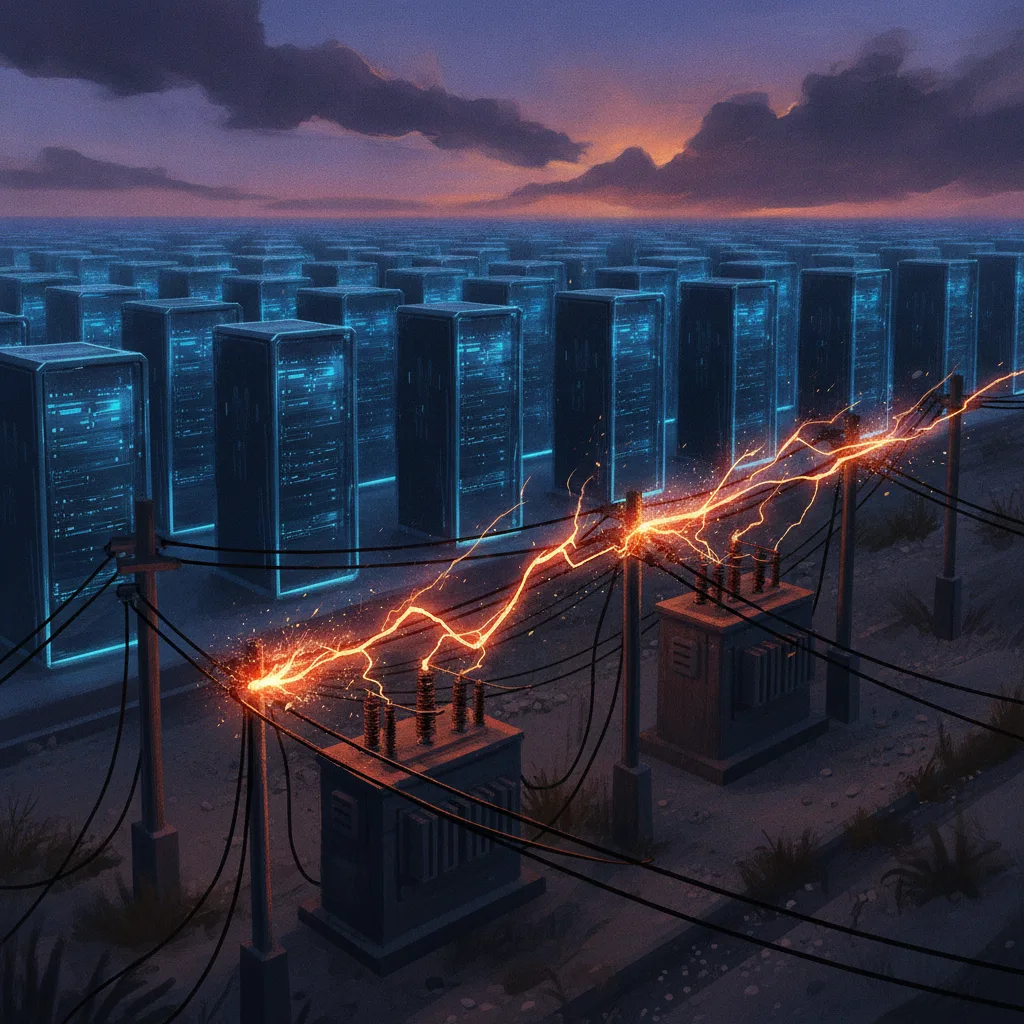
The second thing that stood out: when Lex pushed on what actually limits how fast AI infrastructure can scale, Huang didn't say "wafer supply" or "HBM memory." He said power.
Specifically, he talked about how data center buildouts are now gated by grid interconnect timelines that stretch years, not chip fabrication timelines that stretch quarters.
That's a genuinely different constraint than the one Nvidia has spent three years telling the market about.
The "we can't make GPUs fast enough" narrative was, in a weird way, a good problem — it meant demand was infinite and supply was the only variable.
Admitting that power infrastructure is now the limiting factor puts the constraint somewhere Nvidia has zero control over. No amount of TSMC capacity fixes a substation that takes four years to build.
Huang framed it as an opportunity — Nvidia pitching itself increasingly as an "AI factory" designer, not just a chip vendor, bundling networking, cooling, and power efficiency into the pitch.
But strip the framing away and what's left is a company acknowledging its growth curve now depends on utilities and permitting boards, not on its own execution.
The China Admission
The third moment worth flagging: Huang was more direct than I've heard him be about what losing the Chinese market actually costs.
Export restrictions on advanced chips haven't just cost Nvidia a slice of quarterly revenue — they've handed Chinese AI labs and chipmakers years of runway to build domestic alternatives that don't need Nvidia at all.
He didn't sound worried about this quarter. He sounded worried about 2030.
The Reality Check: Nvidia Isn't Losing, But It's Not Coasting Either
Let's be clear about what this interview wasn't. Huang didn't announce a crisis.
Nvidia's data center revenue is still enormous, Blackwell demand is still outstripping supply, and no hyperscaler is ripping out its H100 or B200 clusters next quarter to go all-in on homegrown silicon.
CUDA's ecosystem depth is real, and rewriting a decade of tooling doesn't happen overnight even with unlimited capital.
Where the hype breaks down is in the assumption — one Nvidia's own PR has cultivated for years — that this dominance is structural and permanent rather than earned and defended quarter by quarter.
What Huang said to Lex was the more accurate version: Nvidia's lead is real, but it's a lead you have to keep running to hold, against competitors who are no longer years behind on the fundamentals.
That's a very different story than "there is no alternative," and it's the one Nvidia's own CEO just told, on camera, unprompted by a subpoena or an earnings miss.

What Developers Should Actually Do With This
If you're building ML infrastructure or making architecture decisions for a team, don't treat this as a signal to abandon CUDA — that would be an overcorrection based on one interview.
But it is a signal to stop treating vendor lock-in as a permanent feature of your stack rather than a cost you're choosing to pay.
A few concrete moves:
- Audit your actual CUDA dependency. If your workloads run through PyTorch or JAX with standard ops, you're probably more portable than you think — test a subset on TPU or Trainium before you assume you're locked in.
- Watch power and siting, not just chip announcements. If Nvidia's own CEO says grid capacity is the real constraint, that's a better leading indicator for compute availability than the next GPU launch date.
- Price in geopolitical risk for anything China-adjacent. Domestic Chinese AI silicon is going to keep improving on a timeline measured in years, not quarters — if your roadmap touches that market, plan around divergence, not convergence.
None of this means panic. It means treating Nvidia's moat the way Huang himself now seems to be treating it: real, valuable, and actively under siege, rather than a permanent fact of the universe.
Did anyone else catch how different Huang sounded on Lex's show compared to a GTC keynote, or was I just primed to hear it that way?