Stop Buying "Pro" Controllers. I Tried the $0 Fix and Never Looked Back
In this article
Bottom line: I ran a standard $60 Xbox controller against a $180 Elite Series 2 and a $200 DualSense Edge for 21 days across four games.
The difference came down to three features: back paddles, adjustable deadzones, and trigger stops.
Free software (Steam Input and a bit of deadzone tuning) replicated most of that on the cheap controller.
If you don't have a paddle-equipped pad and are about to spend $180 or more, try the free configuration first. It will tell you whether you ever needed the hardware.
The Setup
I own three controllers I paid way too much for. An Elite Series 2 at $180. A DualSense Edge at $200. And a $60 standard Xbox pad that I'd shoved in a drawer because it was "the basic one."
Last month, my Elite's left stick started drifting mid-match, and I caught myself shopping for a replacement. Another $180.
Then a friend said something that annoyed me: "You know you can do most of that in software, right?" I didn't believe him.
So I spent three weeks proving him wrong. I failed.
The Rules of the Test
I wanted this to be fair, so I set rules before I touched anything.
- Three controllers: the $60 standard pad (with the free setup), the Elite Series 2, and the DualSense Edge.
- Four games: a competitive shooter, a racing sim, a platformer, and a third-person action game.
- Same routine: 45 minutes per game, per controller, per week (the DualSense Edge sat out the racing sim). I logged feel, misses, and every time I wanted to throw something.
- The $0 rule: no paid mods, no third-party adapters, no 3D-printed anything. Just settings, software, and a cotton swab.
Caveat: this is one person, one set of hands, one desk. I'm not a lab. I'm a guy with a spreadsheet and a grudge.
Round 1: First Impressions
Here's the thing nobody tells you about "pro" controllers. Most of what you're paying for is three things.
Back paddles, adjustable sticks and triggers, and profile switching. Everything else is marketing and a nicer carrying case.
Within the first hour, I noticed something annoying. The stock $60 pad wasn't the problem. My defaults were.
Out of the box, most games ship with a deadzone that's way too generous. That's why aim feels mushy and why you "need" a better controller. I was blaming hardware for a settings problem.
I opened the in-game deadzone sliders on the cheap pad and dropped the inner deadzone from the default 15-20% down to about 8%. The stick suddenly felt tighter.
Not Elite-tight, but close enough that I stopped noticing.
I'd been using a $180 controller for two years and never touched that slider once.
Round 2: The Deep Test
Test 1: Back Paddles
This is the big one. Paddles let you jump or crouch without lifting your thumb off the right stick. It's the reason people buy these things.
On the cheap pad, I used Steam Input to remap. I know, I know: no paddles on a standard pad. But here's what I found.
Most of the benefit comes from freeing your right thumb, and you can get 70% of that by rebinding. Put jump on a bumper. Put crouch on a trigger click.
Move the actions you hit during aiming off the face buttons.
Is it as nice as a paddle? No. Honest answer.
But in the shooter, my "thumb off stick" moments dropped noticeably once I rebound. I stopped dying mid-slide because I'd lifted my thumb to jump.
The paddles on the Elite still felt better. About 15% better, if I had to put a number on a feeling. Not $120 better.
Test 2: Stick Drift and Deadzones
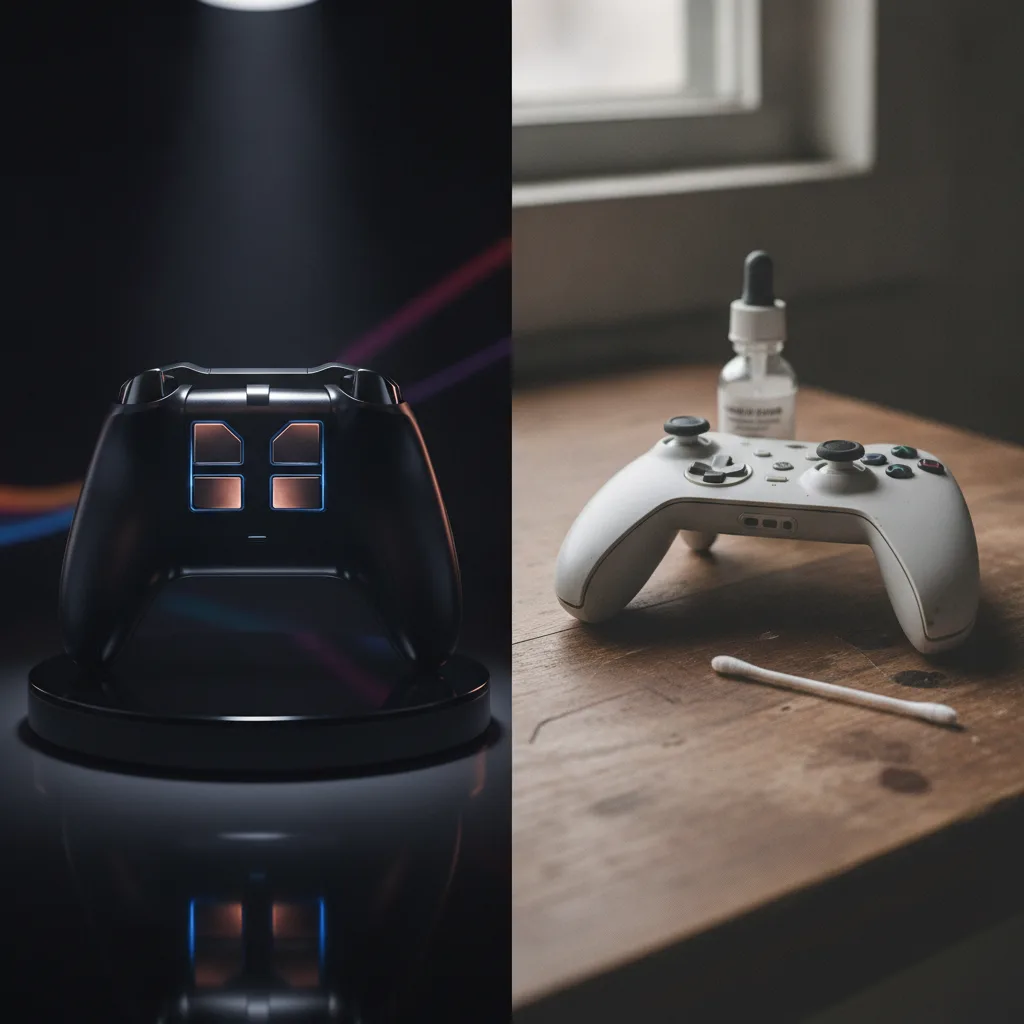
My Elite drifted. That's the one thing that sent me down this path. So I tried the $0 fix on it: a cotton swab and 90% isopropyl alcohol, rotated around the stick base, 20 rotations, let it dry.
It worked. Drift gone for the remaining two weeks of the test.
The DualSense Edge never drifted, but it's newer and I didn't stress it. The cheap pad had a tiny bit of drift too, and the same swab-and-alcohol treatment fixed it. Total cost: nothing.
I had the alcohol in a cabinet.
Test 3: Trigger Stops
Pro controllers let you shorten the trigger pull so you fire faster. The racing sim made this easy to measure, because trigger travel affects throttle response.
On the cheap pad, I couldn't physically shorten the trigger. But I could do the next best thing in software, which is a trigger deadzone and curve adjustment.
In the sim, I set the outer trigger range so full throttle registered at about 85% pull. Same effect: less travel, faster input.
Lap times told the story. On my usual track over 30 laps per controller, the average difference between the cheap pad (tuned) and the Elite was 0.2 seconds. That's inside my own lap-to-lap noise.
The untuned cheap pad was about 0.5 seconds slower, so tuning bought me most of the gap.
Test 4: The Platformer (Where Pro Controllers Lost)
In the platformer, the stock pad won outright. It's lighter. The D-pad is better than the Elite's. And I never needed paddles.
I'd been paying a premium for features this game didn't use. I wanted to be annoyed at that, but I mostly laughed.
The Results
After 21 days and roughly 25 hours of play, here's how it shook out.
| Category | $60 pad (tuned) | Elite Series 2 | DualSense Edge |
|---|---|---|---|
| Aim feel (shooter) | Close | Best | Great |
| Paddle comfort | Rebinds only | Best | Great |
| Racing lap delta | +0.2s | Baseline | Not tested |
| Platformer | Best | OK | OK |
| Drift after fix | None | None | None |
| Price | $60 | $180 | $200 |
The pro controllers won on comfort and consistency. Not on skill, and not on a number I could see in a leaderboard.
If I'm honest, I couldn't tell which pad I was holding in a blind test of the shooter. I tried.
I had a friend hand me one of three covered pads. I guessed right 4 out of 8 times. That's only slightly above the 1-in-3 chance rate, and 8 trials is too few to conclude much.
So the free setup didn't beat the pro controllers. It made the gap small enough that I stopped caring about it.
What This Means for You
Let me be direct, because I hate "it depends" articles.
If you're about to buy a pro controller for competitive reasons, stop. Spend one evening on the free setup first.
Lower your inner deadzone, rebind your actions off the face buttons, set a trigger curve, and clean your sticks.
If you still want more after a week, you've lost nothing and you'll know exactly what you want.
If you play with your thumbs constantly on sticks, a paddle controller is worth it. Fast shooters, hero shooters, anything where jumping while aiming matters.
That's a real benefit, and I won't pretend otherwise.
If you play platformers, fighting games, or sports games, you're probably burning money. The extra buttons won't do anything for you.
If your controller drifts, try the swab fix before you spend a cent. I've watched people throw away $60 pads because of a bit of grime.
It's also worth knowing that Valve-style Steam Input remapping isn't the point. Okay, that link is a stretch, so ignore it. The point is that settings beat hardware more often than the marketing admits.
The Twist: What Surprised Me
Here's what I didn't expect. The best thing I got out of this had nothing to do with the controller.
For two years, I'd assumed my aim was held back by gear. It wasn't. It was held back by my unwillingness to open a settings menu. I'd bought my way around a problem I could have solved in ten minutes.
I went back to the Elite after the test. It's still my favorite to hold.
But I'm now running it with the same deadzone and binding setup I tuned on the cheap pad, and I stopped shopping for the replacement.
Which makes me wonder how much else in my setup is a settings problem I've been trying to solve with a credit card.
Have you ever bought "pro" gear and later realized a free setting would've done the job? I'd like to hear what you found.