Rome Fell for 1,000 Years. Byzantium Broke Every Rule to Survive It.
In this article
Bottom line: Western Rome "fell" in 476 AD, but its eastern half — what we call the Byzantine Empire — kept calling itself Rome and kept functioning for another 977 years, until Ottoman cannons breached Constantinople's walls in 1453.
It survived by doing the opposite of what most institutions do when they're dying: it swapped its language, rewrote its legal code, restructured its military from the ground up, and fragmented into pieces before reassembling — all while insisting nothing had changed.
History YouTube has rediscovered this story hard this year, and the reason it's resonating with a tech audience isn't nostalgia. It's a case study in how systems survive by refusing to stay the same.
I was on a call with a friend who runs infrastructure at a mid-size fintech last month, and he brought up a Byzantine history video unprompted.
Not because he's a history buff — because he'd just spent a weekend migrating a fifteen-year-old billing system off a mainframe, and something about watching an empire quietly become unrecognizable while insisting it was the same empire hit uncomfortably close to home.
That's the video essay moment we're in right now. Channels covering Byzantium — long-form, patient, unglamorous history — are pulling numbers that dwarf their usual audience.
And the pull isn't just "empires are cool." It's that Byzantium is the best-documented example in human history of an institution that survived a millennium by never once staying still.
Why This Story Is Trending Now
The "fall of Rome" is one of the most over-told stories in Western education — 476 AD, barbarians at the gate, the lights go out on antiquity. It's clean, it's dramatic, and it's incomplete.
The Roman state didn't fall in 476. Half of it did.
The eastern half, centered on Constantinople, kept going. Its citizens called themselves Romans — Rhomaioi — right up until the end.
Historians only started calling it "Byzantine" centuries later, mostly to make the story easier to teach.
That framing device is exactly what's cracking open on YouTube right now: creators are telling audiences, correctly, that they were taught a marketing label as if it were a historical fact.
That reveal is catnip for an internet that loves finding out it's been lied to by a textbook.
The timing also isn't random.
Interest in institutional collapse and institutional survival tends to spike when audiences are anxious about their own systems — economic, political, technological — losing coherence.
A thousand-year case study in adaptive survival is a comforting thing to watch when your own timeline feels unstable.
The Historians' Case: Byzantium Never "Became" Anything
A meaningful strand of modern Byzantine scholarship — associated most prominently with historians like Anthony Kaldellis, who has spent much of his career arguing against the "Byzantine" framing altogether — makes a pointed claim: there was no meaningful break.
The people living in Constantinople in 1200 AD considered themselves the direct, unbroken continuation of the state founded by Augustus.
Same legal tradition, same imperial office, same claim to Rome itself.
This isn't a semantic quibble.
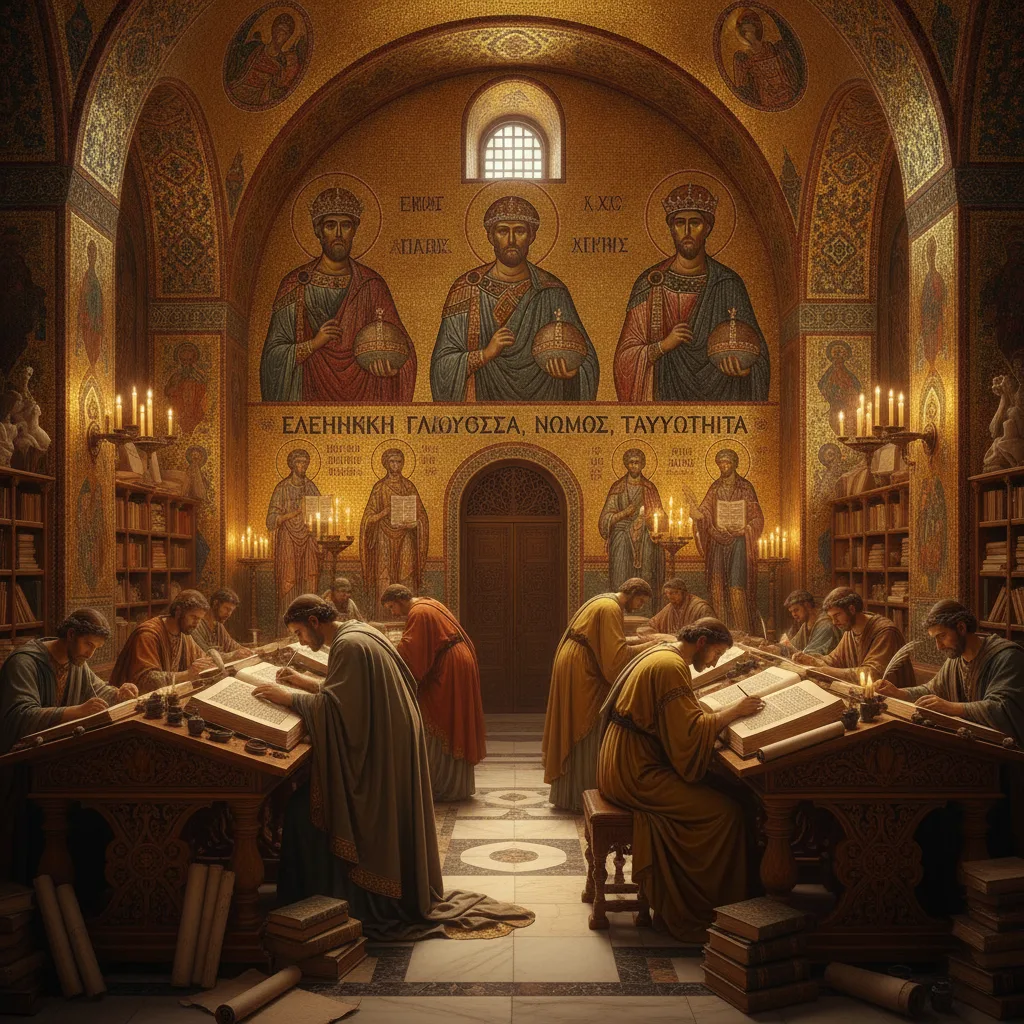
It matters because it reframes the entire story from "a new empire emerged from the ashes" to "one empire kept solving problems for a thousand years." Under Justinian in the 6th century, the empire commissioned the Corpus Juris Civilis — a total codification of Roman law that still underpins civil law systems in dozens of countries today.
That's not a successor state writing new rules.
That's the original system doing what long-lived systems do: consolidating, documenting, and compacting its own legacy code before it becomes unmaintainable.
The continuity argument extends to the currency.
The gold solidus, later called the nomisma, held its value and purity for roughly 700 years — an almost unthinkable run of monetary stability that made Constantinople the financial clearinghouse of the medieval world.
A currency that doesn't devalue is, in modern terms, an API that never breaks its contract. People built on top of it for generations because they trusted it wouldn't move.
The Counter-Voice: This Was Not the Same Empire
Other historians push back hard on the continuity framing, and they have the receipts.
By the reign of Heraclius in the early 600s, the empire had lost Egypt, Syria, and eventually most of its Latin-speaking western holdings to the Sassanid Persians and then the Arab conquests.
Latin, the administrative language of Rome for six centuries, was replaced by Greek at the level of imperial bureaucracy and law.
The army was reorganized into the "theme" system — regional military-administrative districts that traded a centralized professional army for distributed, self-funding garrisons tied to land grants.
That's not continuity. That's a full architectural rewrite, forced by losing more than half your addressable territory in under a generation.
And the empire didn't just change once.
In 1204, the Fourth Crusade — nominally Christian allies — sacked Constantinople itself and carved the empire into fragments: the Latin Empire, the Empire of Nicaea, Epirus, Trebizond.
For 57 years there was no single Roman state at all.
It took until 1261, under Michael VIII Palaiologos, for Constantinople to be recaptured and the empire stitched back together — smaller, poorer, and never fully whole again, but still, insistently, calling itself Rome.
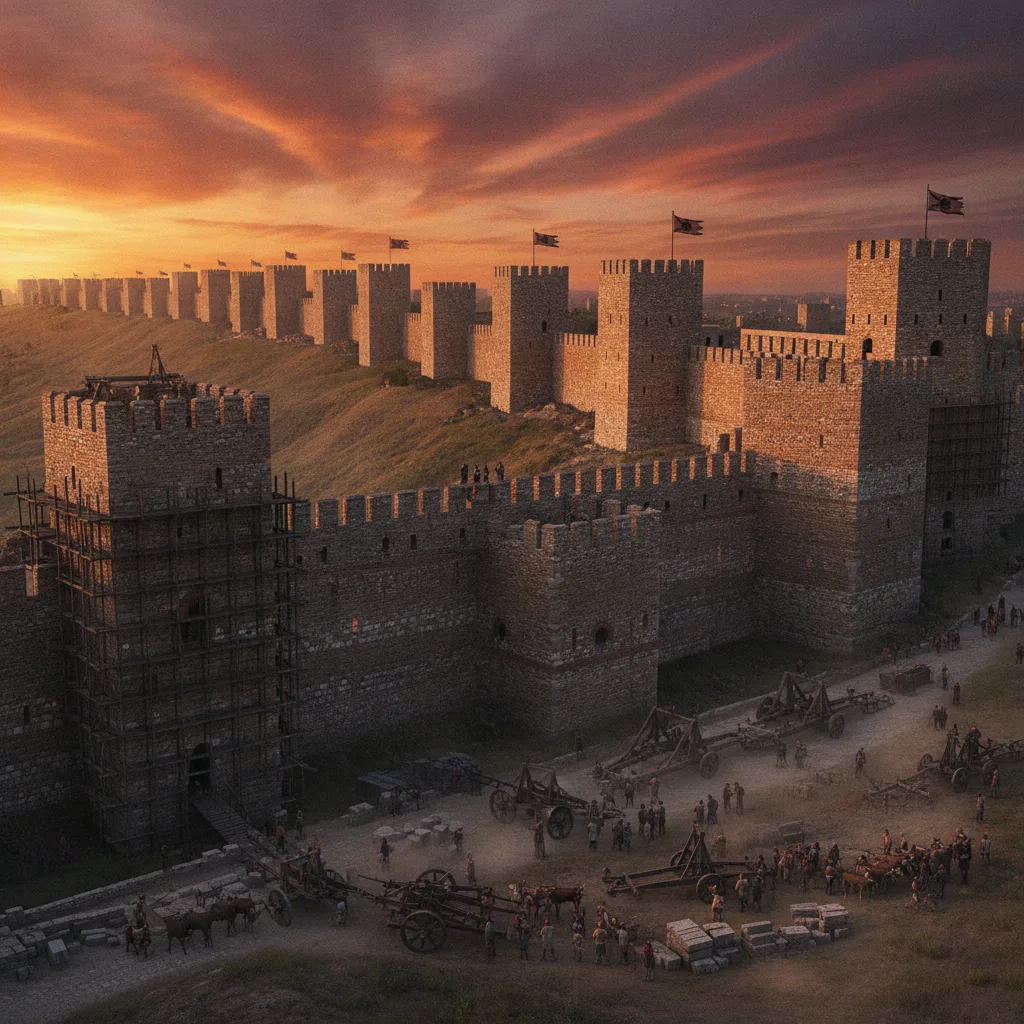
It finally fell for good in 1453, when Mehmed II's forces breached the Theodosian Walls using massive bronze cannons designed by a Hungarian engineer named Orban — walls that had held for over a thousand years against everyone else who'd tried.
The honest read is somewhere between the two camps: the name and the legal claim never broke, but almost everything underneath it did, repeatedly, under duress.
What the Timeline Actually Shows
Strip away the interpretation and the raw sequence is the argument by itself:
- 476 AD — Western Rome's last emperor deposed; the eastern half keeps functioning uninterrupted - 529–534 AD — Justinian's legal code compiles and compresses 900 years of Roman law into a usable, teachable system - 7th century — catastrophic territorial losses to Persia and the Arab conquests force a total restructuring of language, military, and administration
- 1204 — Constantinople sacked by fellow Christians; the empire fragments into four competing successor states - 1261 — reunification under Michael VIII, at a fraction of its former size and strength - 1453 — Constantinople falls to Ottoman cannon fire, ending Roman continuity 977 years after the "fall" of Rome
Every one of those transitions was survivable only because the institution was willing to look nothing like itself a generation later while insisting, on paper, that it was unchanged.
What This Means If You Build Systems for a Living
Here's the part that made my friend bring this up mid-migration call.
Byzantium is the best case study I've found for the difference between a system's identity and its implementation. The empire kept its name, its legal claim, and its core institutional memory intact for nearly a millennium — while swapping its language, its military architecture, its territorial footprint, and even its ruling dynasty multiple times over.
That maps almost exactly onto what separates long-lived codebases and companies from the ones that die in a decade.
The businesses and systems that last aren't the ones that avoid change — they're the ones that decouple their identity from their implementation early, so the implementation can be replaced without anyone declaring bankruptcy on the brand.
Three patterns from the Byzantine playbook translate directly:
Rewrite before you're forced to. Justinian's legal compilation happened while the empire was still strong, not after it had collapsed.
Waiting until your legacy system is actively failing to consolidate it is how you end up doing the rewrite during the crisis instead of before it.
Modularize under pressure, don't centralize harder. The theme system was a response to losing centralized control — regional, semi-autonomous units that could function even when the center was compromised.
That's a real-world argument for the same instinct that pushes teams toward microservices and regional failover: a monolith that depends entirely on one control plane doesn't survive its worst day.
Protect the thing people trust most, even if everything else changes. The nomisma stayed stable for 700 years while territory, language, and government were in constant flux.
If you're going to change everything else about a system, the interface — the contract users actually depend on — is the last thing that should move.
The empire that finally fell in 1453 wasn't undone by a failure to adapt.
It was undone by cannon technology that made thousand-year-old walls obsolete overnight, after the polity behind those walls had already outlasted every other institution from its founding era by roughly a thousand years.
That's not a story about stubbornness winning. It's a story about knowing exactly which parts of your system are load-bearing, and rebuilding everything else without apology.
Have you ever inherited a system — a codebase, a team, a process — that survived by changing everything except its name? What was the one thing it refused to let go of?
I'd like to hear it in the comments.