I Watched 5 Hours of Rome vs. Byzantium. It Changes How You Read Everything
In this article
- The Setup: Why a 1,600-Year-Old Empire Matters to Your Slack Channel
- The Contrarian Reframe: "Falling" Is a Story We Tell About Endings We Didn't Watch Closely Enough
- The Framework: The Byzantine Blind Spot
- Real-World Implications: What This Means for the Decisions You're Making This Quarter
- The Bigger Picture
Bottom line: The Western Roman Empire "fell" in 476 CE — but its eastern half, the Byzantine Empire, kept functioning as a continuous state until Constantinople fell to the Ottomans in 1453, nearly 1,000 years later.
Popular culture collapses these into a single "Rome fell" event, which flattens one of history's clearest lessons: institutions rarely die, they transform, rebrand, and keep operating under names we stop recognizing.
After binge-watching several long-form YouTube history essays on the Rome-to-Byzantium transition, I started seeing the same blind spot everywhere in tech — in how we declare crypto "dead," call remote work "over," or announce the AI bubble has "popped" the moment growth slows.
The mistake isn't factual. It's structural, and once you see it, you can't unsee it.
I used to think "Rome fell in 476 AD" was just a fact I learned in ninth grade.
Turns out it's closer to a rounding error historians have been quietly correcting for over a century — and almost nobody outside academic circles bothered to update the popular version.
That's what five hours of YouTube history essays did to me over a couple of weekends in July. Not a dramatic realization.
A slow, uncomfortable one: I'd been telling a simplified version of a story for thirty years, and the simplification wasn't neutral. It erased something important.
The Setup: Why a 1,600-Year-Old Empire Matters to Your Slack Channel
Here's the part everyone skips. When the last Western Roman emperor, Romulus Augustulus, was deposed in 476, the empire didn't end — it split off.
The eastern half, centered in Constantinople, kept its senate, its legal code, its bureaucracy, and its army running for another 977 years, until the Ottomans took the city in 1453.
Historians call it the Byzantine Empire. The people living in it just called themselves Romans, right up until the end.
So "Rome fell" is true for only its western half.
The eastern half kept sending tax collectors, minting coins, and fighting wars for nearly a millennium after the "fall" — under a government its own citizens never stopped calling Roman.
I'm not a historian. I'm someone who builds software and reads a lot about how narratives move through culture.
And the thing that stopped me mid-scroll wasn't the history — it was recognizing the shape of the mistake.
We do this constantly with technology. We declare something dead the moment its most visible, most photogenic phase ends, and we miss the quieter, longer, often more consequential phase that follows.
The Contrarian Reframe: "Falling" Is a Story We Tell About Endings We Didn't Watch Closely Enough
Everyone loves a fall. It's dramatic, it's teachable in one class period, and it fits neatly into a listicle.
"Rome fell because of lead pipes / barbarians / moral decay" is a sentence you can put on a slide.
"Rome's western administrative apparatus collapsed while its eastern institutions adapted, survived, and evolved for centuries" is not.
The mainstream take on Rome isn't wrong because it's dishonest — it's wrong because it's optimized for memorability over accuracy.
And I think that's exactly what's happening right now with how we talk about tech cycles.
Take crypto. The mainstream narrative in 2022–2023 was "crypto is dead" — FTX collapsed, prices crashed, and the story wrote itself. But the infrastructure didn't disappear.
Stablecoin settlement volume kept climbing through 2024 and 2025. Tokenized treasury products moved from niche experiment to a line item on institutional balance sheets.
The "empire" didn't fall — its flashy western capital did, while a quieter eastern half kept doing the actual work of moving money.
Or take "remote work is over." Every RTO mandate from a big-name company gets treated as the empire crumbling.
Meanwhile the operational muscle — async documentation, distributed hiring pipelines, tools like Notion and Linear built assuming nobody's in the same room — never went anywhere.
The empire didn't fall. It moved its capital and kept minting coins.
The mainstream view isn't lying to you. It's just telling you about the collapse it could see, not the continuity it couldn't be bothered to track.
The Framework: The Byzantine Blind Spot
Here's the mental model I built out of those five hours, and it's the part I actually want you to remember and reuse.
1. The Visible Capital Falls First
Every system has a "Rome" — the flashy, symbolic, media-friendly center everyone watches. When it stumbles, headlines write themselves. Sam Bankman-Fried in handcuffs.
A CEO's tearful all-hands about layoffs. A stock chart cratering 80%. This is the part of the story that gets covered, because it's the part with pictures.
2. The Working Capital Relocates Quietly
While attention is on the visible collapse, the actual operational core — the talent, the capital, the institutional knowledge — doesn't vanish. It relocates.
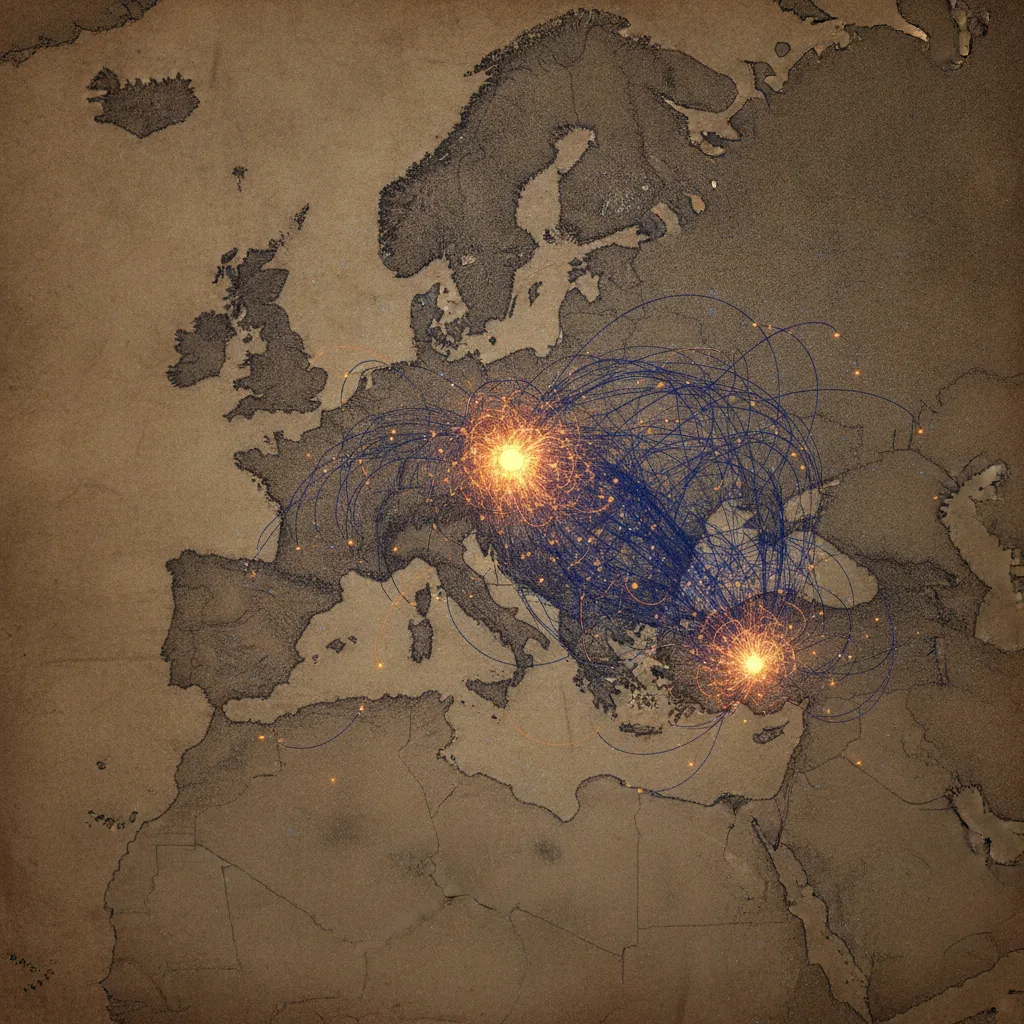
Byzantium moved the center of gravity from Rome to Constantinople more than a century before the western "fall" even happened.
Nobody threw a parade for that. It just happened, administratively, unglamorously.
In tech, this looks like: engineers leaving a collapsing startup and rebuilding the same idea, better funded, at a company nobody's watching yet.
It looks like open-source infrastructure quietly absorbing what a failed company was trying to commercialize.
3. The Narrative Lags the Reality by 5–15 Years
This is the gap that gets people. Western Rome "fell" in 476.
But historians will tell you the functional decline started generations earlier, and the eastern continuation was already the dominant Roman institution before the western half collapsed.
The narrative — "Rome fell" — locked in decades after the underlying reality had already shifted.
Right now, in 2026, I'd bet we're inside one of these lag periods with AI. The "AI bubble" narrative gets a news cycle every time a funding round looks frothy or a chatbot company misses a quarter.
Meanwhile the actual infrastructure — inference costs dropping, models like Claude 4.6 and ChatGPT 5 getting embedded into unglamorous backend workflows — keeps compounding, invisibly, in places nobody's writing headlines about.
4. The "Fall" Gets Simplified Into a Single Cause
Pop history blames barbarians. Pop tech blames a CEO, a bad product bet, one viral tweet.
Real institutional decline is almost always multi-causal and slow, and single-cause stories persist because they're the ones you can retell at a dinner party.
5. The Empire That "Fell" Often Outlasts the One That "Won"
This is the gut-punch part of the Byzantine story. The "barbarian" kingdoms that replaced Western Rome mostly didn't last.
Byzantium — the "fallen" half everyone forgot about — outlived nearly all of them by centuries. Whoever gets to declare victory first is not the same as whoever's still standing in 500 years.
Real-World Implications: What This Means for the Decisions You're Making This Quarter
If you're a founder, stop reacting to "X is dead" headlines as decision inputs.
When you read "no-code is dead" or "the API economy has peaked," ask which capital fell — the visible one, or the whole thing.
Nine times out of ten it's the former, and the latter is still quietly compounding somewhere you're not looking.
If you're mid-career and worried AI is coming for your role, the useful question isn't "is my job Rome or Byzantium" — it's "which part of my job is the visible capital everyone's watching, and which part is the operational core that'll relocate and keep running under a different name." Junior code review is Rome.
The judgment about what to build and why it matters is closer to Byzantium — it'll outlast the current interface wrapped around it.
If you're allocating budget, build the habit of tracking lagging institutional indicators, not headline events. Retention of the people who actually know how the system works.
Whether the underlying usage numbers keep climbing after the press cycle moves on. Whether the "dead" thing is still quietly issuing tax receipts, so to speak, five years after its funeral got written.
The Bigger Picture
What got me, watching those five hours, wasn't the history.
It was realizing how much of my professional judgment has been shaped by narratives optimized for memorability, not accuracy — and how rarely I go back and check.
We are, all of us, living through a period that will eventually get compressed into a single sentence in someone's slide deck: "AI changed everything in the mid-2020s." That sentence will be true and almost entirely useless, the same way "Rome fell in 476" is true and almost entirely useless.
The actual story — which parts fell, which parts relocated, which parts are still quietly running a millennium later under a name we haven't learned yet — is the only version worth knowing if you're trying to make a decision today rather than tell a story at a dinner party in 2040.
So here's my actual question, and I mean it: what's the "Rome fell in 476" version of some story in your industry right now — the headline everyone repeats — and what's actually still standing that nobody's bothered to notice?
— Andrew, Founder of Signal Reads. Builder, reader, occasional contrarian.