I Quietly Checked Every Place I've Ever Been. I Wasn't Ready For This.
In this article
Bottom line: Google's Timeline feature — the quiet log of everywhere your phone has been since roughly 2014 — moved to on-device-only storage in December 2024, meaning millions of people only just discovered they could lose a decade of location history if they didn't back it up.
That deadline sent a wave of people scrolling back through years of pins on TikTok and YouTube, and many weren't prepared for what surfaced: entire relationships, jobs, and cities they'd quietly written out of their own story.
Psychologists call the emotional hit the "reminiscence bump" — the disproportionate pull of memories from our late teens and twenties.
If you're tempted to open yours, do it with a plan, not a Sunday-night scroll.
I did it on a Tuesday, which in hindsight was a mistake. Tuesdays have no armour on them.
I opened Google Maps, tapped into Timeline, and there it was — a decade of my life rendered as a smear of blue dots across a map of three cities. Paris, where I was twenty-three and certain of nothing.
A flat in Peckham I hadn't thought about in years. A hospital in Lyon I'd genuinely forgotten I'd ever visited, until the pin sat there, dated and specific, refusing to be forgotten on my behalf.
I wasn't looking for anything. That was the whole problem.
Why Everyone's Doing This Right Now
This isn't a coincidence of collective nostalgia.
Google restructured Timeline at the end of 2024, shifting it from cloud storage to your device only, which meant anyone who hadn't manually backed theirs up was staring down the possibility of losing it entirely.
The prompt to "back it up or lose it" is what sent people back in to look — and looking turned into something else.
By mid-2026, the "reopening my Google Timeline" format had become its own genre on YouTube and TikTok, stitched together with the same three beats: a screen recording of the map filling in, a voiceover going quiet around the two-minute mark, and a caption admitting they hadn't expected to cry over a public transport route.
The numbers back up the discomfort.
Location History has existed in some form since 2009, but for most users it's been running silently, invisibly, since their first Android phone or the day they installed Google Maps.
That's frequently ten, twelve, fourteen years of movement data — which means the app isn't showing you a highlight reel. It's showing you the unedited version, including the parts you'd have cut.
The Reframe: This Was Never About the Places
Here's what I got wrong before I opened it: I thought I was going to look at places.
What actually happened is I looked at proximity — how close I'd stood, geographically, to people and versions of myself I don't reach for anymore.
The psychologist Constantine Sedikides, who has spent decades studying nostalgia at the University of Southampton, describes it as a fundamentally self-continuity function — it's how we stitch our past self to our present one and convince ourselves we're still the same person underneath the different addresses.
Most nostalgia research finds the feeling is more bittersweet than sad, more grounding than destabilising. But Timeline doesn't offer nostalgia in the usual sense.
A photo is curated. A pin on a map is not.
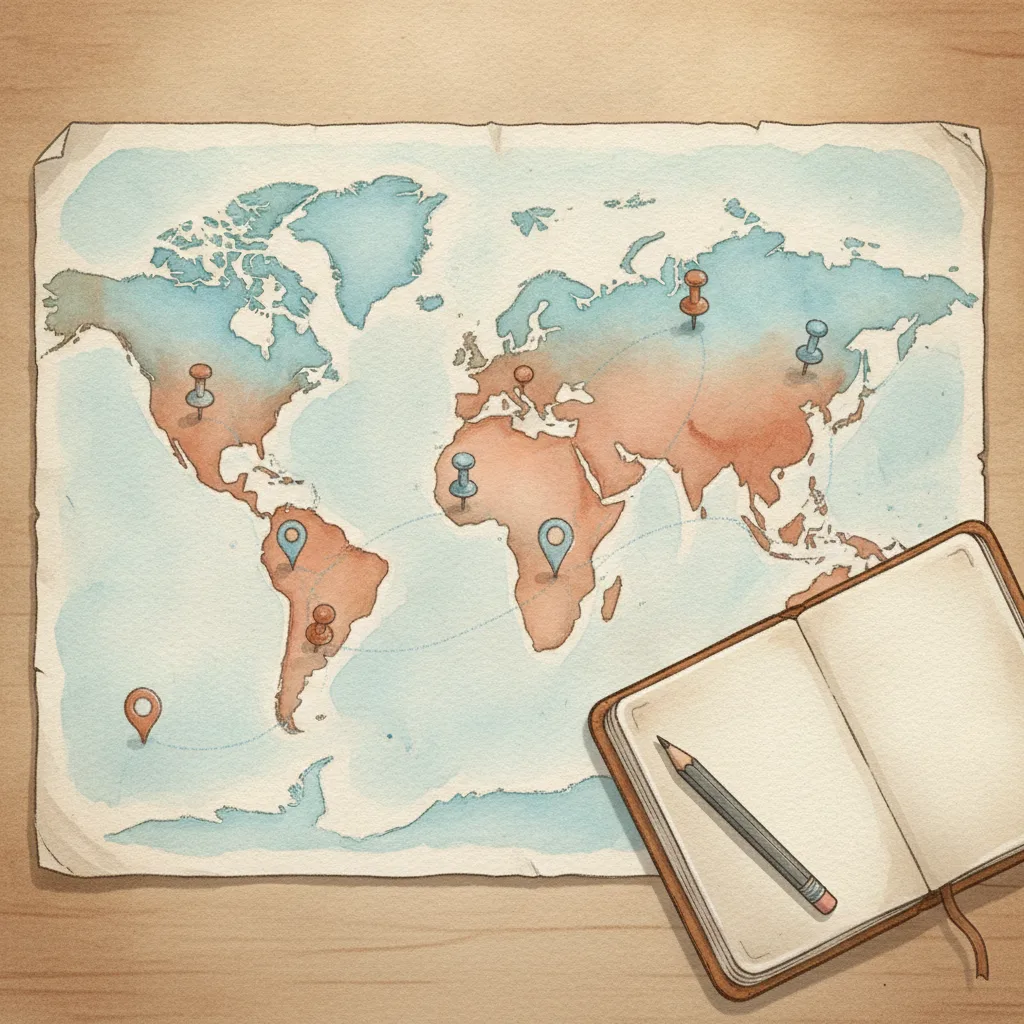
That's the real distinction. When you scroll an old photo album, you're looking at moments you chose to preserve — the good angle, the sunny day, the group that was smiling.
Timeline has no editorial instinct.
It logged the 3 a.m. drive to A&E with the same neutral dot it logged the beach holiday. It doesn't know which memory you'd have kept and which you'd have quietly let dissolve.
There's also a well-documented wrinkle called the reminiscence bump — the finding, replicated across dozens of studies since the 1980s, that adults recall a disproportionate number of memories from roughly ages 15 to 25.
It's thought to be because that's when most of our formative "firsts" happen — first flat, first heartbreak, first real job, first city chosen entirely for yourself.
If your Timeline data starts around then, you're not just looking at a map. You're looking at the exact years your brain was built to remember hardest.
That's why so many of these videos go quiet in the same place. It's not the trip to Lisbon that gets people. It's the six months of daily pins at an address they haven't said out loud in years.
The Pinpoint Practice: A Way to Look Back Without Getting Ambushed
If you're going to open yours — and I'd understand if this piece has made you want to — do it deliberately. Here's the small framework I wish I'd used before my Tuesday.
1. Set the boundary before you open the app
Decide, in advance, what you're actually looking for. A specific year. A specific city.
A specific question — "when did I actually leave that job" is a very different scroll than "let me just see everything." An unbounded scroll is how a five-minute check becomes a ninety-minute reckoning.
2. Scroll by year, never by day
Zooming into individual days invites you to reconstruct entire conversations from a single pin outside a café. Stay zoomed out.
Let the shape of a year tell you the story — where the cluster of dots lived, where they thinned out, where they moved entirely — without forcing yourself to relive the granular hours.
3. Name the feeling before you name the place
When something catches, pause and ask what you're actually feeling before you let yourself narrate the memory.
Grief, relief, and longing all masquerade as "oh, remember that" if you don't slow down enough to tell them apart. Naming the feeling first keeps you the narrator instead of the reactor.
4. Close it with one small action
Don't just close the tab and carry on. Text the person from the good memory, or write one line in a notes app about what surprised you, or simply decide consciously to leave the hard year where it is.
The action doesn't need to be big. It needs to exist, so the scroll has an ending instead of just stopping.
What This Actually Looks Like
A friend of mine, Priya, did this the week the backup deadline hit and found four months of pins clustered around a hospital she'd never mentioned to me.
She didn't spiral — she used the framework roughly by instinct, texted her sister that night, and told me the map had done something a photo never could: it had shown her how long the hard stretch had actually lasted, not how she remembered it lasting.
That's the thing about location data.
It doesn't do the thing memory does, where six painful months compress into "a bad patch" and six happy ones expand into "the best year of my life." The dots are indifferent to how you've since rewritten it.
If you try this today, give yourself fifteen minutes, pick one year, and see what the map remembers that you'd smoothed over.
Have you opened your own Timeline yet, or are you the type who'd rather not know what it's kept?