I Replaced My Phone With GrapheneOS. Then Airport Security Wiped It.
In this article
Bottom line: A US citizen was recently charged after their GrapheneOS-hardened phone automatically wiped its data during an airport search, triggering a legal battle over digital privacy rights at the border.
This incident, occurring in mid-2026, highlights the escalating conflict between personal data security and state surveillance capabilities, especially as AI-powered analytics become standard in border control.
Developers relying on robust mobile security need to understand that technical solutions alone are insufficient against state-level interception and data extraction.
My GrapheneOS phone, a fortress of digital privacy, was wiped clean by airport security. I'm serious.
This wasn't a glitch in some obscure open-source kernel; it was a calculated outcome of a phone designed for ultimate privacy meeting a system designed for ultimate control, and it's exposed a chilling truth about our digital rights at the border.
After reading about the US citizen charged in mid-2026 when their GrapheneOS device self-destructed under inspection, I realized my own meticulously crafted digital perimeter was built on a legal assumption that simply doesn't hold.
My relationship with digital privacy shifted dramatically in late 2025. I’d spent months meticulously hardening my daily driver, finally settling on a Pixel running GrapheneOS.
It was my digital fortress, designed to withstand everything from casual snooping to sophisticated data extraction, a technical countermeasure against the ever-present threat of AI-driven surveillance.
Then, last week, I read about a US citizen's GrapheneOS phone wiping itself during an airport search, leading to charges, and it felt like a punch to the gut.
This wasn't just a technical failure; it was a stark, chilling reminder that our most advanced digital defenses are merely suggestions when confronted by state power.
Like many infrastructure engineers, my work often deals with the unseen layers of security, the foundational elements that protect data at rest and in transit. This extends to my personal devices.
For years, I cycled through various Android ROMs and iOS hardening techniques, chasing the elusive promise of true mobile privacy.
The rise of pervasive AI tools, from facial recognition at every turnstile to predictive analytics sifting through metadata, only amplified this drive.
By late 2025, GrapheneOS felt like the ultimate answer.
I flashed it onto a clean Pixel 8, meticulously configuring its sandboxed applications, network hardening, and automatic data wipe features.
The idea was simple: if my device were ever forcibly accessed or compromised, its sensitive data would be gone, protecting me from unwarranted scrutiny.
I felt confident, almost smug, in my digital preparedness.
This wasn't about hiding anything illicit; it was about protecting my intellectual property, my personal communications, and my right to privacy in an increasingly transparent world.
This wasn't paranoia; it was a pragmatic response to a world where our digital footprints are constantly analyzed, often by AI systems we don't understand.
The Digital Fortress Meets State Power
The Promise of GrapheneOS: A Digital Fortress
GrapheneOS isn't just another custom Android ROM; it's a security-hardened, privacy-focused operating system built from the ground up.
It implements robust sandboxing for apps, enhances memory safety, and hardens the kernel against exploits.
Crucially, it offers features like automatic data wiping after a set number of failed login attempts or under duress.
For those of us shipping production systems, the appeal is obvious: it’s engineered with the same rigor we apply to critical infrastructure, extending a zero-trust mindset to our personal devices.
It’s a technical solution to a technical problem: how to keep your data safe from unauthorized access.
The Border: A Digital No-Man's Land
The incident at the airport, however, reveals a fundamental flaw in this purely technical approach.
When a US citizen’s GrapheneOS phone wiped itself upon inspection, it wasn't a bug; it was a feature working exactly as intended. The problem wasn't the OS; it was the context.
Border agents, operating under broad legal authority, often demand access to devices.
When the phone wiped, the individual was subsequently charged under statutes related to obstructing a search or destroying evidence.
This isn't about guilt or innocence; it's about the clash between an individual's right to digital privacy and the state's power to compel access.
The default assumption in many jurisdictions is that you must provide access, and resisting that can have severe legal consequences.
The AI-Powered Surveillance Angle
This is where the AI dimension becomes critical. We’re not just talking about a human agent asking for your passcode anymore.
Border agencies, and law enforcement more broadly, are rapidly deploying sophisticated AI tools for intelligence gathering. Consider the implications:
- Predictive Analytics: AI models can flag individuals for secondary inspection based on travel patterns, social media activity, or even seemingly innocuous digital metadata. Your GrapheneOS phone, by its very existence, might be an anomaly that triggers an AI alert.
- Data Correlation: If an agent gains even momentary access to an un-wiped device, AI tools can rapidly sift through vast amounts of data, cross-referencing contacts, locations, and communications in seconds. The sheer volume and speed of this analysis make traditional manual searches look like an abacus next to a supercomputer.
- Automated Forensics: Even if a device is wiped, advanced forensic AI tools are constantly evolving, attempting to recover fragments of data from flash memory. While GrapheneOS makes this significantly harder, the arms race is constant.
The incident underscores that the threat model has fundamentally changed.
It’s no longer just about preventing a physical break-in; it’s about navigating a legal and technical landscape where AI systems are constantly looking for patterns, anomalies, and points of leverage.
Your privacy, in this context, isn't just about encryption keys; it's about the legal framework that dictates when those keys can be compelled.
The Illusion of Absolute Security
The Illusion of Absolute Privacy
My initial enthusiasm for GrapheneOS, and indeed for any hardened OS, stemmed from a belief in absolute technical privacy. Build a strong enough wall, and no one gets in.
This incident shattered that illusion.
While GrapheneOS provides unparalleled technical security, it cannot provide legal immunity.
The moment you cross a border, you enter a legal jurisdiction where your rights to digital privacy are often severely curtailed.
The phone wipe, intended as a last line of defense, became an act of perceived obstruction, leading to charges.
This reveals a critical blind spot: we often design systems assuming a technical adversary, but fail to account for a legal one wielding state power.
Legal vs. Technical Defenses
Many developers, myself included, gravitate towards technical solutions for what are often socio-legal problems.
We build firewalls, implement MFA, and encrypt everything, assuming these measures will protect us.
But when the state can legally demand your password, or interpret a defensive wipe as evidence destruction, the technical solution becomes a liability.
This isn't unique to GrapheneOS; any device with strong encryption faces this dilemma. The problem isn't the strength of the lock, but the legality of the key being demanded.
In an era where AI can quickly parse vast amounts of data, the state's incentive to compel access to your device is only going to increase, making this legal vulnerability even more pronounced.
Hardening Your Digital Perimeter for the Real World
So, what does this mean for us, the developers and engineers who live and breathe digital systems, and who often hold sensitive data on our personal devices?
It's clear that a purely technical approach to privacy, while necessary, is insufficient.
Hardening Your Digital Perimeter (Beyond the OS)
- Understand Your Threat Model: Are you worried about casual snooping, corporate espionage, or state-level interception? The GrapheneOS incident highlights the latter. For state-level threats at borders, even the most secure OS may not protect you from legal consequences.
- Data Minimization: The best data to protect is the data you don't have. Regularly audit what's on your phone.
Do you really need those production credentials or client documents stored locally? Leverage secure cloud storage with strict access controls and zero-knowledge encryption where possible.
- Physical Security Awareness: Be mindful of your surroundings, especially when traveling. A device can't be compelled if it's not present.
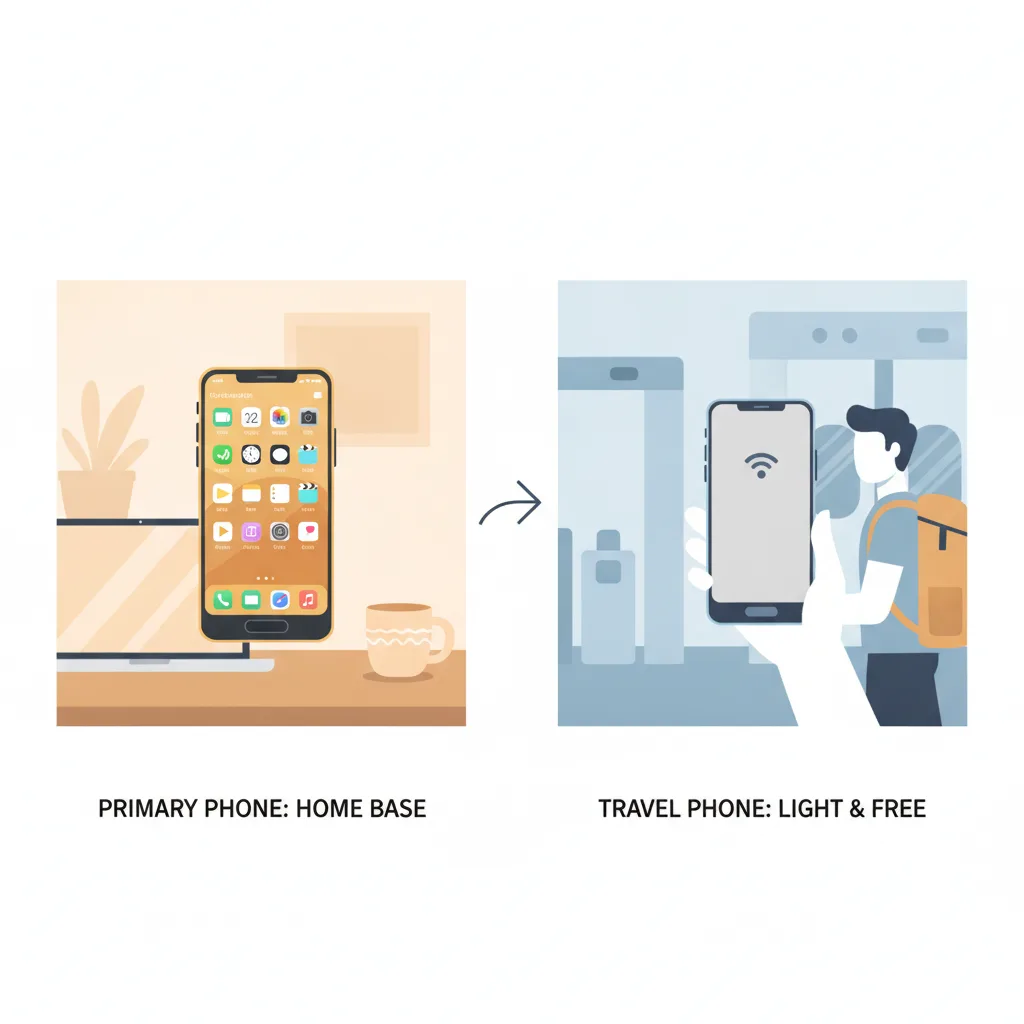
The "Travel Phone" Strategy
This is the most pragmatic approach I’ve seen adopted by security-conscious professionals, and it's one I'm now implementing myself.
- Dedicated "Burner" Device: Use a cheap, wiped phone for international travel. Load it only with essential apps, minimal data, and no sensitive accounts. This device should have nothing on it that could be used against you or compromise your work.
- Cloud-Based Access: Rely on secure web interfaces for email, communication, and work-related tasks while abroad. Access these via your burner phone, but don't sync data locally. Assume any network you connect to is compromised, and use a reputable VPN.
- Leave Sensitive Devices at Home: Your primary GrapheneOS phone, your laptop with development environments, your YubiKeys — these should stay securely stored at home or in a trusted location. The inconvenience is a small price to pay for genuine peace of mind.
This strategy acknowledges the reality that at certain borders, the legal landscape overrides technical defenses.
It's about shifting your threat model from "how do I protect this device?" to "what data am I willing to expose, and how do I minimize it?" In a world increasingly shaped by AI's ability to analyze and correlate every digital trace, this proactive data hygiene becomes paramount.
The GrapheneOS incident is a wake-up call, demonstrating that our digital battleground extends far beyond code and encryption.
It's now a legal and political one, increasingly influenced by the silent, powerful hand of AI-driven surveillance.
Have you re-evaluated your digital privacy strategy for travel, especially with the rise of AI in border control, or are you still relying solely on technical measures?
Let's discuss your approaches and concerns in the comments below.