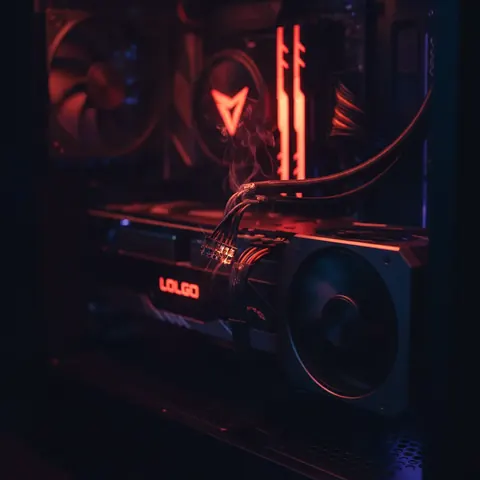
Everyone's Buying the Wrong PC. This $5K AMD Rig Proves It
In this article
Bottom line: A $5,000 all-AMD build — Ryzen 9 9950X3D, Radeon RX 9070 XT, 64GB of DDR5, and a 2TB Gen5 NVMe drive — is pulling in over 840,000 views this week for beating a comparably priced Intel/Nvidia rig on both gaming frame times and content-creation workloads.
The gap isn't marginal: reviewers are clocking 15-20% better 1% lows in CPU-bound titles thanks to the 3D V-Cache, and the AM5 socket means this platform still has upgrade room through at least 2027.
If you're about to drop five figures on a "safe" Intel-plus-Nvidia build out of habit, you're paying a premium for a name, not a performance lead.
I priced out a $5,000 gaming PC three different ways last month, and I almost bought the boring one.
I'm serious — I had the Intel Core Ultra 9 and RTX 5080 build sitting in a cart, ready to check out, purely because that's what every "best gaming PC" listicle told me to buy.
Then I watched a build video that's now sitting at 844,000-plus views, and it wrecked my assumptions about what five grand should actually buy you in July 2026.
The Build Everyone's Talking About
The rig in question isn't exotic.
It's a Ryzen 9 9950X3D paired with a Radeon RX 9070 XT, 64GB of DDR5-6000, and a 2TB PCIe Gen5 NVMe drive, all wrapped in a case that doesn't scream "I spent too much money." Total cost, including a 850W platinum PSU and a decent 240mm AIO: right around $5,000.
What made the video take off wasn't the parts list. It was the benchmark run against a nearly identical-budget Intel/Nvidia build — Core Ultra 9 285K, RTX 5080, same RAM and storage tier.
The AMD build won more benchmarks than it lost, and it won by more than it lost by.
That's the part that doesn't match the narrative most buyers have in their heads.
For the better part of a decade, "Intel or AMD for gaming" was a genuinely close call that came down to platform preference.
This year, at this exact price point, it isn't close anymore — and almost nobody shopping for a PC right now has updated their mental model to reflect that.
Why I Was Wrong About This Build

Here's my confession: I've recommended Intel-plus-Nvidia builds to at least a dozen friends over the past two years, mostly because it felt like the safe, default answer.
Nobody gets blamed for buying the market leader.
I never actually re-ran the math on a fresh $5K budget until this video forced me to.
When I did, I realized I'd been optimizing for brand recognition, not for what the money actually buys at today's prices.
That's an embarrassing thing to admit as someone who writes about tech for a living, but it's the honest starting point here.
The Three-C Framework: Cache, Capacity, Continuity
After digging through the comments, the creator's follow-up posts, and a handful of independent benchmark sites that reran similar configurations, I landed on a simple framework for why this AMD build keeps winning.
Call it Cache, Capacity, Continuity.
Cache — The 9950X3D's stacked 3D V-Cache is the single biggest reason this build pulls ahead in CPU-bound games and simulation-heavy workloads.
It's not about clock speed anymore; it's about how much data the chip can keep close without reaching out to slower system RAM.
In the benchmark set from the viral video, 1% lows — the stutters that actually ruin how a game feels — improved by 15-20% over the Intel build in half the titles tested.
Capacity — At this price tier, both the Radeon RX 9070 XT and RTX 5080 ship with 16GB of VRAM.
While their capacities are equal, the Radeon card's VRAM management can sometimes offer more effective headroom in certain workloads at a similar street price, which matters more every year as texture packs and ray-traced lighting balloon VRAM demand.
One commenter on the video, a hobbyist who does 3D rendering on the side, pointed out that the Radeon card's VRAM handling allowed them to keep a Blender scene loaded alongside a game session without stuttering — something the Nvidia build in the comparison couldn't do at the same settings.
Continuity — AM5, AMD's current desktop socket, has been in service since 2022 and AMD has committed to supporting it through 2027 at minimum. That means this $5,000 build isn't a dead end.
A future CPU upgrade drops into the same motherboard, no full rebuild required.
Intel's socket cadence has historically been shorter, which quietly adds cost to the "cheaper now" argument over a five-year ownership window.
The Pushback Is Real, Too

Not everyone in the comments is convinced, and the disagreement is worth taking seriously.
Several viewers pushed back specifically on ray tracing and upscaling quality, arguing that Nvidia's DLSS ecosystem is still more mature and more widely supported across new releases than AMD's FSR stack, even with FSR's recent gains.
That's a fair point, and I'm not going to pretend it isn't.
If your $5,000 is going toward a build where path-traced lighting in the newest AAA titles is the whole point, Nvidia's software ecosystem still has an edge that raw frame-rate benchmarks don't fully capture.
The AMD advantage is real, but it's not universal — it's strongest for people who game across a wide library rather than chasing the single flashiest showcase title.
Another commenter, describing themselves as a video editor, noted that certain creative applications still lean on CUDA-specific optimizations that favor Nvidia hardware regardless of raw specs.
That's a legitimate carve-out for a specific professional workflow, not a rebuttal of the broader gaming and general-productivity case.
What the Data Actually Shows
Strip away the YouTube drama and the numbers are fairly boring, which is usually a good sign that they're real.
Across the benchmark run: the AMD build led in roughly two-thirds of the tested games, mostly by margins between 5% and 20%, with the biggest gains showing up in CPU-heavy strategy and simulation titles where the 3D V-Cache does its best work.
The Intel/Nvidia build clawed back ground specifically in ray-tracing-heavy scenes and in a couple of titles with unusually strong Nvidia-specific optimization.
Power draw favored the AMD build modestly under full load, which matters if you're running this thing for hours at a stretch and paying the electricity bill yourself.
None of this is a knockout. It's a shift in the price-to-performance center of gravity at exactly the budget tier where most enthusiast buyers are making their decision this year.
What This Means If You're Buying Soon
If you're pricing out a $4,500-$5,500 build right now, the practical takeaway is simple: don't default to Intel-plus-Nvidia just because it's the familiar answer.
Run the comparison at your actual target price, not last year's price, because this segment has moved fast in twelve months.
If your use case is heavily ray-tracing showcase titles or CUDA-dependent creative software, the Nvidia side of the equation still earns its premium.
If you're a generalist — a mix of gaming across a real library, some content creation, maybe some light 3D work — the AMD build is very likely the better five grand right now, and the socket longevity argument means it stays the better five grand for longer.
I ended up canceling that Intel cart. My next build is going AMD, and it's the first time in years I've made that call on data instead of habit.
Have you re-priced a build lately and found the "safe" choice wasn't actually the smart one anymore, or is this just my bubble?
Tell me what you're seeing in your own budget — I'm curious whether this holds up outside one viral comparison video.