I Priced Out 2026's Fastest PC. The Number Broke Me.
In this article
Bottom line: A no-compromises gaming and AI-workstation build — RTX 5090, Ryzen 9 9950X3D, 64GB DDR5-8000, a 4TB PCIe Gen5 SSD — priced out at $7,412 in September 2026, up from roughly $4,100 for the same tier of build a year earlier.
The jump isn't GPU scalping this time.
It's memory: DRAM and NAND prices have spiked 80-150% since late 2025 because Samsung, SK Hynix, and Micron are redirecting fab capacity toward AI datacenter memory instead of consumer RAM and SSDs.
If you're planning a build or an upgrade, buy your memory and storage now — every forecast says Q4 2026 and Q1 2027 get worse before they get better.
I sat down last weekend to build a parts list for a YouTube video. Nothing fancy — "here's what the actual fastest PC costs in 2026," the kind of content that used to write itself.
I've done this exercise every year since 2019. I know roughly what it should cost.
I closed the tab, opened it again, and re-added every line item because I assumed I'd fat-fingered a quantity. I hadn't. A 64GB kit of DDR5-8000 that cost me $189 last September now lists for $460.
That single number is the whole story of this article, and I want to explain why it happened, who's actually affected, and what you should do about it if you're a developer, a gamer, or just someone whose laptop is finally dying.
The Build, Line by Line
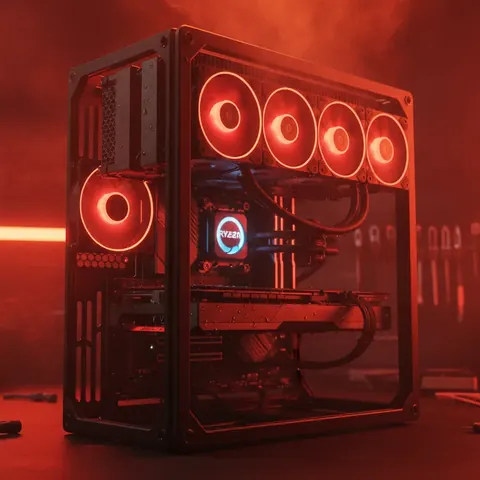
Here's what "fastest consumer PC" means in September 2026, and what each piece actually cost me when I ran the numbers:
- GPU: NVIDIA RTX 5090 — $2,799 (MSRP was $1,999 at launch)
- CPU: AMD Ryzen 9 9950X3D — $649
- Motherboard: X870E flagship board — $549
- RAM: 64GB DDR5-8000 CL30 — $460
- Storage: 4TB PCIe Gen5 NVMe — $610
- PSU: 1200W Titanium — $329
- Case + cooling: $415
- Everything else (fans, cables, a second drive for good measure): $601
Total: $7,412. For comparison, this same tier of parts list — same GPU generation, same CPU tier — ran about $4,100 in September 2025.
That's an 80% increase in twelve months on a machine that is not, in any meaningful sense, 80% faster.
The GPU markup is old news — it's been scalped, tariffed, and re-scalped since the RTX 40-series.
What surprised me, and what actually made me stop and write this instead of just filming the video, was the RAM and the SSD. Those used to be the boring, stable line items.
The ones you didn't think about.
Why Now: AI Ate the Memory Supply
Here's the mechanism, as best I can piece it together from supply chain reporting and conversations with people who actually buy chips for a living.
Samsung, SK Hynix, and Micron make DRAM and NAND flash.
For the last two years, an enormous and growing share of that output has gone toward HBM (high-bandwidth memory) for AI accelerators — the memory that sits next to GPUs in data centers training and serving models like ChatGPT 5 and Claude 4.6.
HBM isn't the same product as the DDR5 in your desktop, but it's made in the same fabs, competing for the same wafer allocation and the same packaging capacity.
When Microsoft, Google, Meta, and xAI are placing multi-year, multi-billion-dollar orders for HBM to build out AI clusters, the fabs prioritize that business.
Consumer DDR5 and NAND get whatever capacity is left over. Supply tightens, and prices follow.
I talked to a system integrator who runs a boutique PC-building shop outside Austin — the kind of place that builds ten workstations a week for local studios and small dev shops.
He told me his DDR5 supplier quotes have changed three times in the last four months, always upward, and that for the first time in his career he's telling customers to lock in a price the day he quotes it, because it might not hold by the time they pay the invoice.
"I used to worry about GPU allocation," he said. "Now I'm worried about RAM allocation. That's new. RAM was never the scarce part."
The Counter-Argument: This Might Be Temporary
Not everyone thinks this is a structural shift.
An analyst I spoke with who tracks DRAM contract pricing for a supply-chain research firm made the case that memory markets are historically cyclical — booms and busts every few years, driven by whoever overbuilds capacity first.
His argument: fabs are already announcing new DRAM lines specifically because current prices make expansion profitable again, and that new supply typically takes 18 to 24 months to come online and crash prices back down, sometimes overshooting into a glut.
That's a real pattern — it happened in 2018, and again in 2021. The complication this time is that AI demand for HBM doesn't look like a normal cyclical spike. It looks like a floor.
Datacenter operators have signed contracts running through 2028 and beyond, which means even when new fab capacity arrives, a much larger permanent share of it may be spoken for before it ever reaches a consumer RAM stick.
The analyst conceded that point without much pushback: "The AI demand isn't seasonal. It's structural until it isn't, and nobody knows when 'isn't' arrives."
That uncertainty is the whole problem for anyone trying to plan a purchase right now.
What the Data Actually Shows
Pull back from my one build and the picture holds up across the market.
Tom's Hardware and DigiTimes have both tracked DDR5 module pricing climbing in double-digit percentage jumps nearly every month since late 2025.
NAND flash — the chips inside every SSD — has followed a similar curve, driven by the same fabs reallocating output.
Laptop OEMs have started quietly trimming base RAM configurations or raising prices on mid-range models to absorb the cost. Prebuilt desktop makers are doing the same thing with SSD capacities.
None of this is speculative — it's showing up in retail listings you can check yourself right now on any major component retailer.
The one number that stuck with me: 64GB DDR5-8000 CL30 has now had four separate price increases since March 2026, and none of them have been small. This isn't a one-time correction.
It's a trend line, and trend lines like this don't reverse just because a build cost more than someone expected.
What This Means If You're Building or Upgrading
If you're a developer running local models, compiling large codebases, or just someone whose five-year-old machine is finally showing its age, here's the practical version of everything above:
- Buy RAM and SSDs now if you're going to need them in the next year. Waiting for a "correction" is a bet against a trend that's currently accelerating, not one that's flattening.
- Don't assume last year's price list is close to accurate. If you're budgeting a build off a video or article from six months ago, add 25-40% to the memory and storage lines specifically.
- Consider buying slightly less RAM than you want, not more. Capacity above what you'll actually use is where the price curve gets steepest — 32GB kits have risen far less sharply than 64GB and 96GB kits, because manufacturers are prioritizing high-margin, high-capacity SKUs for datacenter customers.
- If you're building for AI/local inference work, budget separately and generously for memory — it's now a bigger swing factor in total build cost than the GPU choice, which used to be unthinkable.
I ended up not building the machine.
I'm going to sit on the parts list for another month and see if the Ryzen 11000-series launch, whenever it lands, creates enough of a price war on the CPU and motherboard side to offset some of the memory pain.
It probably won't. But $7,412 is a number I need to sit with before I commit it to a video, let alone a shopping cart.
Has your own upgrade budget quietly doubled without you noticing why? Or have you already found a workaround that's actually keeping your build costs sane this year?