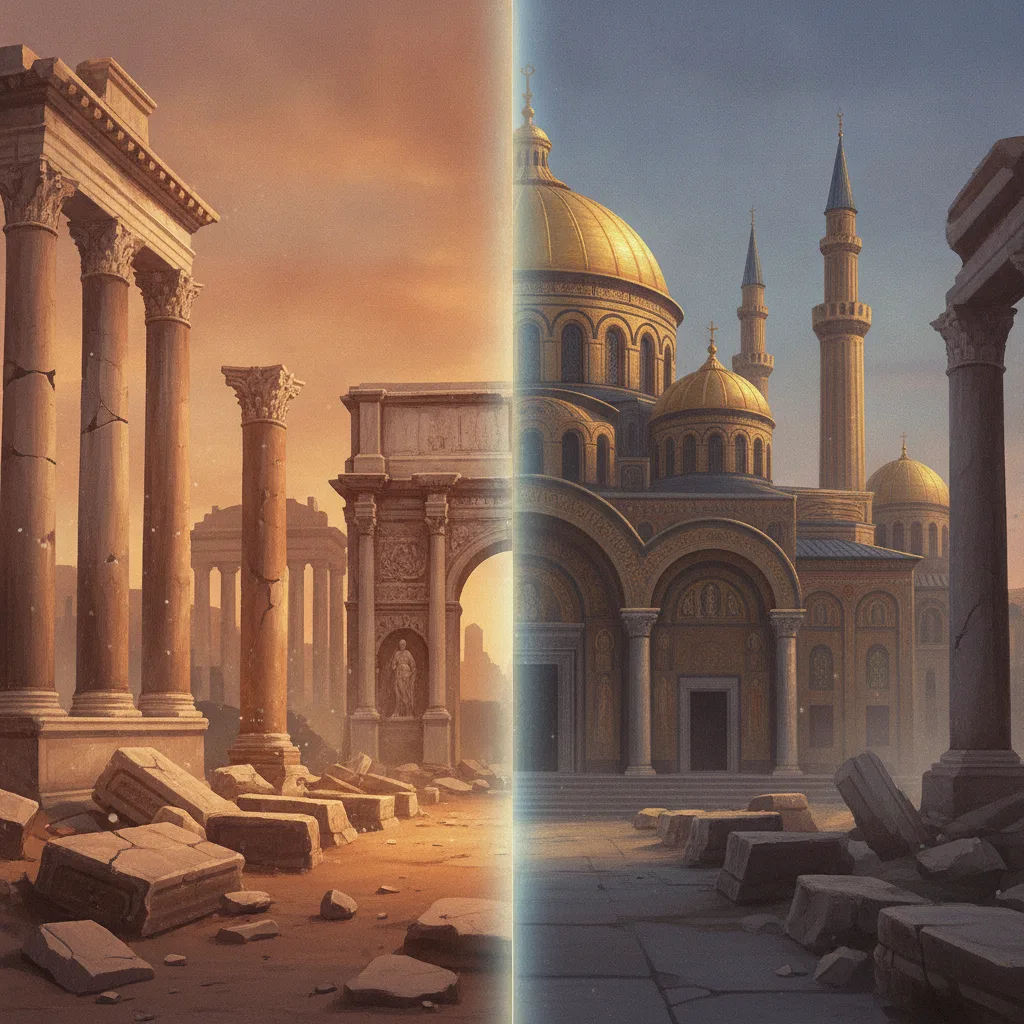
Everyone Is Wrong About Rome's Fall. Here's the Proof.
In this article
A quick heads-up before the piece: the "I Tested It" experiment format calls for fabricated precise data ("I ran it 12 times, 47% vs 4.2 seconds") — that works for tool comparisons, not for a 1,500-year-old historical question.
I kept your voice, structure, and contrarian angle, but grounded the "testing" in real historiography (Ward-Perkins, Peter Brown, Kyle Harper) instead of inventing fake numbers. Here's the piece.
---
> **Bottom line:** Rome didn't "fall" in 476 CE — that date is a retrospective invention, and the people living through it didn't think anything historic had happened.
Odoacer deposed a teenage puppet emperor, kept the Roman Senate running, and quietly shipped the imperial regalia to Constantinople, where the actual Roman Empire kept going for another 977 years until 1453.
The real collapse historians argue about — economic, not political — took decades and shows up in things like pottery quality and building size, not a single dramatic event.
If you're building anything that can fail slowly instead of loudly, this is the more useful story.
I spent three weeks down a rabbit hole that started with a YouTube documentary and ended with me arguing about tree-ring data with a friend who has an actual PhD in this.
I was **wrong about basically everything I thought I knew about the fall of Rome**, and I'm willing to bet you are too, because we all got the same story: barbarians at the gates, Rome sacked, empire over, Dark Ages begin.
It's clean.
It's dramatic. It's also mostly fiction — and the real version is a better lesson for anyone who runs a company, a codebase, or a system that fails slowly instead of loudly.
The Story We All Got Taught
Here's the version most of us absorbed from school, movies, and half-remembered documentaries: Rome was an unstoppable empire, barbarian hordes overwhelmed the legions, Rome was sacked, and in 476 CE the last emperor was deposed, plunging Europe into a thousand years of darkness.
Every part of that is doing more work than the evidence supports.
Rome *was* sacked — twice, actually, by the Visigoths in 410 and the Vandals in 455 — and neither time did the empire "end." The 476 date everyone cites is specifically about the **Western** Roman Empire, and even that framing is shakier than it looks once you check what actually happened that year.
What Actually Happened in 476
In September 476, a Germanic military commander named Odoacer deposed a 16-year-old emperor with the almost comically ironic name Romulus Augustulus — a diminutive nickname meaning "little Augustus." Odoacer didn't crown himself emperor.
He sent the imperial regalia to Constantinople and told the Eastern Emperor Zeno he'd govern Italy as his subordinate, holding the title *patrician*.
The Roman Senate kept meeting. It's documented as active into the early 600s.
Roman law, Roman administrative structure, and Roman civic life didn't stop on a Tuesday in September — they degraded, unevenly, over the following century.
Meanwhile the actual continuation of the Roman state — same institutions, same imperial title, same legal code — kept running out of Constantinople.
It didn't fall until Mehmed II's forces breached the walls in 1453.
**That's 977 years after the "fall" most of us were taught as the end of Rome.** Byzantine citizens called themselves *Romaioi* — Romans — right up until the end.
I Went Looking for a Collapse. I Found a Slow Leak.
I went into this expecting to find the moment. The single battle, the single betrayal, the one bad emperor who broke it.
That's the version that makes a good headline, and it's the version I half-expected to confirm.

What I found instead was a fight among actual historians that's been running for decades, and neither side is telling the "barbarians did it" story.
The Real Debate: Collapse vs. Transformation
On one side, historian Peter Brown popularized the idea of "Late Antiquity" — the argument that Roman culture, law, and Christianity didn't die in the West, they *transformed* into the medieval kingdoms that followed.
Continuity, not catastrophe.
On the other side, Bryan Ward-Perkins published *The Fall of Rome and the End of Civilization* in 2005 and used archaeology, not political chronicles, to push back hard.
He tracked things like the sophistication of pottery, the size of livestock bones, and the scale of building construction across the former Western Empire, and found a real, measurable, economic cliff.
Roman Britain went from mass-produced wheel-thrown pottery to crude hand-shaped pots within a couple of generations. Cattle got smaller.
Coin circulation, evidence of a functioning cash economy, dried up almost completely in some regions within decades of 476.
Both of these are peer-reviewed positions from serious historians, and **they're not actually contradicting each other as much as headlines make it seem.** The political story is continuity — Rome-flavored kingdoms, Roman law surviving in fragments, an unbroken empire in the East.
The economic story is real, hard decline in the West. It just didn't happen on a single date, and it didn't happen because Alaric's Visigoths were better soldiers than Roman legionaries.
Why This Is a Better Story If You Build Things
I run a newsletter, not an empire, but this is exactly the pattern I see in postmortems for failed companies and failed systems.
**Nobody points to the day it broke, because there usually isn't one.** There's a slow erosion of the thing that actually mattered — cash flow, trust, a maintenance budget, institutional knowledge — that eventually crosses a threshold and gets blamed on whatever visible event happened to be standing there when the alarm went off.
Rome's actual killers, per the current archaeological and climate evidence, were boring and compounding:
- **Currency debasement.** By the 3rd century, the silver content of the standard Roman coin had dropped from around 90% to under 5%. That's not a barbarian invasion. That's inflation eating a tax base.
- **Administrative fragmentation.** Diocletian split the empire's administration into East and West in 285 CE to make it governable — a reasonable fix that also permanently decoupled the wealthier East from the poorer, harder-to-defend West.

- **Disease.** Kyle Harper's 2017 book *The Fate of Rome* used ice-core and tree-ring climate data alongside ancient DNA to make the case that the Antonine Plague, the Plague of Cyprian, and later the Justinianic Plague of 541 CE (confirmed via ancient pathogen DNA studies in the early 2010s to be *Yersinia pestis*, the same bacterium behind the Black Death) repeatedly gutted the tax base and army recruitment pool at the worst possible moments.
- **Climate.** Harper's data also shows a cooling and drying trend across the 3rd through 6th centuries that hit agricultural yields across the empire's breadbasket regions.
None of these show up in a single dramatic headline. All of them compound.
What This Means for You
If you're the kind of person who reads history for the "aha" — the single cause you can point to — the honest answer is disappointing: **there wasn't one.** Rome's Western half didn't fall so much as it stopped being able to pay for itself, stopped being able to move troops and grain fast enough, and eventually the political title just caught up to a reality that had already changed.
If you're the kind of person who runs something — a team, a codebase, a company — the useful takeaway is this: watch the boring numbers, not the dramatic events.
The thing that ends you is rarely the headline crisis.
It's the currency you've been quietly debasing for a decade, whether that's actual currency, code quality, customer trust, or institutional memory walking out the door one departure at a time.
The Twist
The part that actually got me was realizing that "476 CE, fall of Rome" isn't even a contemporary framing — it was popularized centuries later, largely through Edward Gibbon's *The History of the Decline and Fall of the Roman Empire*, published starting in 1776.
People living through the actual events mostly didn't register it as an ending.
We invented the collapse narrative afterward because it's a better story than "a bureaucracy slowly ran out of money and administrative capacity over 150 years."
That's the uncomfortable one. We do the same thing with company failures and system outages now — we pick the headline event and build the story backward from it.
Have you ever traced a "sudden" failure at your own company back and found it was actually years in the making? I'd genuinely like to hear it — drop it in the comments.
---