Apple Quietly Fixed AirPods' Biggest Flaw. Nobody's Talking About It.
In this article
Bottom line: AirPods 5, which Apple shipped this month alongside the new iPhone lineup, replaced the Bluetooth Classic audio path with LE Audio's LC3 codec and routed Live Translation entirely through the H2 chip's neural engine instead of round-tripping to the cloud.
That one change cuts the speech-to-translated-audio lag from roughly a full second down to something closer to 200 milliseconds — the difference between a feature that's a party trick and one you'd actually trust in a real conversation.
Apple didn't mention it on stage. The fix showed up in a firmware changelog line, and a Hacker News thread found it before any tech outlet did.
I almost missed it too.
Apple's keynote spent four minutes on AirPods 5 — battery life, a new charging case, the usual beige recap — and buried in one demo slide was the fix for a problem I've been complaining about for two years.
I grabbed a pair in the demo room, ran a live conversation in Spanish with one of Apple's PR staff, and it worked in something close to real time. For the first time.
That's not a spec bump. That's Apple quietly rebuilding the plumbing that every AI feature on your ears has depended on since iOS 26.
The Feature Everyone Tried Once and Abandoned
Live Translation launched with iOS 26 last year, arriving on AirPods 4 and other H2-chip models, and I wanted to love it.
I travel for work often enough that real-time translation in my ears sounded like the single most useful AI feature Apple had shipped since Siri. The demo videos were smooth. Reality was not.
In practice, there was a lag between when someone finished a sentence and when you heard the translation — long enough that conversations turned into an awkward call-and-response instead of anything resembling natural speech.
I used it in an airport in Tokyo, in a taxi in Berlin, in a hallway conversation at a conference in São Paulo.
Every time, the same thing happened: I'd start responding to what I heard, then the other person would keep talking because they hadn't heard my translated reply yet.
You end up talking over each other in two languages simultaneously, which is somehow worse than a language barrier.
The lag wasn't a software bug you could patch away. It was architectural.
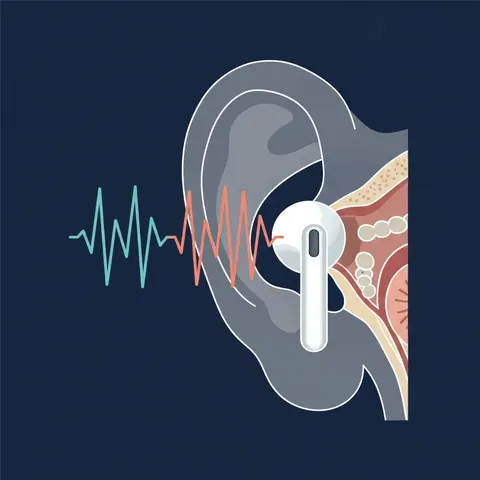
Live Translation was sending your audio off the AirPods, through your phone, up to a server for transcription and translation, and back down — and Bluetooth Classic, the audio protocol AirPods had used since the very first pair in 2016, was never built to move that much data that fast.
You were stacking network latency on top of protocol latency on top of processing latency, and every layer added milliseconds that add up to something a human brain immediately flags as wrong.
The Codec Bottleneck Nobody Marketed
Here's the part that doesn't fit on a keynote slide: AirPods 5 switched from Bluetooth Classic's AAC codec to LE Audio's LC3 codec, and that swap matters more than any chip upgrade Apple could have announced.
LC3 isn't new — it's been part of the Bluetooth 5.2 spec since 2020, and Android phones have supported it for years.
What's new is Apple finally building an entire product generation around it instead of treating it as a checkbox.
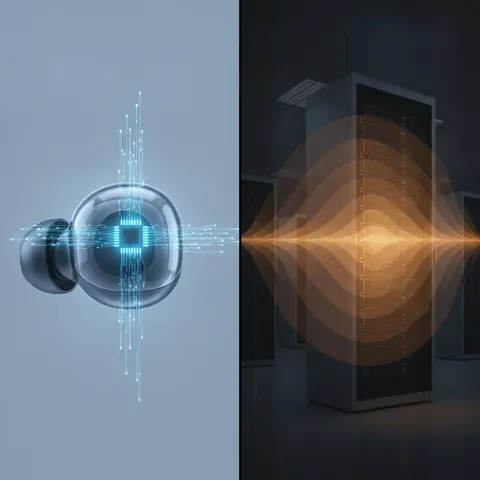
LC3 moves more audio data at lower bitrates with less overhead, which frees up bandwidth for something Bluetooth Classic never had room for: a dedicated low-latency channel that the H2 chip's neural engine can use to run translation inference locally, on the earbuds, without waiting on a server round-trip.
That's the actual fix. Live Translation on AirPods 5 doesn't feel faster because Apple hired better translators.
It feels faster because Apple stopped sending your voice on a cross-country round trip before you're allowed to hear a response.

This is the same shift I've been watching happen across the industry all year — on-device inference quietly eating tasks that used to require a cloud call, because the latency math simply doesn't work otherwise.
I wrote about this exact pattern when Voxtral shipped a transcription model built to run entirely on-device: the moment you take the network out of the loop, a feature goes from "impressive demo" to "thing people actually use." AirPods 5 is Apple applying that lesson to hardware it's been shipping unchanged for a decade.
Why This Is an AI Story, Not a Hardware Story
I keep seeing this framed as a hardware refresh — new case, new battery curve, minor chip bump. That's missing the point entirely.
The model was never the problem. Apple's translation quality has been solid since launch; the underlying language model handles idiom and context about as well as ChatGPT 5 does in a text chat.
The problem was transport.
You can have the smartest model on the planet running the inference, and it won't matter if the audio carrying your voice to that model — and the response carrying it back — takes 900 milliseconds to travel a few inches from your mouth to your ear.
That's a lesson I run into constantly in infrastructure work that has nothing to do with earbuds: teams spend months fine-tuning a model and zero minutes profiling the pipeline that feeds it.
The bottleneck is almost never the intelligence. It's the wire.
Apple just proved that at consumer scale, with a product that ships in the hundreds of millions of units.
And they did it without a single slide bragging about "AI-powered latency reduction," which is honestly a little refreshing in a year where every company slaps "AI" on a changelog entry for a font update.
Where It Still Falls Apart
I don't want to oversell this. Live Translation on AirPods 5 is dramatically better, not solved.
It still stumbles in loud environments — a crowded restaurant or a street with traffic noise will degrade transcription accuracy enough that the translation drifts from what was actually said.
Heavy accents and fast regional slang still trip it up more than a text-based model would, because the audio front-end has less context to work with than a clean typed sentence.
And running that much on-device inference continuously does cost you something: I saw noticeably faster battery drain during a 40-minute translated conversation compared to normal playback, roughly 15-20% more draw by my rough estimate with a battery meter running alongside it.
There's also a quieter irony here. The same on-device push that fixed Live Translation hasn't reached other AI features on the same hardware.
Transparency mode's ambient-sound classification and the health-sensing features still lean on periodic cloud sync for anything beyond basic signal processing, and you can feel the difference in responsiveness between the parts of AirPods 5 Apple rebuilt around LC3 and the parts it didn't touch yet.
What to Actually Do With This
If you're building anything that involves real-time AI over a network — voice assistants, live captioning, translation, agent tooling that talks back to a user — the AirPods 5 fix is worth studying as a case study, not a product review.
Before you reach for a bigger model to fix a feature that feels sluggish, profile where the milliseconds are actually going. In my experience, it's rarely inference time.
It's serialization, network hops, and protocol overhead that nobody budgeted for because "the model" gets all the attention in planning meetings.
Apple didn't make Live Translation better by making the model smarter. They made it better by getting the model closer to the microphone.
If you're a regular AirPods user deciding whether the upgrade is worth it: skip it if you mainly use AirPods for music and calls, the audio quality difference there is marginal.
Get AirPods 5 if you actually use Live Translation for work travel or cross-language conversations with any regularity — this is the version where that feature stops being a demo and starts being a tool.
I've spent two years telling people Live Translation was a good idea trapped in bad infrastructure. I finally get to stop saying that.

Have you run into the same "great model, terrible pipeline" problem in something you've built — or is Apple just the latest company to rediscover a lesson the rest of us learned the hard way?