Why your local LLM feels dumber than it is
Bottom line: Your local LLM isn't inherently "dumber" than its API counterpart; it's likely handicapped by the environment you're running it in.
Key factors like aggressive quantization for memory, suboptimal inference engines, and a failure to implement robust RAG pipelines prevent these powerful models from performing optimally.
If you're struggling to get real intelligence from Llama 3 or Mistral on your hardware, the problem often lies in your setup, not the model's foundational capabilities.
Understanding these technical trade-offs is crucial for unlocking their true potential.
I thought I was going crazy.
After spending thousands building out a local inference rig in my home lab — dual RTX 4090s, 128GB of RAM, all the bells and whistles — I fired up Llama 3 70B, then Mistral 8x22B, expecting a revelation.
Instead, what I got felt like a slightly more verbose version of an early GPT-3.5.
The nuanced understanding, the coherent long-form reasoning I'd come to expect from ChatGPT 5 or Claude 4.6? It just wasn't there.
For nearly three months, I spiraled, convinced I'd wasted my time and money on local LLMs, only to discover that the "dumbness" wasn't in the models themselves, but in my naive approach to running them.
When the open-source LLM revolution kicked off, it felt like a seismic shift. Suddenly, we weren't beholden to API costs, rate limits, or the black box nature of proprietary models.
The promise was immense: run powerful AI on your own hardware, maintain full data privacy, and tweak models to your heart's content.

Infrastructure engineers like me, who thrive on control and transparency, were naturally drawn in.
I pictured a future where I could spin up a custom-trained Llama 3 instance to debug a complex Kubernetes cluster, feeding it internal logs without a second thought about data exfiltration.
The reality, for many of us, has been a rude awakening.
We download a quantized version of a state-of-the-art model, fire it up with `ollama` or `llama.cpp`, and then wonder why it struggles with tasks that Gemini 2.5 breezes through.
We blame the models, or the open-source community, or even our hardware.
But after diving deep into the trenches of local inference over the last year and a half, I've realized we're often comparing apples to oranges, or more accurately, a raw apple to a perfectly blended, chilled, and sweetened apple juice from a commercial factory.
The "dumbness" isn't an inherent flaw; it's a symptom of engineering compromises we make (often unknowingly) to fit these behemoths onto consumer-grade hardware.
The Quantization Conundrum: Trading Precision for Portability
The first, and arguably most significant, reason your local LLM feels dumber is quantization.
When you download a model like `Llama 3 70B Q4_K_M`, you’re not getting the full, 16-bit floating-point (FP16) model that was originally trained.
You’re getting a version where the model’s weights and activations have been reduced in precision, often down to 4-bit integers.
This is a technical marvel — it allows a 70-billion parameter model that would normally require 140GB of VRAM to fit into a GPU with 24GB or 48GB.
The trade-off, however, is performance. Every bit you shave off precision introduces a subtle loss of information.
While 4-bit quantization can be incredibly efficient and surprisingly effective, it's not without cost.
Imagine trying to paint a detailed portrait with only four colors instead of 16 million. You can still get the gist, but the nuances, the subtle shading, and the fine details are lost.
Similarly, the model's ability to grasp complex logical relationships, recall obscure facts, or maintain long-form coherence can degrade.
It’s a necessary compromise for local deployment, but one that directly impacts perceived intelligence. You’re effectively running a slightly dumber version of the original model to make it fit.
Inference Engines: The Unsung Heroes (or Villains) of Local LLMs
Beyond quantization, the inference engine you use plays a critical, often overlooked, role.
Tools like `ollama`, `llama.cpp`, `vLLM`, and `MLC LLM` are not just model loaders; they are sophisticated runtime environments that handle everything from loading weights to managing the attention mechanism and KV cache.
Each engine has its own optimizations, hardware acceleration capabilities, and default settings.
A poorly configured `llama.cpp` build or an `ollama` setup that isn't fully leveraging your GPU can dramatically impact not just speed, but also the quality of the output.
Some engines might default to less efficient sampling methods, or their KV cache management might be less sophisticated than what a high-performance API endpoint uses.
For instance, `vLLM` excels at throughput for multiple concurrent requests, but if you're only running a single prompt, its advantages might not be immediately obvious, and other engines might offer different latency profiles that could impact the perceived responsiveness and quality for an interactive user.
The choice of engine, and how it’s configured, can be the difference between a sluggish, incoherent bot and a surprisingly capable local assistant.
The Missing Context: Why Your RAG Pipeline Matters More Locally
Here's a hard truth: when you query ChatGPT 5 or Claude 4.6, you're not just sending a prompt to a raw model.
You're often interacting with a sophisticated Retrieval Augmented Generation (RAG) pipeline.
This means before the LLM even sees your prompt, an upstream system has likely searched vast databases, internal documentation, or the entire internet for relevant information, and then injected that context directly into the model's input.
This allows the model to "know" things it wasn't explicitly trained on, or to provide highly specific, up-to-date answers.
When you run a local LLM, you're usually just feeding it your prompt directly. There's no invisible army of context providers enriching its input.
So, when your local Llama 3 struggles to answer a question about a recent tech trend or a specific detail from your company's internal wiki, it's not because Llama 3 is dumb.
It's because it doesn't have the context that the API model would have been fed. We expect the local model to perform like a fully integrated system, but we're only giving it one piece of the puzzle.
Building an effective RAG pipeline for your local LLM, connecting it to your data sources, is paramount for it to match the perceived intelligence of its cloud-hosted cousins.
Hardware Limitations: The Unspoken Bottleneck
Finally, let's talk about hardware. While my home lab setup is decent, it’s not a data center.
Most local LLM users are running these models on consumer GPUs (if they’re lucky), or even just on their CPU.
Even the best quantization won't fully overcome the limitations of insufficient VRAM, slow memory bandwidth, or a CPU that's not designed for high-parallel inference.
When a model struggles to keep its entire context window in VRAM, it might have to swap data to slower system RAM, drastically increasing latency and potentially fragmenting its internal state.
A model that's constantly context-swapping or waiting for data is effectively a model operating at a fraction of its potential.
This isn't about the model's inherent intelligence, but its ability to process information efficiently.
It's like having a brilliant mind but being forced to think through molasses.
By mid-2027, as models continue to grow, these hardware constraints will only become more pronounced for those without dedicated inference accelerators.
The Reality Check: It’s Not a Fair Fight
The core issue is that we're often comparing a highly optimized, production-grade AI system (the API endpoint) with a raw, often resource-constrained, local deployment. The API models benefit from:
- Massive, high-precision training: The original FP16 or BF16 models are what truly represent the cutting edge.
- Sophisticated inference infrastructure: Custom-built hardware, optimized software stacks, and massive parallelism.
- Advanced RAG and prompt engineering: Layers of intelligence augmenting the base model.
- Continuous fine-tuning: Models are often subtly updated and fine-tuned for specific tasks based on user feedback.
Your local LLM, while based on the same foundational architecture, is typically running a quantized version, on less optimal hardware, with a generic inference engine, and often without any RAG.
It's like asking a Formula 1 driver to win a race in a go-kart with a slightly deflated tire. The driver is still world-class, but the vehicle is holding them back.
The local LLM isn't dumb; it's simply underequipped for the expectations we place on it, especially when comparing it to a fully weaponized cloud service.
The Practical Takeaway: How to Unleash Your Local LLM’s Inner Genius
So, how do you get your local LLM to live up to its potential?
It requires a shift in mindset: treat it like a powerful, raw engine that needs careful tuning and supporting infrastructure, not a plug-and-play solution.
#### 1. Experiment with Quantization Levels
Don't just grab the smallest quantized model. If your hardware allows, try stepping up. If you're running a Q4_K_M, try a Q5_K_M or even a Q8_0 if you have the VRAM.
You might be surprised how much perceived intelligence returns with a slight increase in precision. Benchmark specific tasks to see where the sweet spot is for your hardware and use case.
#### 2. Choose and Optimize Your Inference Engine Wisely
Don't settle for the default. Research which inference engine is best suited for your hardware (NVIDIA, AMD, Apple Silicon) and your specific use case (single-user interactive, batch processing, etc.).
Learn its configuration options.
Ensure you're leveraging all available hardware acceleration, like ROCm for AMD or TensorRT for NVIDIA. A properly configured `llama.cpp` can be incredibly fast and accurate.
#### 3. Build a Robust RAG Pipeline
This is where the real magic happens. Connect your local LLM to your data.
Tools like `LlamaIndex` or `LangChain` can help you build local RAG pipelines that index your documents, retrieve relevant chunks, and inject them into the LLM's prompt.
This transforms your local model from a general knowledge base into an expert on your specific information. This is particularly crucial for enterprise use cases where data privacy is paramount.
#### 4. Leverage the Full Context Window
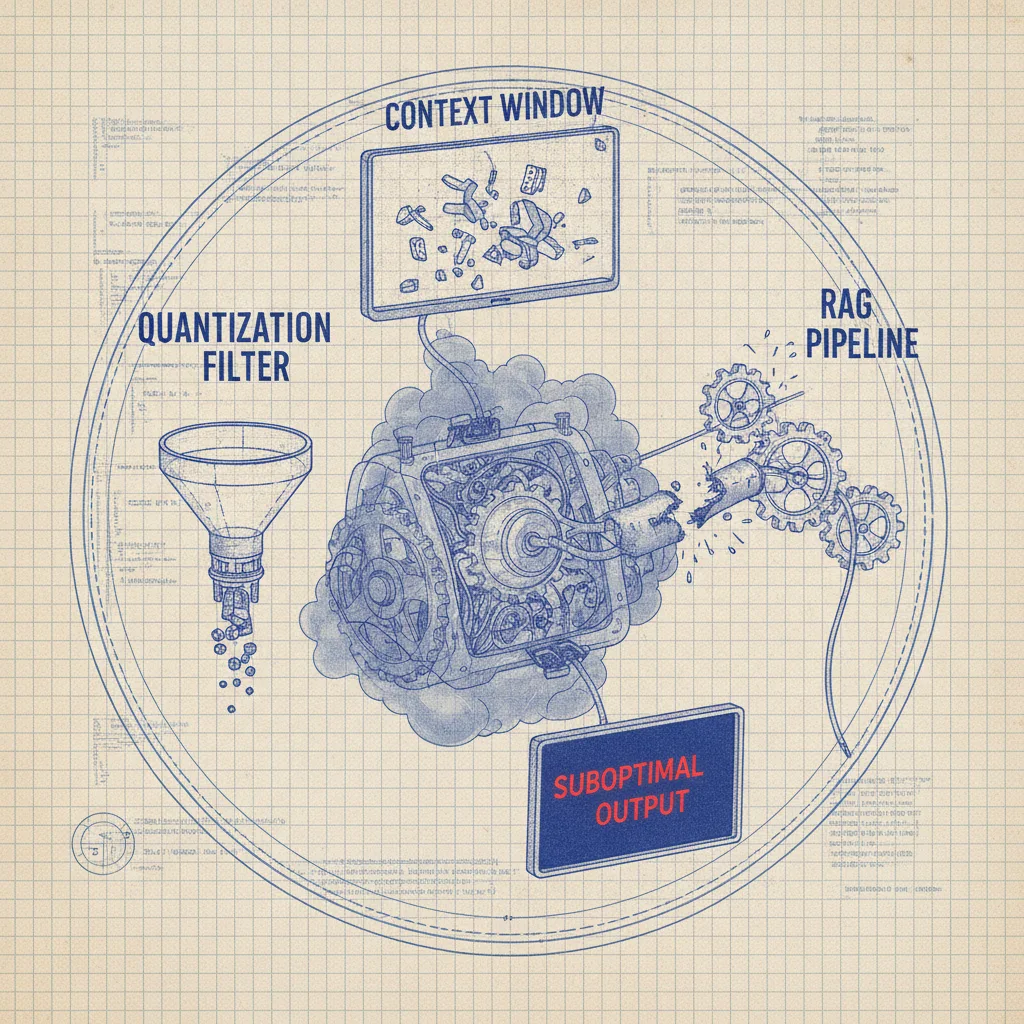
Many open-source models now boast massive context windows (e.g., 128K, 256K tokens). Don't waste them. Maximize the information you feed into the prompt, especially when using RAG.
The more relevant context the model has, the better its reasoning and recall will be. Don't be afraid to push the limits of your hardware here; a larger context often means a smarter response.
#### 5. Consider Local Fine-tuning
For specific, repetitive tasks, even a small, locally-run fine-tune can dramatically improve performance over a general-purpose model.
Techniques like LoRA (Low-Rank Adaptation) allow you to adapt a model to your data with relatively little computational overhead.
This is where the true power of open-source shines: creating highly specialized agents on your own terms.
Your local LLM isn't dumb. It's just waiting for you, the engineer, to give it the optimized environment and the rich context it needs to shine.
The control and privacy benefits are immense, but they come with the responsibility of building the right infrastructure around them.
Have you found your local LLM experience frustrating, or have you cracked the code for getting real intelligence out of your self-hosted models?
What's your secret sauce for bridging the gap between local power and perceived prowess?