Why Building AI Data Centres Isn’t Working Anymore
Bottom line: The hyper-scale AI data center model, which dominated infrastructure planning from 2024 to early 2026, is hitting a wall.
Massive power requirements, acute cooling challenges, and increasingly complex supply chains for specialized hardware are driving costs beyond sustainable ROI, leading to project delays and diminishing returns for compute-intensive AI workloads.
Companies are realizing that simply throwing more GPUs into ever-larger facilities isn't a viable long-term strategy for scaling AI.
I thought scaling AI compute was just about throwing more GPUs at the problem. I was wrong.
For years, as an infrastructure engineer, my career revolved around making systems bigger, faster, and more resilient.
When the generative AI boom hit in 2023, the directive was clear: build more data centers, cram in more silicon.
But what I’ve witnessed over the last 18 months, working on some of the largest AI infrastructure projects, has exposed a fundamental flaw in that strategy.
It's becoming clear that the very approach we've taken to build the backbone of modern AI is unsustainable, uneconomical, and in some cases, physically impossible to scale further.
Back in 2024 and 2025, the narrative was simple: AI needs compute, so we build bigger facilities, fill them with NVIDIA's latest, and watch the magic happen.
Every major cloud provider, every tech titan, was pouring billions into constructing sprawling "AI factories." We were designing new power substations, negotiating for massive land parcels, and pre-ordering specialized liquid cooling systems years in advance.
The goal was always to achieve economies of scale, to centralize intelligence, and to offer AI-as-a-service at unprecedented levels.
I was part of the teams architecting these behemoths, convinced that with enough engineering prowess and capital, we could overcome any hurdle.
We built some truly impressive systems that pushed the boundaries of traditional data center design.
But the real-world constraints started to bite hard by late 2025. The promises of infinite compute, delivered instantly, began to look more like a mirage.
We were running into bottlenecks that weren't just about software optimization or network latency.
These were fundamental, physical limitations that no amount of clever code or financial muscle could simply wish away.
The Unseen Bottlenecks
The problem isn't a lack of ambition; it's a collision with the laws of physics and economics.
We've pushed the density of compute so high that the supporting infrastructure has become the primary constraint.
Power: The Silent Killer
A modern AI cluster is a power-hungry beast. We're not talking about server racks drawing a few kilowatts anymore.
A single rack of high-density AI accelerators, packed with components like NVIDIA's Blackwell B200s or AMD's Instinct MI300X, can easily pull 100-150 kilowatts.
To put that in perspective, that's roughly the power consumption of 100 average American homes, all concentrated in a single, small footprint.
Now multiply that by hundreds or thousands of racks in a single AI data center. A 100-megawatt AI facility, which was considered large a year ago, is now becoming standard.
These facilities demand as much power as a small city.
Utility grids, already strained by population growth and the transition to renewables, simply aren't designed for this kind of sudden, concentrated demand.
We're seeing multi-year delays in securing grid connections, with utilities demanding billions in upgrades to their transmission infrastructure before they can even consider supplying new AI sites.
Even when the power is available, the cost of electricity is skyrocketing, eroding the profit margins of running these massive compute farms.
Cooling: A Battle Against Physics
Where there's power, there's heat. And AI accelerators generate an astonishing amount of it. Air cooling, the stalwart of traditional data centers, is effectively obsolete for high-density AI racks.
The thermal loads are just too high.
We've fully transitioned to liquid cooling — direct-to-chip or immersion cooling — which is more efficient but introduces an entirely new layer of complexity and potential failure points.
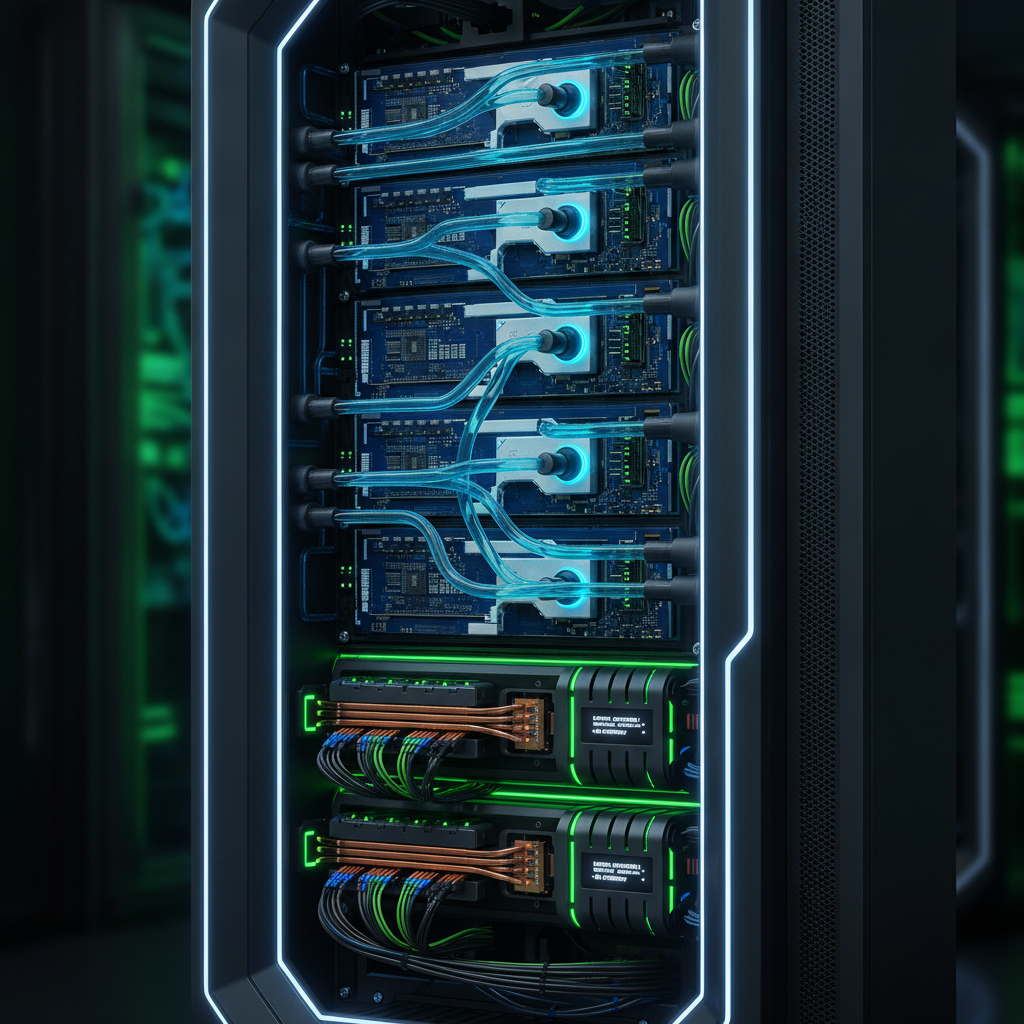
Imagine miles of specialized plumbing, pumps, heat exchangers, and massive cooling towers.
These systems require vast quantities of water, which is becoming a major environmental and political issue in many regions, especially in the Western US and parts of Europe.
Even with closed-loop systems, evaporation and maintenance demand constant replenishment.
We're literally fighting a battle against entropy, trying to dissipate megawatts of heat into the atmosphere, often in environments that are already experiencing record-breaking temperatures.
This isn't just an engineering challenge; it's a geographical and resource allocation nightmare.
Supply Chain & Specialization
It's not just about getting enough GPUs, though that's still a significant hurdle with lead times stretching into 2027 for the most cutting-edge silicon.
The specialized infrastructure required to support these GPUs is equally problematic.
We need custom-designed power delivery units, high-bandwidth interconnects like InfiniBand or NVLink at scale, and network fabrics capable of handling terabits per second of data traffic between accelerators.
These aren't off-the-shelf components. They come from a limited number of vendors, often with proprietary interfaces and long manufacturing cycles.
Any hiccup in the global supply chain — a factory delay, a geopolitical event, a natural disaster — can bring an entire data center build to a grinding halt.
We're building incredibly complex, specialized machines at a scale that the existing industrial ecosystem was never meant to support.
The level of integration required means that a failure in one niche component can cripple an entire system, leading to unexpected outages and maintenance nightmares.
The Cost Curve That Broke
The economics of these mega-data centers are also starting to unravel.
The initial CAPEX to build a single 100MW AI facility can easily run into the billions of dollars, even before you factor in the cost of the GPUs themselves.
Then there's the OPEX: the exorbitant electricity bills, the maintenance of complex cooling systems, the highly specialized engineering talent required to run them.
What we're seeing is a diminishing return on investment.
While the first few generations of AI models showed dramatic improvements with more compute, the gains for subsequent generations are becoming less pronounced relative to the exponential increase in infrastructure cost.
Training the next frontier model on ChatGPT 5 or Gemini 2.5 might require an order of magnitude more compute than its predecessor, but the performance uplift isn't always linear.
Companies are questioning whether the enormous investment in these centralized, monolithic compute farms is actually delivering the economic value they initially promised.
The Illusion of Infinite Compute
The cloud providers, for their part, have done an excellent job of abstracting away these physical realities.
From a developer's perspective, spinning up a cluster of H100s or B200s on AWS or Azure feels instant and limitless.
But beneath that polished API lies a sprawling, physically constrained infrastructure.
The promise of "infinite compute" is an illusion, sustained by massive capital expenditure and the hope that the physical limits won't catch up too quickly.
This illusion is cracking. We're seeing major cloud customers being put on waiting lists for large-scale AI compute, or being forced to compromise on hardware generations.
The environmental impact is also becoming undeniable.
The sheer energy and water consumption of these facilities are drawing increasing scrutiny from regulators and the public.
Building a new AI data center in a water-stressed region, or one reliant on fossil fuels, is becoming a PR and political liability.
This isn't just about efficiency anymore; it's about ethical responsibility and long-term sustainability.
Companies that committed to the "build it and they will train" philosophy are now facing delays, cost overruns, and the stark reality that their compute capacity might not be as elastic or readily available as they'd hoped.
My team recently worked on a project where a planned expansion for a new AI research cluster was pushed back 18 months due to grid capacity issues.
That's 18 months of lost competitive advantage, all because of an unseen bottleneck in the power supply.
Rethinking AI Infrastructure
So, if simply building bigger isn't working, what's next? The answer lies in a multi-pronged approach that prioritizes efficiency, distribution, and a more sustainable architectural philosophy.
Optimizing, Not Just Scaling
The first and most critical shift is from brute-force scaling to intelligent optimization. This means renewed focus on making AI models inherently more efficient.
Techniques like model quantization, sparse activation, and efficient attention mechanisms are no longer academic exercises; they are existential necessities.
We're seeing a resurgence in research on smaller, more specialized models that can perform specific tasks with far less compute than general-purpose LLMs.
Software-defined infrastructure, which dynamically allocates and reconfigures resources based on real-time demand and efficiency metrics, is also becoming paramount.
This isn't just about resource management; it's about minimizing wasted cycles and maximizing the utility of every precious watt.
Distributed & Edge AI
Instead of centralizing all compute in massive facilities, we need to distribute it.
This means pushing AI inference and even some training workloads closer to the data source, whether that's an IoT device, a local factory, or a regional data center.
Edge AI, once a niche, is now a core strategy for reducing latency, improving data privacy, and alleviating the strain on central hubs.
Federated learning, where models are trained on decentralized data without moving the data itself, offers another powerful paradigm for leveraging distributed compute resources more effectively.
This shift requires a different kind of infrastructure engineering, one focused on robust, secure, and low-power deployments at the periphery.
Hybrid Approaches
The future isn't purely on-prem or purely in the cloud. It's a smart hybrid.
Many organizations are realizing that critical, high-volume inference might be best served from their own optimized, smaller-scale on-prem clusters, while burst training capacity or less sensitive workloads can leverage cloud resources.
This strategy allows companies to maintain control over their most demanding and sensitive AI operations while still benefiting from the elasticity of the public cloud when needed.
It demands sophisticated orchestration layers and a deep understanding of workload characteristics to make intelligent placement decisions.
Long-term Planning for Sustainability
Finally, sustainability can no longer be an afterthought. It needs to be a foundational principle for any new AI infrastructure project.
This means designing facilities from the ground up with renewable energy integration in mind, exploring advanced cooling technologies that minimize water consumption, and even considering the embodied carbon in the hardware itself.
Governments and industries are collaborating on standards for green AI, and by 2027, I expect to see stringent environmental impact assessments become a mandatory part of any large-scale AI data center proposal.
The era of simply building bigger AI data centers is over. We've hit the physical and economic limits of that approach.
The next phase of AI innovation won't be about who can build the largest compute farm, but who can build the smartest, most efficient, and most sustainable infrastructure.
It's a harder problem, but it's the only path forward.

What physical or economic bottlenecks have you encountered trying to scale AI workloads, or is this just something infrastructure engineers like me worry about too much? Let's talk in the comments.