Tech Hot Takes at MrBeast YouTuber Legends Event
Bottom line: MrBeast's recent "YouTuber Legends" event, a massive entertainment spectacle, unexpectedly showcased "tech hot takes" from top creators that expose a critical blind spot in traditional Silicon Valley thinking.
These creators, masters of audience acquisition and engagement, demonstrate that organic, scalable distribution now often trumps even the most innovative product.
I believe this shift demands a new "distribution-market fit" alongside product-market fit, and tech companies ignoring it will increasingly struggle for relevance, regardless of their engineering prowess.
It’s a stark reminder that building something great is only half the battle; getting it into the hands of billions is the real game.
I almost scrolled past it. Honestly, when I saw the "YouTuber Legends" event popping up in my feed a few weeks ago, I mentally categorized it as pure entertainment.
Another massive MrBeast spectacle, sure, but nothing that would fundamentally challenge my perspective on how tech companies build, launch, and scale.
I was wrong.
After watching a specific segment where some of the world's biggest creators casually dropped their unfiltered thoughts on everything from monetization models to platform algorithms, I realized I’d been missing a critical piece of the puzzle – and so has most of Silicon Valley.
It made me question everything I thought I knew about what "disruption" actually looks like in 2026, and the answer is far less about elegant code and far more about gritty, relentless audience building.
The Billion-Dollar Stage Where Tech Got Real
The "YouTuber Legends" event itself was a masterclass in scale.
We’re talking millions of concurrent viewers, a production budget that would make most indie film studios blush, and a lineup of creators whose combined reach dwarfs many traditional media empires.
But amidst the challenges and spectacles, there was this segment – a roundtable, almost – where these titans of the creator economy just talked.
They weren't pitching VCs, they weren't selling a product roadmap, and they certainly weren't using buzzwords.
They were talking about what actually works to reach, engage, and monetize billions of eyeballs.
This wasn't some polished tech conference panel.
This was raw, pragmatic insight from people whose livelihoods depend on understanding human psychology, platform mechanics, and the fickle nature of attention better than any product manager I’ve ever met.
They discussed everything from the subtle shifts in YouTube’s recommendation engine to the brutal economics of launching a direct-to-consumer brand when you're also managing a global audience.
It struck me then: while we in the tech world are busy optimizing our dev pipelines and chasing the next AI breakthrough (and don't get me wrong, those are important), these creators are proving that the biggest challenge for any product today isn't building it, but distributing it.
The Grand Illusion: Why Product-Market Fit Isn't Enough Anymore
The conventional wisdom in Silicon Valley is simple: build a great product, achieve product-market fit, and the users will come. We've seen countless startups raise billions on this premise.
The narrative is that superior features, innovative technology, or a disruptive algorithm will naturally attract an audience.
And for a long time, that was largely true.
The internet was a vast, open frontier, and if you built something genuinely useful or entertaining, word-of-mouth (and early search engines) would do a lot of the heavy lifting.
But that world is gone. The internet of June 2026 is an incredibly crowded, noisy, and competitive space.
Every platform is saturated, every niche has a dozen contenders, and attention is the scarcest resource on the planet.
What the MrBeast event starkly illustrated is that while product innovation is still necessary, it's no longer sufficient.
The creators weren't talking about who had the best video editing software or the most advanced camera tech.
They were talking about how they broke through the noise, how they captivated millions, and how they built communities so loyal they'd follow them anywhere.
This is where the mainstream tech perspective fundamentally misses the mark. We're still largely obsessed with building better mousetraps.
These creators, however, are showing us that the real leverage lies in building better mousetrap delivery systems – systems capable of reaching billions.
A groundbreaking new AI tool, a revolutionary new social network, or an elegantly designed SaaS product means nothing if you can't get it in front of the right people, at the right time, at a massive scale, organically.
The era of "build it and they will come" is dead. The new reality is: if you can't distribute it, it doesn't matter how good it is.
The 'Audience-First' Principle: Your New Operating System
What I took away from those "hot takes" is a new mental model for how successful ventures operate in the attention economy.
I call it the Audience-First Principle, and it’s a framework that prioritizes distribution and community building as core product functions, not just marketing afterthoughts.
It's about achieving Distribution-Market Fit alongside your traditional product-market fit.
#### The Attention Economy's Iron Law
The first pillar of the Audience-First Principle is a brutal truth: attention is a zero-sum game.
Every minute someone spends watching a MrBeast video or scrolling through a creator's short-form content is a minute they're not spending on your app, your website, or your product.
Creators understand this viscerally.
They are in a constant, high-stakes battle for screen time.
Tech companies, particularly those focused on B2B or "deep tech," often treat attention as a secondary problem, something the marketing team handles after the product is built. This is a fatal flaw.
Your product's success is directly correlated with its ability to capture and sustain attention, and that means understanding the platforms, the algorithms, and the psychology of engagement at an expert level.
It's not about being viral; it's about being sticky in a sea of distractions.
#### Creator-Led Product Feedback Loops
These top YouTubers and streamers aren't just content producers; they are hyper-efficient product developers.
Their "products" are their content, their communities, and increasingly, their merchandise or direct-to-consumer brands. And their feedback loop is instant, brutal, and public.
A video bombs, and they know why within hours. A new merch drop doesn't sell, and they get real-time data on audience preferences.
Tech companies often spend months in beta, iterating internally, or relying on small user groups.
Creators iterate in public, with millions of users, every single day. They are building with their audience, not just for them.
This means their "product" is constantly optimized for the exact desires and behaviors of their distribution channel.
Imagine if your engineering team had that level of direct, unvarnished, immediate feedback from a billion users.
#### The Vertical Integration of Distribution
MrBeast isn't just a YouTuber; he's a media conglomerate, a product development lab, a logistics company, and a global distribution network, all rolled into one.
He owns the entire funnel: from content creation, to audience acquisition, to engagement, to monetization, to physical product fulfillment. Most tech companies specialize in one or two of these areas.
They build the product, then they rely on external channels (ads, app stores, social media algorithms) for distribution.
The Audience-First Principle suggests that true leverage in 2026 comes from vertically integrating as much of that distribution funnel as possible.
This doesn't mean every startup needs to become a content creator, but it does mean thinking about how you can own more of your audience's journey, rather than just renting it.
It’s about building direct relationships that bypass the platform gatekeepers as much as possible, or at least understanding their gatekeeping mechanisms so profoundly that you can game them.
#### The Algorithm as a Co-Founder
Finally, and perhaps most controversially, creators treat the platform algorithms not as obstacles, but as co-founders. They don't fight YouTube, TikTok, or Instagram; they master them.
They spend countless hours analyzing data, running experiments, and reverse-engineering the black boxes that dictate organic reach.
They understand that the algorithm isn't just a technical system; it's a reflection of human behavior at scale, and it's the primary engine of their distribution.
For tech companies, this means moving beyond a simplistic view of SEO or SEM.
It means having engineers, data scientists, and product managers who deeply understand the mechanics of every major platform, not just how to integrate an API.
It means designing products and experiences that are inherently "algorithm-friendly," built to be discovered and amplified by the very systems that govern online attention.
What This Means For Your Career and Company
This isn't just an abstract observation; it has concrete implications for anyone building or investing in technology today.
For Founders and Product Leaders: Your job description just expanded. Distribution cannot be an afterthought; it must be a core part of your product strategy from day one. Stop building in a vacuum.
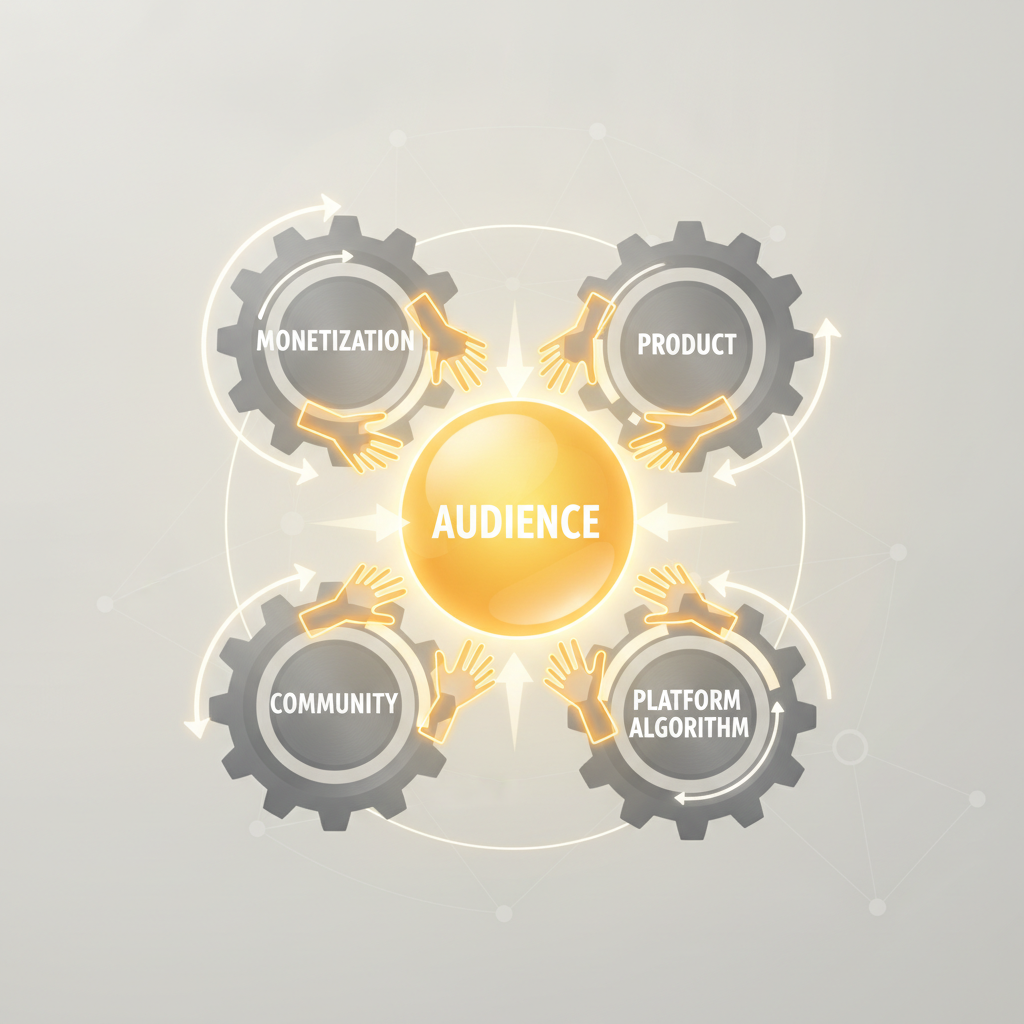
Start thinking like a creator: how do I get this in front of millions organically? This means deeply understanding platform dynamics, community building, and the psychology of virality.
Your product-market fit needs a partner: distribution-market fit. If you're not obsessing over how your product will spread as much as you're obsessing over its features, you're already behind.
For Developers and Engineers: The "build it and they will come" mentality is dead.
Your technical skill needs to be paired with an understanding of how platforms work, how content spreads, and how to build features that facilitate organic growth.
This might mean designing for shareability, integrating seamlessly with social graphs, or even understanding the subtle cues that make content algorithmically favorable.
You're not just building a feature; you're building a distribution vehicle.
If you're a mid-level backend engineer, here's what changes in the next 12-18 months: expect to be asked not just "how does this scale?" but "how does this spread?" You'll need to understand user behavior patterns on platforms, not just database performance.
For Marketers and Growth Teams: Your role is evolving beyond just paid acquisition. You need to become strategists for organic growth, community building, and platform mastery.
This means less reliance on ad spend and more on authentic engagement, creative content strategies, and a deep understanding of the algorithms that govern attention.
You're not just selling a product; you're cultivating an audience.
For Investors: Look for teams that understand distribution as deeply as they understand product. Ask about their "distribution DNA." How will they organically reach their first million users?
What's their strategy for virality that doesn't rely solely on ad spend?
A great product with no distribution is a hobby; a mediocre product with phenomenal distribution can be a billion-dollar business.
The New Gold Rush: Attention, Not Just Innovation
The MrBeast "YouTuber Legends" event wasn't just entertainment; it was a live, unscripted masterclass in the future of business.
It showed us that the lines between product, marketing, and community are entirely blurred, and the new gold rush isn't just about innovation, but about attention.
These creators, who've built empires by mastering the subtle art of getting and keeping eyeballs, are holding up a mirror to Silicon Valley, revealing its blind spots.
The tech world has always prided itself on building the future, but perhaps it's time we learned a thing or two from the people who are already living and monetizing it at an unimaginable scale.
Are you building for an audience you understand, or just building a product you hope someone will find?
How are you personally adapting to this "audience-first" reality in your work, or is Silicon Valley's product-centric echo chamber still ringing louder? Let's talk in the comments.