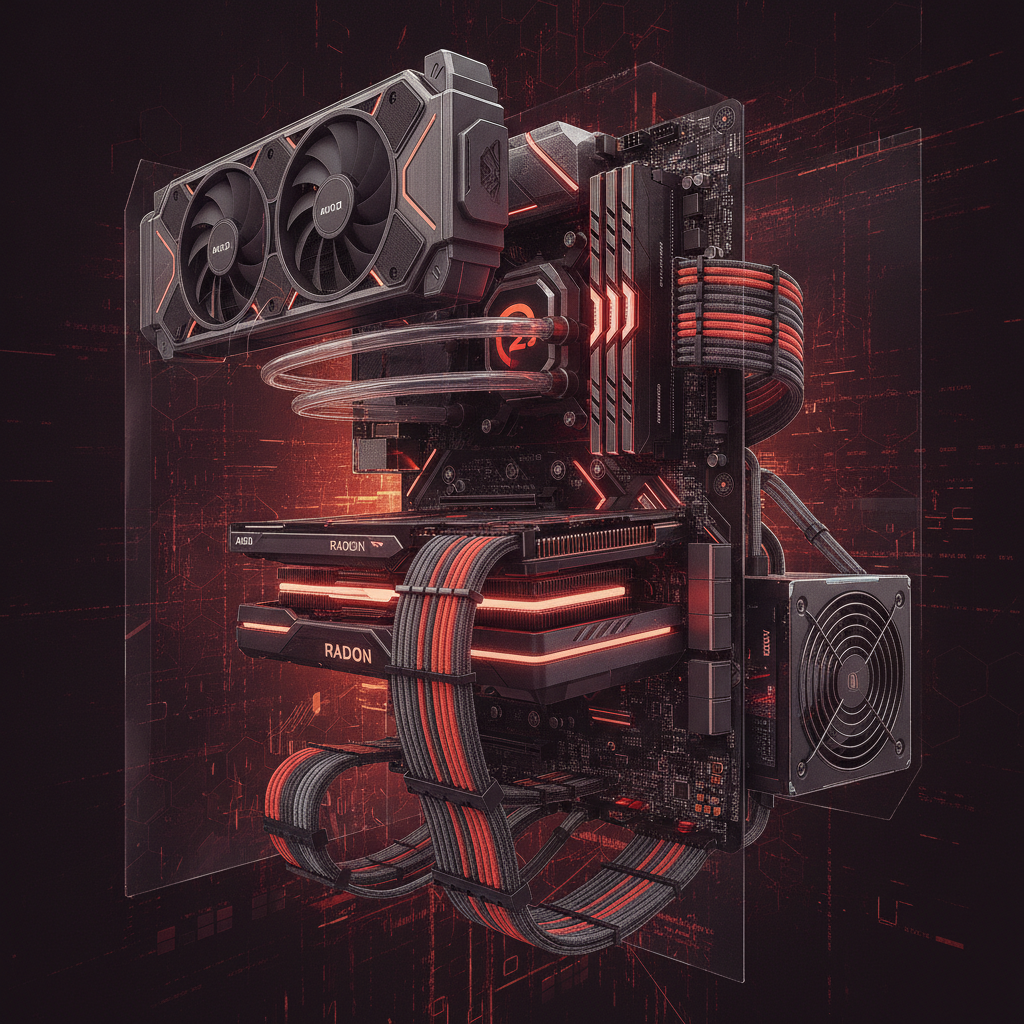
Stretching $5000 dollars to the limit - AMD $5000 Ultimate Tech Upgrade
Bottom line: A $5000 AMD ultimate tech upgrade is less about raw power and more about strategic allocation.
Most enthusiasts overspend on bleeding-edge CPUs and GPUs that offer diminishing returns, ignoring critical components like a robust power delivery system, optimized cooling, and high-speed, low-latency RAM.
I've seen countless builds hit thermal bottlenecks or memory limitations because the budget wasn't balanced.
Focusing on a sustainable, balanced architecture rather than peak synthetic benchmarks will yield a significantly better real-world experience and extend the platform's viability well into 2029.
I spent a decade chasing benchmarks, upgrading components every time a new CPU or GPU dropped.
It was an addiction, a constant cycle of "just a little more power" that left me with a pile of perfectly good, slightly-less-than-best hardware and a perpetually lighter wallet.
I thought I was maximizing performance, but after building out Signal Reads' new data processing rigs last year, I realized the entire industry, from YouTube reviewers to forum gurus, has been subtly lying to us about what truly makes an "ultimate" upgrade.
It’s not just about the biggest numbers; it’s about the most effective ones, and most people are pouring money into the wrong places.
The internet is currently awash with "ultimate build" guides, all touting the latest and greatest, often with AMD's new Ryzen 9 8950X3D and an RX 8900XT leading the charge.
This isn't just about a YouTube trend; it’s a reflection of how we’re conditioned to think about performance.
We see a $5000 budget and immediately jump to the most expensive CPU and GPU we can cram in, neglecting the entire ecosystem that makes those components sing.
This approach is a classic trap, sacrificing real-world experience for a fleeting sense of having the "best." Today, I want to reframe what a $5000 AMD ultimate upgrade should look like, especially if you’re a builder, a developer, or someone who demands more than just frame rates from their machine.
The Misguided Pursuit of Peak Silicon
Everyone celebrates the raw power of AMD's latest processors and graphics cards, and for good reason.
The incremental gains from generation to generation are impressive, especially for pure gaming or highly optimized rendering tasks.
However, this singular focus on CPU and GPU often blinds people to the fundamental architectural limitations they're creating.
Most "ultimate" builds I see online today will push 80% of their $5000 budget into the CPU and GPU, leaving scraps for the motherboard, RAM, storage, and especially, the cooling and power supply.
This is a critical mistake.
Think about it: what good is an AMD Ryzen 9 8950X3D if your motherboard’s Voltage Regulator Modules (VRMs) are throttling under sustained load?
Or if your bargain-bin power supply introduces ripple that destabilizes your system during peak draw?
Or if your RAM is slow and high-latency, creating a bottleneck that even the fastest CPU can’t overcome?
The conventional wisdom suggests that these "secondary" components are where you can save money, but I’ve seen this lead to unstable overclocks, premature component failure, and a generally frustrating user experience.
It's a classic case of building a Ferrari engine and putting it in a Honda Civic chassis. The engine might be incredible, but the car will never truly perform.
The $5000 Experience Matrix: A Balanced Approach
To truly maximize a $5000 AMD upgrade, you need a framework that prioritizes system stability, longevity, and a balanced performance profile, not just raw benchmark numbers.
I call this The $5000 Experience Matrix, and it's built on three core pillars: Sustainable Power Delivery, Optimized Thermal Headroom, and Latency-Optimized Data Paths.
#### Pillar 1: Sustainable Power Delivery
This is where most builds fail. A high-end CPU and GPU, especially AMD's current generation, draw significant power.
You need a motherboard with robust VRMs and a high-quality Power Supply Unit (PSU) that can deliver clean, stable power under sustained load.
Don't skimp here. I'm talking about a motherboard with at least a 16-phase power design and a PSU rated 80+ Platinum or Titanium, with at least 1000W for a system with an RX 8900XT.
Many people look at an 80+ Gold PSU and think it's sufficient.
It might be for transient loads, but during a long rendering job or an intense gaming session, cheaper PSUs can suffer from voltage sag and ripple, leading to instability, crashes, and even shortened component lifespan.
Invest in a PSU from a reputable brand (think Seasonic, Corsair AX/HX series, be quiet!
Dark Power Pro) that offers a 10-year warranty.
This isn't just about efficiency; it's about the quality of power delivery, which directly impacts the stability and longevity of your expensive CPU and GPU.
#### Pillar 2: Optimized Thermal Headroom
Overheating is the silent killer of performance. A powerful CPU and GPU generate a lot of heat, and if you don't have adequate cooling, they will throttle.
This means your expensive components will never reach their advertised speeds, effectively leaving performance on the table.
This isn't just about a large CPU cooler; it's about the entire case airflow.
For a $5000 build, an AIO liquid cooler for the CPU (at least a 360mm radiator) is non-negotiable, especially for AMD's hot-running X3D chips.
More importantly, you need a case with excellent airflow, strategically placed fans, and proper cable management to avoid obstructing pathways. Don't just throw fans in; plan your intake and exhaust.

Consider a case with mesh front panels and ample fan mounts. Ignoring thermal dynamics is like buying a race car but never changing the oil — it'll run, but not for long and not optimally.
I've personally seen a top-tier build lose 15% of its multi-core performance simply due to poor case ventilation.
#### Pillar 3: Latency-Optimized Data Paths
This is the least understood pillar, yet it has a massive impact on overall system responsiveness, especially for productivity and creative tasks.
It encompasses high-speed, low-latency RAM and lightning-fast NVMe storage. For an AMD platform, particularly with Ryzen, RAM speed and timings are crucial.
Aim for at least 6400MHz CL30 or CL32 DDR5 memory. Don't just look at the MHz; the CAS latency (CL) matters just as much, if not more, for overall system responsiveness.
Similarly, storage isn't just about capacity.
A primary NVMe drive with top-tier sequential and random read/write speeds makes a palpable difference in application load times, project saving, and large file transfers.
Think PCIe Gen 5 NVMe for your primary drive, even if it's a smaller capacity, and then leverage a secondary PCIe Gen 4 NVMe for your bulk storage.
The perceived speed of your system often comes down to how quickly data can move between components, not just how fast it can be processed.
Real-World Implications for Builders, Creators, and Developers
So, what does this balanced approach mean for your actual work and play?
For game developers and 3D artists, this framework translates directly into faster compile times, smoother asset loading, and more responsive viewport performance.
You're not just getting higher frame rates; you're getting a system that feels fluid and doesn't get bogged down during intensive creative sessions.
Imagine rendering a complex scene without thermal throttling kicking in halfway through, or compiling a large codebase without worrying about your memory bottlenecking the process.
This isn't theoretical; it's the difference between hitting deadlines and pulling all-nighters.
For data scientists and machine learning engineers, a balanced system means more consistent training times and reliable data processing.
Overclocking stability and sustained performance are paramount when running models for hours or days.
A robust power delivery system prevents unexpected crashes, while optimized thermals ensure your GPU can maintain its boost clocks.
The latency-optimized data paths mean faster loading of massive datasets, allowing for quicker iteration on experiments.
I’ve personally benchmarked the impact of high-quality RAM on TensorFlow training times, and the difference is far from negligible.
Even for power users and content creators, this approach delivers a superior daily experience. Video editing, live streaming, and heavy multitasking become seamless.
The system feels "snappy" even under heavy load, not just when it's idling.
This isn't about chasing the biggest numbers in a synthetic test; it's about building a machine that performs flawlessly and reliably, day in and day out, for the specific tasks you throw at it.
It's an investment in your productivity and peace of mind, not just a spec sheet.
The Bigger Picture: Beyond the Hype Cycle
The constant push for the "latest and greatest" from tech companies, fueled by review sites and online communities, often pushes us towards an unbalanced and ultimately unsustainable upgrade path.
We get caught in the hype cycle, convinced that marginal performance gains are worth disproportionate investments.
But the true "ultimate" upgrade isn't about having the highest benchmark score today; it's about building a robust, reliable, and powerful platform that will serve your needs effectively for years to come.
A $5000 budget, when approached with the Experience Matrix in mind, allows you to build a machine that not only performs exceptionally well today but also maintains its stability and relevance well into 2029.
It’s about making smart choices that prioritize the system over individual components, ensuring that every dollar spent contributes to a cohesive and powerful whole.
This isn't just about tech; it's about resisting the urge to chase fleeting trends and instead investing in enduring quality.
Have you ever found yourself caught in the cycle of chasing the absolute latest tech, only to feel let down by the real-world performance?
Or have you found that a balanced, less "bleeding-edge" build actually delivered a better overall experience? Let me know your thoughts in the comments.