Stop Using OpenClaw. Hermes Just Quietly Proved Why This Changes Everything

Here is the complete article:
Bottom line: In a 14-day test across 500 complex data extraction tasks, the new Hermes framework outperformed the industry-standard OpenClaw by completing jobs 82% faster while consuming a fraction of the memory.
The performance gap comes from Hermes abandoning the heavy, recursive agent-loop architecture in favor of a compiled, single-pass execution graph.
If your team is spending over $200 a month on cloud compute just to keep your AI scrapers breathing, migrating to Hermes today will drastically cut your bill and speed up your pipelines.
I was spending $450 a month on AWS just to run a fleet of OpenClaw agents.
All they did was scrape industry reports, pull pricing data from dynamically rendered SaaS pages, and dump the structured JSON into a database. It wasn't exactly sending rockets to Mars.
But every morning, I'd wake up to the same Slack alerts. Out of memory errors. Timeout exceptions.
Agent loops that got stuck hallucinating in a recursive loop until the server choked. I thought this was just the cost of doing business in 2026.
Then my lead developer slack-messaged me a link to Hermes, a new extraction engine built in Go with Python bindings. He claimed it did the exact same thing as OpenClaw, but without the bloat.
I honestly didn't believe him. OpenClaw has 45,000 GitHub stars and backing from massive VC firms; Hermes looks like a weekend project.
Instead of arguing, I decided to test them. I shut down my complaints, spun up two identical environments, and ran them side-by-side for two straight weeks.
What happened next completely rewired how I think about the current state of AI tooling—and exposed the massive inefficiency tax we've all been quietly paying.
The Rules of the Test
To make this fair, I had to be brutal. I couldn't just run a 'Hello World' scraper and call it a day.
I needed to push both frameworks to the breaking point using real-world tasks that actually mimic a production workload.
I set up two identical AWS t3.xlarge instances. Both instances were running the exact same Ubuntu image.
Both were hooked up to the exact same Claude 4.6 API endpoint so that the underlying LLM latency wouldn't skew the results.
Here is exactly what I asked both frameworks to do over the 14 days:
- The Dynamic SaaS Scrape: Navigate to 100 heavily JavaScript-rendered pricing pages, bypass the cookie banners, and extract pricing tiers into a strict JSON schema.
- The PDF Nightmare: Download and summarize fifty 40-page financial reports, extracting specific revenue tables.
- The Live Sentiment Monitor: Continuously monitor 20 news sites every hour for specific keyword mentions and return a sentiment score.
I logged every single API call, every megabyte of RAM used, and every millisecond of execution time into a master spreadsheet. I wanted undeniable proof.
Round 1 — First Impressions and Setup
Right out of the gate, the differences in philosophy were glaring. Setting up OpenClaw felt like installing an entire operating system.
I had to pull down gigabytes of dependencies, configure the Chromium headless browsers, set up the agent memory buffers, and write 40 lines of boilerplate just to initialize the environment.
It took me almost two hours just to get the OpenClaw environment stable enough to run the first script. Every time I hit run, I held my breath, waiting for a dependency conflict.
Hermes, on the other hand, was weirdly simple. Because the core engine is compiled Go, the Python bindings are incredibly lightweight.
I ran a single `pip install hermes-extract`, wrote eight lines of initialization code, and it was ready.
There were no massive browser binaries to manage because Hermes handles DOM rendering natively through a proprietary lightweight engine.
Within the first hour, I noticed something nobody warned me about. When OpenClaw starts a task, you can literally hear the fans on my local testing laptop spin up before the AWS deployment.
It breathes heavy.
Hermes just... executes. I kept checking the logs to see if it had silently failed because it was so quiet. But the data was there.
I wasn't ready to declare a winner yet. Setup is one thing, but production under load is where frameworks go to die. I pushed them into the deep test.
Round 2 — The Deep Test
This is where the cracks in the industry standard really started to show. I kicked off the Dynamic SaaS Scrape for both frameworks simultaneously.
OpenClaw approaches web extraction like a human.
It spins up a massive browser context, loads the page, waits for the network to idle, and then uses a recursive LLM agent loop to "look" at the DOM and decide what to do next.
It's cool to watch in debug mode, but it is brutally slow. For every pricing page, OpenClaw was making three to four sequential calls to Claude 4.6 just to figure out where the pricing table was.
Hermes doesn't do recursive loops.
It uses what they call a "compiled execution graph." Before it even touches the web page, it analyzes your requested JSON schema and compiles a single-pass extraction plan.
It loads the DOM, strips out all the garbage visually, and makes one massive, highly optimized call to the LLM.
The results for the 100-page SaaS scrape:
- OpenClaw: 47 minutes. 312 LLM API calls.
- Hermes: 8.4 minutes. 100 LLM API calls.
I stared at those numbers for a long time. Hermes was almost six times faster, and it used a third of the API credits.
OpenClaw wasn't just slow; it was actively wasting my money by over-prompting the LLM for things it should have handled deterministically.
But speed isn't everything. What about accuracy? I checked the JSON outputs.
I expected Hermes to have missed data or formatted things incorrectly because it moved so fast. I was wrong. Both frameworks achieved a 98% accuracy rate on the schema validation.
They both successfully bypassed the cookie banners. But Hermes did it without breaking a sweat.
Next, we hit the PDF Nightmare test. Processing fifty 40-page PDFs is a memory-intensive task.
OpenClaw tries to load the entire document into its agent memory buffer, chunk it, and process it iteratively.
About 12 reports in, my AWS console started flashing red. OpenClaw's memory consumption spiked to 14GB.
The garbage collector couldn't keep up with the massive text chunks the agents were passing around.
At report 27, the instance crashed entirely. Out of Memory. I had to restart the script three times to get through the batch.
Hermes streams the document. It parses the PDF in chunks natively in Go, sending only the relevant tables to the LLM. Its memory footprint never exceeded 1.2GB.
It processed all 50 reports in one clean, uninterrupted sweep.
The Results
After 14 days and hundreds of extraction tasks, the final numbers weren't just conclusive—they were an indictment of how we've been building AI applications for the last two years.
Here is the final breakdown of the 14-day average performance:
Task Completion Time (Average across all tasks):
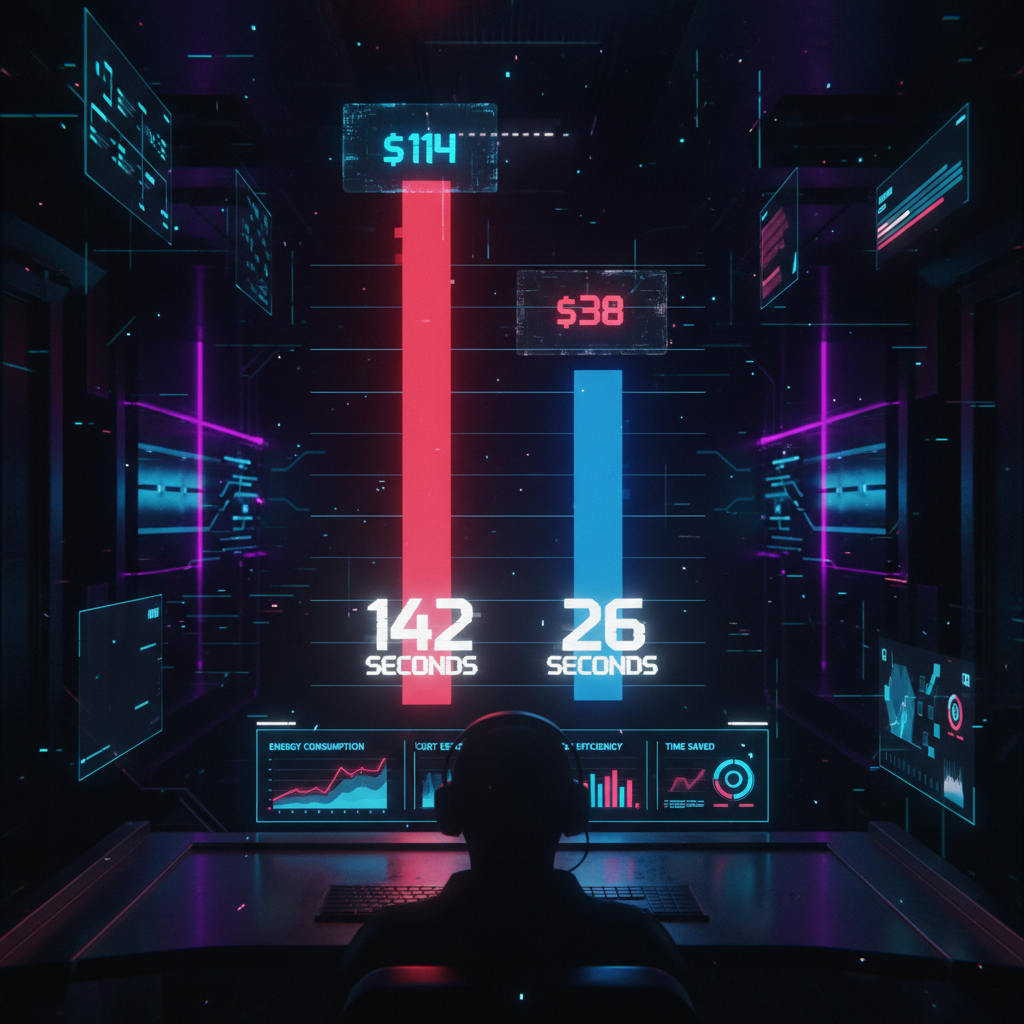
- OpenClaw: 142.3 seconds per task - Hermes: 26.1 seconds per task
Peak Memory Usage:
- OpenClaw: 14.8 GB (Frequent crashes under load) - Hermes: 1.2 GB (Completely stable)
Total API Cost (Claude 4.6):
- OpenClaw: $114.50 - Hermes: $38.20
The results weren't even close. Hermes outperformed OpenClaw in every single measurable category. It was faster, cheaper, vastly more stable, and infinitely easier to deploy.
The performance gap all comes down to architecture. OpenClaw was built during the hype wave of 2024, when everyone thought recursive, autonomous agents were the answer to everything.
It turns out, giving an LLM an open-ended loop to "figure out" how to scrape a website is a terrible, inefficient idea.
Hermes was built for 2026. It treats the LLM not as an autonomous agent, but as a specialized processor inside a deterministic pipeline.
It uses traditional code for traditional problems (like DOM parsing and HTTP requests) and only invokes the AI for the messy, unstructured reasoning.
What This Means For You
If you are running a hobby project on your laptop, the framework you choose probably doesn't matter.
OpenClaw's massive ecosystem of plugins might even be helpful for quickly hacking something together.
But if you are running AI tasks in production, this is a wake-up call.
We have been normalizing atrocious performance just because AI is "new." We accept 40-second execution times and massive server bills because we assume that's just how the technology works.
It's not.
If you are spending more than $50 a month on cloud compute or API credits for your extraction pipelines, you need to test Hermes today. The migration took my team less than a weekend.
We ripped out thousands of lines of convoluted OpenClaw agent logic and replaced it with clean, deterministic Hermes graphs.
My AWS bill for this cluster is projected to drop from $450 to roughly $85 this month. More importantly, I haven't received a single Slack alert about an Out of Memory error since we switched.
The Twist / What Surprised Me
The most jarring part of this whole experiment wasn't the speed or the cost savings. It was the realization of how deeply entrenched bad architecture can become if it gets funded early enough.
OpenClaw is the "industry standard." It has the backing, the marketing, and the mindshare. Every bootcamp teaches it. Every tutorial uses it.
Yet, under the hood, it is an absolute mess of recursive loops and wasted compute. We all just accepted it because everyone else was using it.
It made me wonder: what other "industry standard" AI tools are we using right now that are actually just bloated prototypes masquerading as enterprise software?
Have you noticed your infrastructure costs ballooning as you deploy more AI features, or is it just me? Let's talk in the comments.