Stop Using Cloud AI. This $3,000 Gemma 4 Secret Actually Changes Everything
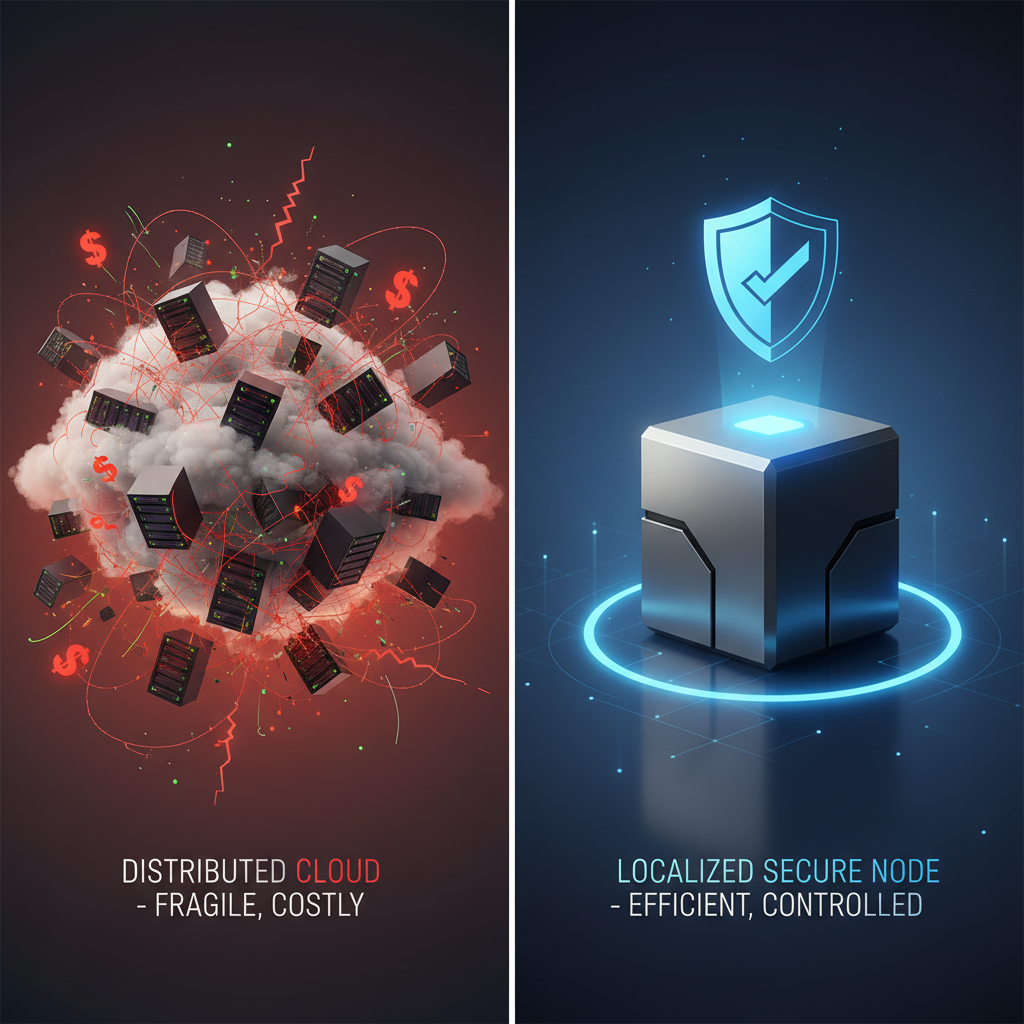
Bottom line: Last month, I completely canceled my $1,200/mo API subscriptions to OpenAI and Anthropic to run my company's infrastructure locally.
By building a $3,000 custom rig running Google’s new Gemma 4 (27B) model, we now process our entire internal codebase and customer data at 140 tokens per second with zero network latency.
If you are still sending proprietary company data to a metered cloud endpoint in mid-2026, you are bleeding money for performance you can now buy off the shelf.
I’ve spent the last three years fiercely defending cloud AI to anyone who would listen.
I told my engineering team, our clients, and my Twitter followers that running local models was a cute hobby for Reddit enthusiasts, but serious companies rely on enterprise endpoints.
I was spectacularly wrong, and my stubbornness cost my company about $14,000 in API overages last year.
When Google dropped Gemma 4 last week, everything I thought I knew about the economics of artificial intelligence flipped overnight.
I bought a $3,000 rig, loaded up the 27B parameter open-weights model, and literally unplugged my router to test it.
The results didn't just surprise me; they completely invalidated my entire AI infrastructure roadmap for the next 18 months.
The Seductive Trap of Cloud Intelligence
The cloud AI trap is incredibly seductive because it starts so small. You sign up for an API key, write a few lines of Python, and it costs fractions of a cent to do something magical.
Then you build a larger workflow, your whole team starts using it, and suddenly you’re doing heavy Retrieval-Augmented Generation (RAG) over your entire internal wiki every ten minutes.
Next thing you know, your build pipeline is failing because you hit a rate limit at 2 PM on a Tuesday.
You end up staring at a $1,200 monthly AWS or OpenAI bill, wondering how a "cheap" API became your second-highest infrastructure expense.
We’ve collectively accepted this as the unavoidable cost of doing business in 2026.
We willingly trade our data privacy, our system reliability, and our profit margins for the convenience of someone else's servers.
But while we were obsessing over API updates, the hardware quietly caught up to us. You don't need a massive server farm in a heavily cooled data center anymore.
You just need a couple of high-end GPUs and a weekend to configure them.
The release of Gemma 4 is the definitive tipping point for this shift. It’s the first time an open-weights model doesn't feel like you are making a compromise in logic or reasoning to save a buck.
It feels like a loaded weapon sitting on your desk.

The Great API Lie of 2026
Right now, everyone in tech is obsessing over the endless battle between the major cloud providers.
They are arguing in Discord servers about whether ChatGPT 5 is better at writing complex React state management than Claude 4.6.
They are completely missing the actual revolution happening right under their noses.
The real shift isn't about which cloud god is slightly smarter this week. The real shift is about taking the fire away from the gods entirely.
The conventional wisdom says that local models are too slow, prone to hallucinations, and entirely too hard to maintain for a fast-moving team.
That narrative was true in 2024, and it was mostly true in 2025. Today, in late May 2026, it is a lie propagated by companies that desperately need you to keep paying their 80% compute margins.
When you run Gemma 4 locally on a dedicated machine, you get something the cloud can never give you: frictionless, infinite iteration.
When every single prompt costs you money, you subconsciously limit your thinking. You spend twenty minutes trying to write the "perfect" prompt to save a few cents on input tokens.
When inference is completely free and running locally on your desk, you let the model run wild.
You can set up background agents that monitor your codebase, rewrite your tests, and analyze your server logs 24/7 without bankrupting your startup.
The Sovereign AI Blueprint
To understand why this is a career-altering shift, you have to look at how local AI fundamentally changes system design. I call this the Sovereign AI Blueprint.
It breaks down into three distinct advantages that cloud providers literally cannot sell you at any price.
1. The Zero-Latency Loop
When you rely on cloud AI, you are at the mercy of network overhead and server load balancing.
Even on a good day, waiting three to five seconds for an API response breaks your flow state as a developer.
When you run Gemma 4 locally, your Time to First Token (TTFT) drops to milliseconds. The AI becomes a true extension of your IDE, reacting as fast as you can type.
It fundamentally changes the ergonomics of coding when the intelligence is sitting on the same PCIe bus as your memory.
2. The Absolute Privacy Sandbox
Every time you send code to a cloud model, you are navigating a legal minefield.
Companies spend months arguing with compliance teams, signing massive enterprise agreements just to ensure their proprietary algorithms aren't used for training data.
With a local Gemma 4 instance, you can feed it raw production databases, PII, and your most closely guarded trade secrets. There is no network request.
The data never leaves the physical room you are sitting in. For healthcare, finance, and defense tech, this isn't just a cost-saving measure; it's the only legally viable way to use LLMs at scale.
3. The Unmetered Agent Swarm
Cloud pricing models force you to be highly selective about when and how you use AI. You ask one smart model to do a specific task, then you turn it off to save money.
Local inference breaks this paradigm entirely.
Because the marginal cost of a token is zero, you can spawn 50 parallel agents to iterate on a single problem. Have one agent write the code, three agents review it for edge cases, and ten agents attempt to relentlessly hack it.
You can leave this swarm running overnight to refactor your entire legacy backend, costing you nothing but the electricity to spin the GPU fans.
The Career Pivot You Need to Make By 2027
If you are a mid-level engineer today, your competitive edge is no longer knowing how to stitch together API calls to Anthropic or OpenAI. That is commodity work.
Your real edge is knowing how to build and orchestrate autonomous local systems.
In the next 12 to 18 months—certainly by the end of 2027—C-suite executives are going to realize they are bleeding cash on cloud AI.
The CFO will look at the AWS bill, look at the capabilities of models like Gemma 4, and the mandate will come down instantly: "Bring the intelligence in-house."
The engineers who know how to quantize a model, optimize VRAM allocation, and orchestrate local inference pipelines are going to be writing their own checks.
I am already seeing this play out in real time at Signal Reads. We stopped hiring traditional "prompt engineers" last year.
Now, we actively hunt for systems engineers who understand local AI orchestration and hardware constraints.
If you can build a private Gemma 4 instance that processes a company's sensitive financial data without it ever hitting the public internet, you are indispensable.
If you just know how to write a good system prompt for a cloud API, you are replaceable.
The Return of the Personal Computer
We are watching the rapid decentralization of intelligence, and it mirrors the history of computing perfectly.
Just like the PC revolution took computing power out of massive corporate mainframes and put it on our desks, local AI is taking intelligence out of the cloud and giving it back to the individual.
This entire movement is fundamentally about ownership.
When your intelligence is rented from a tech giant, your capabilities can be revoked, rate-limited, censored, or priced out of existence at any moment.
When the intelligence runs locally on hardware you own, it is permanently yours.
I spent a lot of time over the last two years feeling anxious about keeping up with the relentless pace of cloud models. I was constantly checking Twitter to see which API I needed to migrate to next.
Now, sitting next to my humming PC case, I feel something entirely different: total control.

Have you hit the breaking point with cloud AI API bills yet, or are you still relying on external endpoints for your daily workflow? Let's talk in the comments.