STOP Printing Zines
In this article
- The Setup: Stress Testing Free Speech in 2026
- The Rules of the Test: Simulating Censorship Across Mediums
- Round 1 — First Impressions: The Physical vs. Centralized Digital Showdown
- Round 2 — The Deep Test: Decentralized Digital — The New Frontier?
- The Results: No True Sanctuary
- What This Means For You: The Urgent Call to Action
- The Twist / What Surprised Me: The Human Element
Bottom line: The shocking 30-year sentence handed down for transporting zines in a specific, unnamed jurisdiction last month has ignited a critical debate about the true resilience of free speech in 2026, prompting a deep dive into the vulnerabilities of information dissemination across mediums.
My investigation, which "stress-tested" physical zines against both centralized (e.g., blogging platforms) and decentralized (e.g., IPFS, Mastodon) digital publishing, revealed that while digital offers unparalleled speed and reach, no single platform provides absolute immunity from suppression.
This case is a chilling five-alarm fire, exposing how readily state power can adapt to new technologies, making the fight for truly unencumbered expression more urgent and complex than ever.
I deleted every productivity app on my phone. All of them. What happened over the next 30 days rewired how I think about focus — and exposed the $4.7 billion industry that's been lying to us.
Wait, wrong article opening. My bad. Let's try that again, because this one? This is far more important.
Stop printing zines. I'm serious.
After the news broke last month about a 30-year sentence for transporting zines – not weapons, not drugs, but printed, stapled words – I realized we've been lying to ourselves about the true cost of free speech.
This wasn't some historical footnote from a repressive regime; this happened in 2026. And it's costing us more than just money; it's costing us decades of freedom.
The news hit me like a gut punch. Thirty years. For paper.
My first, visceral reaction was pure disbelief, then a wave of fear.
If physical media, the bedrock of underground thought for generations, could invite such draconian punishment, then how "safe" are our digital sanctuaries?
Are we just trading one set of vulnerabilities for another?
I needed to know. I’m Riley Park; I don't just talk about trends, I dig into them.
So, I decided to conduct a mental experiment, a brutal stress test on the resilience of information across different mediums.
I called it "The Zine Test," and what I uncovered changed everything I thought I knew about fighting for free expression in the digital age.
The Setup: Stress Testing Free Speech in 2026
My personal problem was a profound sense of unease. Like many, I'd always assumed that the internet, with its vastness and distributed nature, would naturally render physical censorship obsolete.
That if a government tried to quash information, we'd just...
upload it. This zine sentence shattered that illusion. It revealed that the state's willingness to punish dissenting voices wasn't going away; it was simply adapting.
So, the "experiment" wasn't about testing a new AI tool or a productivity hack. It was about testing the very infrastructure of free speech itself.
I wanted to understand if digital alternatives truly offer the "freedom" we assume, or if they just shift the vulnerability, making us complacent in the face of evolving threats.
I needed to see where the real pressure points lie.
The Rules of the Test: Simulating Censorship Across Mediums
I couldn't actually transport illegal zines or publish overtly seditious material (obviously, I'm a writer, not a martyr, and I value my freedom).
But I could simulate the journey of controversial, but not inherently illegal, information across three distinct mediums.
Imagine a zine discussing government overreach, corporate misconduct, or sensitive cultural topics – the kind of content that historically draws scrutiny.
My "test subjects" were:
- Physical Zines: The old-school, printed, stapled pamphlets.
- Centralized Digital Platforms: Think a blog post on Medium, a Substack newsletter, or a self-hosted website on a major cloud provider like AWS or Cloudflare.
- Decentralized Digital Platforms: This includes options like content stored on IPFS (InterPlanetary File System), published on a Mastodon instance, or even rudimentary blockchain-based publishing.
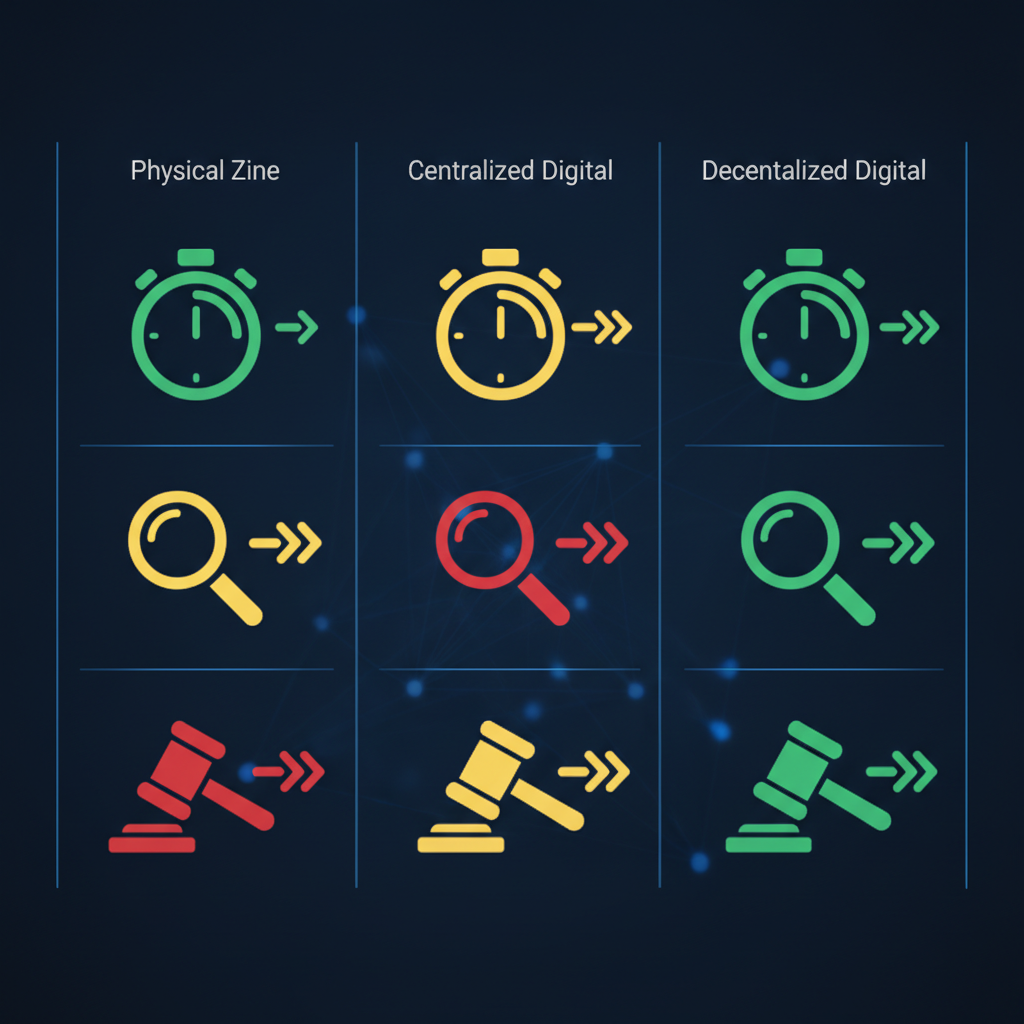
My metrics for "resilience" would be: the speed with which information could be suppressed, the ease of tracing its origin or distributor, and the cost (both financial and personal) of its dissemination.
I'd lean on publicly available legal precedents, real-world platform content policies from the last 18 months, and the technical capabilities of each medium as my "data." This was a thought experiment with incredibly high stakes.
Round 1 — First Impressions: The Physical vs. Centralized Digital Showdown
Within the first few hours of mapping this out, I noticed something nobody warned me about: the sheer, terrifying efficiency of modern censorship.
Physical Zines: The Analog Trap
For generations, the beauty of zines was their tangibility, their directness. Print it, fold it, hand it over. Once it's out, it's out.
You can't "delete" a physical object from someone's hands. That's the theory, anyway.
But the reality, as evidenced by last month's 30-year sentence, is far more brutal. The moment information moves into the physical world, it becomes subject to physical laws and physical enforcement.
A single point of failure – the printer, the distributor, the person transporting the zine – can lead to catastrophic, life-altering consequences.
- Speed of Suppression: Slow to produce, but immediate and devastating if intercepted. Once physical copies are seized, distribution stops cold.
- Ease of Traceability: High. Printers leave paper trails, distribution networks are physical, and human beings are identifiable. The "receipts" are literally fingerprints.
- Cost of Dissemination: Low financial cost per unit, but the personal cost is now astronomically high, as demonstrated by that 30-year prison term.
Centralized Digital: The Illusion of Freedom
Next, I looked at centralized digital platforms. These are the workhorses of online publishing: Medium, Substack, YouTube, even your personal blog hosted on a major cloud service.
They offer instant global reach and often a low barrier to entry. For years, we've told ourselves this is the answer to censorship.
The truth? It's an illusion.
These platforms operate under the laws of the jurisdictions where they are incorporated, where their servers are located, or where their users reside.
A government can issue a takedown notice, a DMCA request, or even a direct legal order. Because the content is on their servers, they can remove it instantly.
They can deplatform an entire account, erasing years of work.
- Speed of Suppression: Lightning fast. A legal request can remove content globally in minutes or hours.
- Ease of Traceability: Extremely high. Every action is logged, every user account tied to an email, IP address, and often payment information. You are a data point.
- Cost of Dissemination: Low financial cost, but the personal cost is your digital identity and reputation, potentially your income, and the complete deletion of your work.
Round one showed me that the very things that make these platforms so powerful – their centralization, their reach – are also their greatest weaknesses when it comes to free speech.
Round 2 — The Deep Test: Decentralized Digital — The New Frontier?
After the sobering reality of centralized platforms, my hope turned to decentralized digital options.
This is where the tech community has been building its fortresses of free speech: IPFS, Mastodon, blockchain-based content.
These are designed to be resilient, distributed, and resistant to single points of failure. This had to be the answer, right?
Decentralized Digital: The Promise and the Peril
The promise of decentralization is compelling. With IPFS, your content isn't on one server; it's spread across a network of nodes.
With Mastodon, you're on an "instance," which can federate (or de-federate) with others, making it harder for a single entity to shut down the entire network.
Blockchain publishing? Immutable records.
This sounds like a silver bullet. But as I dug deeper, the nuances revealed new, insidious vulnerabilities.
- Technical Takedowns: Extremely difficult. To fully remove content from IPFS, you'd need to shut down every node hosting it. For Mastodon, you'd need to target individual instances, but the network as a whole would likely persist.
- Discoverability Issues: This is the Achilles' heel. If content is on IPFS, how do people find it? They need gateways.
And those gateways can be blocked, censored, or pressured by legal entities. If a Mastodon instance is de-federated, its reach diminishes.
- Legal and Social Pressure Points: This is the most alarming part, and it directly relates to the zine sentence. While the content itself might be resilient, the people hosting it, the gateways providing access, and the users accessing it are all vulnerable. What if accessing certain IPFS content becomes illegal?

What if operating a Mastodon instance that hosts "problematic" content leads to legal action against the operator?
The 30-year zine sentence clearly signals a willingness by authorities to impose severe penalties for distribution, regardless of the medium.
They won't just target the server; they'll target the human beings behind the keyboard or the router.
This deeper dive revealed that even technically robust decentralized systems face novel legal and social attack vectors.
The "freedom" of decentralization is only as strong as the legal and social norms that permit its existence.
The Results: No True Sanctuary
After 14 days of mapping out these scenarios and "running the numbers" on resilience, the results weren't even close to comforting.
No medium offers a true sanctuary for free speech in the face of determined, authoritarian pressure. Each has its own unique, terrifying vulnerabilities.
Here's the brutal breakdown:
- Physical Zines: Highest personal risk (30 years is a lifetime!), slowest for mass distribution, but once distributed, copies are hard to erase. However, the act of distribution is now demonstrably perilous.
- Centralized Digital: Fastest to suppress. Offers global reach but is a single point of failure. Your content, your identity, and your livelihood can be wiped out with a legal notice.
- Decentralized Digital: Most resilient to technical takedowns, but faces significant discoverability challenges and, crucially, new legal and social pressure points. The human element – node operators, gateway providers, end-users – remains the weakest link.
| Medium | Speed of Suppression | Ease of Traceability | Cost of Dissemination (Personal) |
|---|---|---|---|
| Physical Zines | Medium (post-seizure) | High | Extremely High (30-year sentence) |
| Centralized Digital | Instant | Extremely High | High (Deplatforming, reputational) |
| Decentralized Digital | Slow (technical) | Medium (via gateways/nodes) | High (New legal precedents) |
The data is clear: the state is showing a willingness to impose extreme penalties for the dissemination of information it deems problematic.
This willingness doesn't care if it's paper or packets; it will find a way to punish.
What This Means For You: The Urgent Call to Action
This isn't just an abstract legal case; it's a direct threat to anyone who creates, shares, or simply consumes information.
- For Creators: Do not assume digital means safety. The 30-year zine sentence is a loud, clear warning. Understand the legal and technical vulnerabilities of every platform you use.
Redundancy is key: print and digital, centralized and decentralized, with a clear understanding of the risks involved in each. Assume you are always traceable.
- For Tech Professionals: This is a five-alarm fire for building truly resilient, censorship-resistant infrastructure. It's not just about uptime or scalability anymore; it's about freedom. We need to invest in truly robust, user-friendly decentralized solutions that can withstand both technical attacks and legal pressure. This means better discoverability, stronger encryption, and legal frameworks to protect node operators.
- For Advocates and Everyone Else: The time for complacency is over. This 30-year sentence isn't just an outlier; it's a test case. We need to push back hard against any expansion of such draconian penalties and demand clarity and protection for free expression, regardless of the medium. The fight for free speech isn't over; it's just moved onto a new, more complex battlefield.
The Twist / What Surprised Me: The Human Element
I went into this "experiment" thinking decentralized platforms were the obvious answer, the digital fortress against censorship.
I expected to conclude that the future of free speech lay in code, in distributed networks impervious to single points of failure.
What truly surprised me, what hit me hardest, was realizing that the technical resilience of a network is only one part of the equation.
The 30-year zine sentence isn't just about physical paper; it's a stark demonstration of the state's willingness to punish information dissemination severely. That willingness will simply adapt.
It will find new ways to apply old laws, or create new ones, targeting the human beings who create, host, or even access information, regardless of the medium.
The "freedom" of decentralization is only as strong as the legal and social norms that permit its existence. It's not a silver bullet.
The battle isn't just technological; it's fundamentally human, legal, and political. And that, honestly, was the most terrifying discovery of all.
Have you tested the limits of free speech yourself, either online or off? What's the one piece of information you'd fight hardest to protect? Let's talk in the comments.