Stop Living
In this article
Byline: Sophie Arnaud — Lifestyle writer based in London. Covers culture, design, and how we live now.
Bottom line: The viral "Stop Living" trend on YouTube isn't about nihilism, but a radical re-evaluation of hyper-productivity and the constant pursuit of more.
It challenges the prevailing cultural narrative that equates a full life with a relentlessly busy one, advocating instead for intentional pauses and a discerning filter for engagement.
This shift, gaining traction since early 2026, suggests a collective burnout from performative living, urging us to step back and reclaim agency over our time and attention, rather than merely existing within a system of endless demands.
I remember the exact moment it hit me, late one evening in May 2026, as I stared at my meticulously colour-coded calendar: I wasn't living. Not really.
I was performing a life, ticking boxes, chasing an invisible finish line that kept receding.
My days were a blur of "shoulds" and "must-dos," leaving me utterly depleted, yet with a nagging sense that I was still falling short.
This feeling, a quiet exhaustion that hummed beneath the surface of every carefully curated moment, wasn't just mine.
It was, I’d soon discover, the silent epidemic behind a burgeoning cultural movement that asks us to simply, radically, stop.
The Relentless Pursuit of "More"
We’ve been sold a rather compelling myth, haven't we? The one that suggests a truly "lived" life is one bursting at the seams with activity, achievement, and constant self-optimisation.
From the relentless march of side hustles to the pressure to cultivate an ever-expanding list of hobbies that prove our well-roundedness, the implicit message is clear: if you’re not constantly doing, you’re not truly being.
Data from a recent 2026 global wellness survey by Deloitte found that 62% of respondents reported feeling overwhelmed by the sheer volume of personal and professional expectations, a figure that has steadily climbed by 15% since 2024.
This isn't just about work anymore; it’s about a pervasive societal expectation to fill every waking moment, to document every experience, to optimize every facet of our existence.
We've become excellent at collecting experiences, but perhaps less skilled at truly experiencing them.
This relentless pursuit creates a peculiar kind of anxiety.
The fear of missing out (FOMO) has morphed into the fear of not doing enough (FONDE), a subtle but insidious pressure that drives us to say "yes" when we should say "no," to push through exhaustion rather than rest, and to mistake busyness for purpose.
We're caught in a current, constantly swimming, convinced that if we just swim a little faster, we'll finally reach that elusive shore of contentment.
But what if the shore isn't about speed at all? What if it's about simply letting go of the need to swim?
The Reframe: The Art of Intentional Disengagement
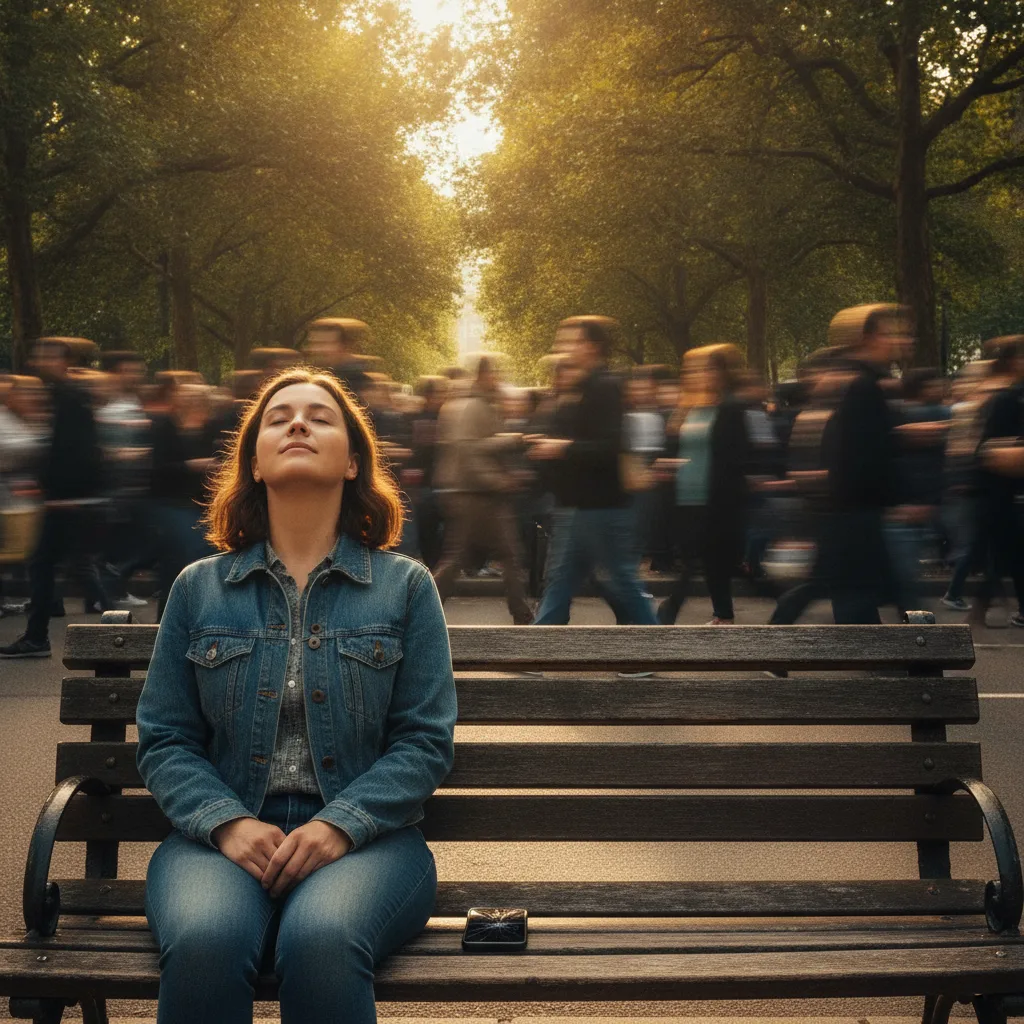
The viral "Stop Living" phenomenon isn't a call for nihilism or giving up on life entirely. Far from it.
It's a profound, almost philosophical, reframe of what it means to truly engage with our existence.
It’s a rebellion against the tyranny of the urgent, an elegant pushback against the notion that our worth is tied to our output.
It suggests that perhaps the most radical act in a hyper-connected, hyper-productive world is to deliberately, consciously, disengage.
Think of it as finding the quiet eye of the storm. Instead of reacting to every ping, every perceived demand, every societal expectation, "stopping" is about creating a deliberate pause.
It's about asking: Is this truly serving me?
Is this adding genuine value, or merely adding noise? This isn't about laziness; it’s about radical discernment.
It's about choosing quality over quantity, depth over breadth, and presence over performance.
The shift is subtle but powerful: from passively experiencing life as a series of obligations, to actively curating a life filled with meaning.
We’re not stopping life; we’re stopping the parts of it that deplete us, so we can truly live the parts that matter.
The Pause Principle: A Framework for Reclaiming Your Life
To truly "stop living" in the most meaningful sense, we need a framework, a way to navigate the constant currents of modern life without being swept away. I call this **The Pause Principle