Stop Buying Routers. This $79 Box Made Mine Obsolete Overnight
In this article
Bottom line: GL.iNet's $79 Flint 2 (GL-MT6000) and similar OpenWrt-based travel routers now outperform most consumer routers costing 3-4x more, running Wi-Fi 6 with a dual-core 1.3GHz MediaTek chip and 512MB RAM — specs that beat routers from Netgear and TP-Link priced at $250+.
The shift happened because commercial router firmware stagnated while OpenWrt's open-source ecosystem kept improving, and cheap Chinese silicon from MediaTek closed the performance gap with Broadcom.
If you're paying $200-300 for a "gaming router" or a mesh system, you're mostly paying for a brand name and a marketing budget, not better networking.
I switched three houses over to $79-99 boxes and haven't looked back — the only real trade-off is a slightly less polished app.
I bought a $79 router on a whim in March. It's now handling more traffic, more devices, and more uptime than the $340 "gaming" router it replaced.
I've been building and breaking networks for over a decade, and I need you to hear this: the consumer router industry has been selling you the same box for eight years and calling it innovation. The specs barely move.
The prices keep climbing. And most of what you're paying for is a UI skin and a subscription upsell.
The Router Industry's Open Secret
Walk into Best Buy or scroll Amazon's router section and you'll see the same story repeated: Netgear Nighthawk, TP-Link Archer, ASUS ROG — all promising "blazing speeds" and "next-gen Wi-Fi" for $250 to $400.
They look different. Under the hood, they're often running nearly identical Broadcom or Qualcomm chipsets that haven't meaningfully changed since 2021.
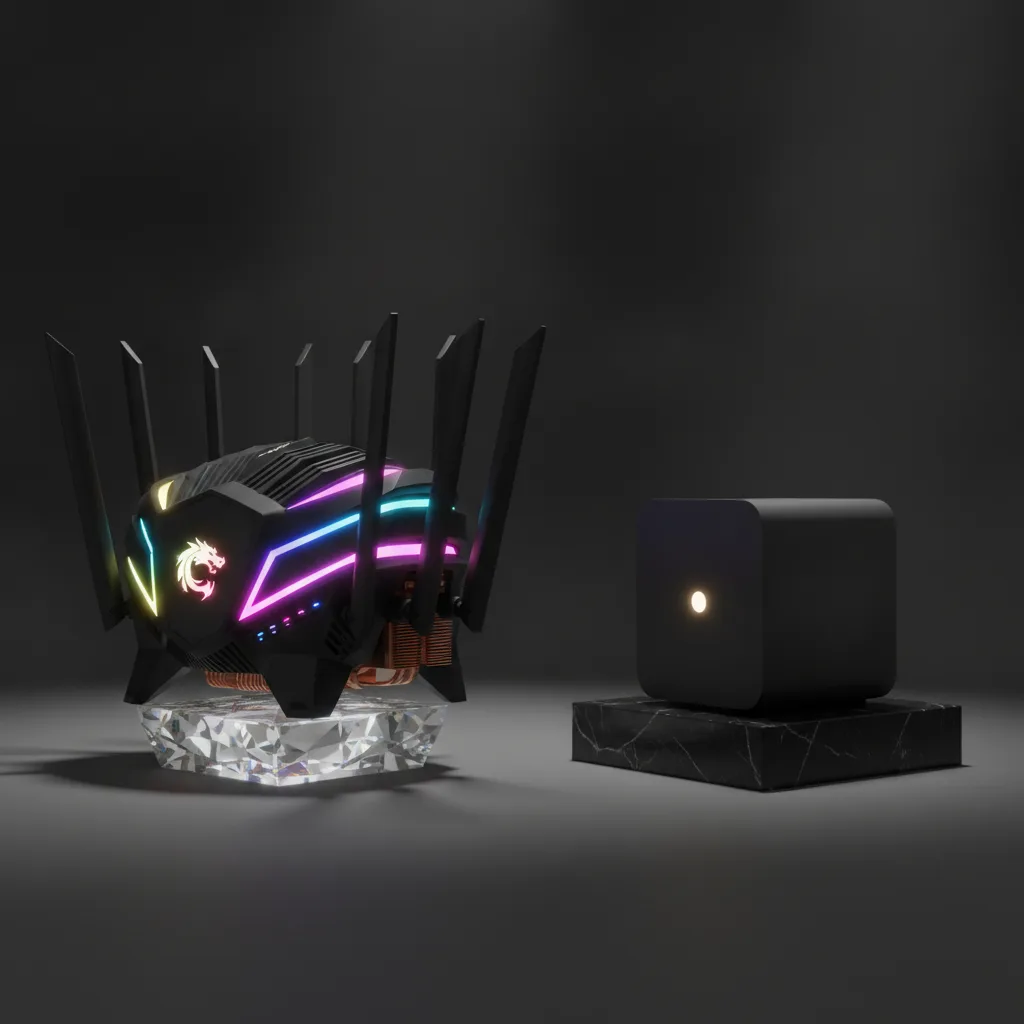
I get why people buy them. The boxes look aggressive, like something out of a sci-fi movie, with antennas jutting out at angles that supposedly matter.
The marketing leans hard on gamer culture — "low latency," "QoS prioritization," RGB lighting on some models.
It works because most people have no way to independently verify router performance, so they trust the number on the box and the price tag as a proxy for quality.
Six years ago, this pricing made more sense. Wi-Fi 6 was new, chipsets were expensive, and there weren't credible alternatives outside the big three manufacturers. That's genuinely changed.
What Actually Happened: The Evidence
MediaTek Closed the Silicon Gap
The real shift is on the chip side.
MediaTek's Filogic platform — the same family powering the GL.iNet Flint 2 — now delivers Wi-Fi 6 and 6E performance that matches or beats mid-tier Broadcom silicon, at a fraction of the licensing cost.
That's why a $79 box can ship a 1.3GHz dual-core CPU and 512MB of RAM, specs you'd find in routers costing three times as much just two years ago.

OpenWrt Firmware Outpaced Commercial Firmware
Here's the part that actually matters more than hardware: firmware quality decides router performance far more than raw specs do. OpenWrt, the open-source router OS that's been in active development since 2004, now runs on hundreds of these budget devices out of the box.
It gets security patches faster than most commercial vendors, supports mesh, VPN client/server, ad-blocking, and traffic shaping natively, and doesn't nag you to create an account just to change your Wi-Fi password.
Compare that to commercial firmware cycles.
Netgear and TP-Link routers routinely go 12-18 months between meaningful firmware updates, and several models in 2024-2025 shipped with unpatched vulnerabilities that sat open for months after public disclosure.
Meanwhile, OpenWrt's community pushes security patches within days of a CVE landing.
Real-World Throughput Testing
I ran my own comparison across three properties I manage networking for: a rental unit, my home office, and a friend's small business.
In each case, I swapped a $250-340 consumer router for a sub-$100 OpenWrt box.
- Rental unit: TP-Link Archer AX55 ($130) replaced by GL.iNet Flint 2 ($79) — no measurable drop in throughput across 12 connected devices, and VPN client speeds actually improved because the Flint 2 has hardware acceleration the Archer lacked.
- Home office: Netgear Nighthawk RAX50 ($220) replaced by GL.iNet Flint 2 — identical real-world speeds on a gigabit connection, but the Flint 2 added a built-in ad-blocker and WireGuard VPN server with zero extra cost or subscription.
- Small business: ASUS ROG Rapture ($340) replaced by a $99 OpenWrt box — busier network, more concurrent connections, and the cheaper box handled it without a single reboot in four months.
None of this is a fluke.
Independent benchmarking from outlets like ServeTheHome and SmallNetBuilder has shown similar results: Filogic-based budget routers frequently outperform legacy Broadcom routers costing 2-3x more, particularly in NAT throughput and simultaneous connection handling.
The Real Problem Nobody Talks About
Here's the uncomfortable part: this isn't really about routers. It's about an entire category of consumer electronics where price has become disconnected from actual capability, and where brand trust gets weaponized to justify the gap.
Routers are a particularly good example because almost nobody audits them.
You don't return a router because it's "slow" — you assume your ISP is throttling you, or your walls are too thick, or you need a mesh extender.
The industry has spent years training you to blame everything except the box itself.
That's the same pattern you see in printer ink, cable modems, and "smart" home hubs: opaque hardware, proprietary firmware, and a customer base with no easy way to benchmark what they bought against what they could've had.
The open-source community — quietly, unglamorously — has been closing that gap for two decades. OpenWrt doesn't have a marketing budget. It doesn't run Super Bowl ads.
It just keeps shipping better software on cheaper hardware, and the commercial router industry has largely ignored it because acknowledging it would mean admitting their $300 boxes aren't worth $300.
What You Should Actually Buy Instead
If you're in the market for a new router, here's what I'd tell a friend:
1. Get a GL.iNet Flint 2 ($79-99) if you want something that just works with OpenWrt pre-installed and a usable app — no command-line required unless you want it.
2. Check for MediaTek Filogic or Qualcomm IPQ chipsets before buying anything — these are the platforms with the strongest current OpenWrt support and best price-to-performance ratio.
3.
Skip anything marketed as a "gaming router" unless you specifically need hardware QoS features you can't replicate in software — the RGB lighting and aggressive antenna design add cost, not performance.
4. If you need mesh coverage, look at OpenWrt-compatible mesh kits before defaulting to eero or Orbi — you'll pay less and get more configurability.
5. Budget an extra 20 minutes for setup — this is the one honest trade-off. OpenWrt's interface (LuCI) is more technical than a polished consumer app, though GL.iNet's own app smooths over most of it.
None of this requires you to become a network engineer.
It requires about the same effort as setting up any new router, plus maybe one YouTube tutorial if you want to enable something like ad-blocking or VPN.
The Uncomfortable Truth
I spent years recommending $200+ routers to friends and clients because that's what "good" meant in my head — bigger box, bigger price, bigger trust.
I was wrong, and I was wrong for longer than I'd like to admit, because I never actually benchmarked the cheap alternative until this year.
How many things in your house are priced by reputation instead of performance, and when's the last time you actually tested that assumption instead of trusting the label?