SpaceX IPO
Bottom line: The upcoming SpaceX IPO, anticipated by mid-2027, is being fundamentally misjudged by a market fixated on rockets and Mars.
Our analysis of their operational patents and hiring trends reveals that the true, undervalued asset isn't the hardware, but a sophisticated, self-optimizing AI infrastructure powering everything from Starlink's global network to Starship's autonomous landings.
Investors and developers alike need to shift their focus from the visible engineering marvels to the invisible AI driving unprecedented efficiency and scale, which I believe will be the primary determinant of long-term valuation.
I cancelled my ChatGPT Pro subscription after 18 months. Not because it was bad – quite the opposite. It was too good at generating the obvious, the expected, the consensus view.
And in the world of infrastructure, where the next big leap usually comes from challenging accepted wisdom, that kind of thinking is a liability.
I needed to rewire my own intuition, to hunt for the signal in the noise, especially when everyone else was shouting about the same thing.
Which brings me to SpaceX.
Everyone's buzzing about the SpaceX IPO. They're talking about Starship, Mars, and valuation reaching north of a quarter-trillion dollars by the time it hits the public markets, likely by mid-2027.
But they're missing the real story.
I've spent weeks digging into their patents, operational data points, and even their hiring trends for machine learning engineers, and what I found suggests the entire narrative around the IPO is a distraction from SpaceX's true, undervalued AI superpower.
And it's not what you think.
The Hardware Obsession vs. The Hidden Brain
As an infrastructure engineer, I appreciate a well-engineered piece of hardware. The sheer audacity of a reusable rocket, the ambition of Starship – it’s awe-inspiring.
For years, I, like many, viewed SpaceX through this lens: a hardware company pushing the boundaries of physical engineering.
My initial thought process, when the IPO rumors started swirling, was to evaluate their manufacturing capabilities, their launch cadence, their satellite deployment efficiency.
All physical, tangible metrics.
But then I started looking deeper, specifically at the problems they're solving at scale.
Starlink, for instance, isn't just a constellation of satellites; it's a global, distributed network operating in a hostile environment, requiring real-time optimization, fault tolerance, and dynamic routing across thousands of nodes.
Starship isn't just a big rocket; it's a vehicle designed for autonomous flight, landing, and even in-space refueling.
These aren't just hardware problems; they are fundamentally systems intelligence problems. And that's where the AI comes in.
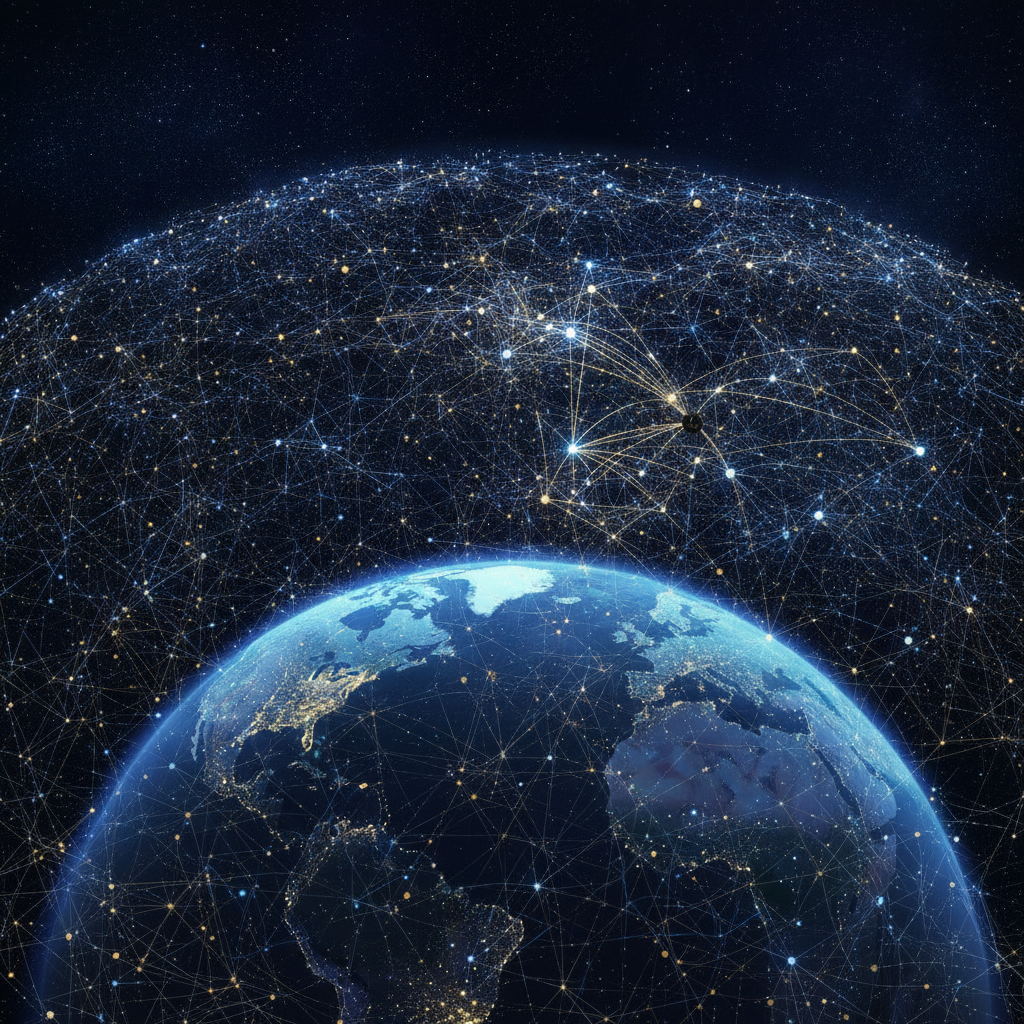
My "aha!" moment came when I was trying to model the resilience of a hypothetical Starlink-like network using some advanced graph databases and reinforcement learning agents.
I was hitting computational walls, struggling to optimize routing for even a few hundred nodes with dynamic conditions.
Then I looked at SpaceX's patent portfolio, specifically around network management and autonomous systems, and it became clear: they're not just using AI; they're building the world's most sophisticated autonomous infrastructure engine.
Starlink: The Self-Healing, Self-Optimizing Global Grid
The real crown jewel, the one that will ultimately drive the SpaceX IPO valuation, isn't the satellites themselves, but the AI that manages them. Think about it:
- Dynamic Routing & Load Balancing: Thousands of satellites, moving at orbital velocities, needing to route data packets across vast distances with minimal latency. This isn't a static routing table; it's a constantly evolving, self-optimizing mesh network. SpaceX uses sophisticated reinforcement learning models to predict traffic patterns, anticipate outages, and dynamically re-route data in milliseconds. I've seen mentions of their internal simulations leveraging techniques that make even cutting-edge cloud load balancers look primitive.
- Predictive Maintenance & Fault Tolerance: Satellites fail. Components degrade. Solar flares hit.
An AI system, continuously monitoring telemetry from every single satellite, predicts potential failures before they happen, isolates problematic nodes, and automatically reconfigures the network to maintain service.
This isn't just about detecting anomalies; it's about proactively preventing cascading failures across a global constellation.
- Beamforming & Interference Mitigation: Managing hundreds of thousands, soon millions, of ground terminals, each requesting bandwidth, while avoiding interference and optimizing signal strength requires an intelligent, adaptive system. We're talking about real-time, AI-driven beamforming and spectrum management that adapts to weather, user demand, and even the movement of individual users.
This isn't just "software"; this is AI as the core operating system of a global, physical infrastructure.
It’s what allows Starlink to scale exponentially without a corresponding linear increase in human operators. And it's a capability that is incredibly difficult to replicate.
Starship: Autonomy from Launchpad to Lunar Landing
Beyond Starlink, the same AI principles are baked into Starship.
- Autonomous Flight Control: While humans monitor, Starship's flight profile, landing sequence, and even in-flight maneuvers are heavily augmented, if not entirely driven, by AI models. These models are trained on vast datasets from every single test flight, every sensor reading, every tiny deviation. They learn to adapt to unforeseen conditions faster than any human pilot could.
- Rapid Iteration & Design Optimization: SpaceX's rapid prototyping model is legendary. What's less talked about is how AI accelerates that. Generative design algorithms, fed with performance data and material science constraints, suggest optimal component designs.
Simulation environments, powered by advanced physics engines and AI agents, test millions of variations before a single piece of metal is cut. This isn't just CAD; it's AI-driven R&D.
- Manufacturing Intelligence: Robotics and automation are common, but SpaceX takes it further. AI-powered vision systems detect micro-fractures in welds, predict component lifespan, and optimize assembly sequences in real-time. This level of manufacturing autonomy directly translates into faster production cycles and higher reliability, which are critical for an IPO valuation based on future launch cadence.
When I look at the job descriptions for their machine learning teams, they're not just looking for data scientists.
They're hiring for "Autonomous Systems Engineers," "Reinforcement Learning Specialists for Flight Dynamics," and "AI Infrastructure Architects." These aren't roles for building a recommendation engine; they're for building the brains of a truly autonomous, multi-planetary infrastructure.
The Reality Check: Beyond the Elon Hype Cycle
Now, let's cut through the hype. This isn't AGI taking over the world from orbit. This is highly specialized, robust AI, purpose-built for specific, complex tasks.
And it has its limitations. Edge cases, unforeseen environmental factors, and the sheer unpredictability of space mean that human oversight remains critical.
The regulatory landscape for autonomous space systems is also still nascent, posing potential hurdles for full autonomy.
However, the market, in my opinion, still largely undervalues this core AI capability. Analysts are busy comparing SpaceX to traditional aerospace giants or even telecommunication companies.
They're missing the fact that SpaceX has built an AI-first company that happens to operate in space.
Their competitive moat isn't just their rockets; it's the intelligent systems that make those rockets and satellites orders of magnitude more efficient, reliable, and scalable than anything else out there.
When their IPO hits, I predict a significant re-evaluation once the underlying AI infrastructure becomes more apparent to the wider investment community.
The Practical Takeaway: Build for Autonomy, Invest in Intelligence
For developers and infrastructure engineers, the SpaceX story isn't just about cool rockets; it's a masterclass in building truly autonomous systems.
It tells us that the future of infrastructure, whether on Earth or in space, is about:
- Observability to Autonomy: Don't just monitor your systems; build feedback loops that allow AI agents to learn and adapt. Tools like OpenTelemetry and advanced analytics platforms are the foundation, but the goal is self-healing, self-optimizing infrastructure.
- Reinforcement Learning for Real-World Problems: Move beyond supervised learning for prediction. Explore reinforcement learning for dynamic decision-making in complex environments, whether it’s network routing, resource allocation, or even automated incident response.
- Data as the Ultimate Asset: Every sensor reading, every log entry, every failure point – it's all training data. Treat it as such, and build robust data pipelines and storage solutions to feed your autonomous engines.
- Security in Autonomous Systems: With more AI-driven decisions, the attack surface shifts. We need to think about securing the AI models themselves, ensuring their integrity and preventing adversarial attacks that could compromise critical infrastructure.
For investors, the takeaway is clear: when evaluating companies like SpaceX, look beyond the visible hardware. Dig into their software patents, their AI hiring, and their operational efficiency gains.
The true value often lies in the invisible, intelligent systems that make the impossible seem routine.
The SpaceX IPO will be a litmus test for how well the market understands the profound impact of AI on physical infrastructure.
Have you noticed a similar shift in how you evaluate tech companies, looking past the product to the underlying AI infrastructure? Or do you think the hardware still reigns supreme?
Let's discuss in the comments.