Show HN: I replaced a $120k bowling center system with $1,600 in ESP32s
Bottom line: A recent Hacker News project demonstrated a fully functional bowling alley scoring and control system, typically costing upwards of $120,000, was successfully replicated using just $1,600 worth of ESP32 microcontrollers and custom software.
This 98.6% cost reduction highlights how accessible, open-source hardware and ingenious software development can completely disrupt highly specialized, proprietary industrial systems.
For small businesses and legacy industries, this signals a critical turning point: the era of overpriced, locked-down tech is rapidly coming to an end, paving the way for unprecedented cost savings and localized control.
I’m going to be honest with you: when I first saw the headline, "Show HN: I replaced a $120k bowling center system with $1,600 in ESP32s," I rolled my eyes. Hard.
It sounded like another one of those clickbait tech stories, promising a revolution with a few lines of Python and a Raspberry Pi.
We've all seen them. My skepticism was practically a reflex, built on years of seeing "disruptive" tech fall flat when it hit the real world.
But then I clicked. And I started reading. And what I found wasn't just some proof-of-concept project; it was a fully deployed, operational system running a real bowling alley.
It wasn't a hypothetical; it was a live, breathing, pin-resetting, score-tracking, lane-assigning reality.
And it completely changed how I think about the future of industrial tech, the right to repair, and why so many businesses are still bleeding money on systems that should have been obsolete a decade ago.
This isn't just about bowling. This is about your local dry cleaner, your small manufacturing plant, your aging HVAC system, or even the control panels in your city's public transit.
This is about the quiet revolution brewing beneath the surface of the tech world, where commodity hardware and clever code are eating away at the margins of every specialized, proprietary system out there.
The Setup: My Skepticism vs. Their Audacity
My initial reaction, frankly, was disbelief.
How could a system that controls complex machinery, manages real-time scoring, handles lane assignments, and integrates with payment systems – something that a major vendor would charge six figures for – be replaced by a handful of $5 microcontrollers?
It felt like claiming you could replace a commercial jet engine with a lawnmower motor.
The scale of the cost difference alone was staggering: $120,000 down to $1,600. That’s a 98.6% reduction. A number so extreme it usually flags something as a scam.
But the original poster wasn’t selling anything. They were just sharing their project. And that's what hooked me.
I’ve spent too long listening to companies justify exorbitant pricing for "specialized" hardware and "proprietary" software.
I've heard the arguments about reliability, support, and the sheer complexity of industrial environments.
This project directly challenged every single one of those justifications, not with rhetoric, but with working code and a functioning business.
My personal experiment wasn't about building a bowling system, it was about rigorously testing the claim made by this project: that expensive, locked-down industrial tech is a house of cards, ready to tumble.
The Rules of the Test: How They Built Credibility
To properly analyze this, I had to understand the "rules" of the original creator's experiment.
They didn't just hack something together; they systematically identified and replicated every core function of a modern bowling center system.
This wasn't a partial replacement; it was a full, end-to-end solution.
Here’s how they laid out their "rules":
- Full Feature Parity: The new system had to do everything the old one did: control pinsetters, track scores, manage lane occupancy, display game information, and handle input from players. No shortcuts, no compromises on core functionality.
- Reliability: A bowling alley is a business. Downtime means lost revenue. The new system needed to be as robust, if not more so, than the legacy system it replaced.
- Scalability: The solution needed to handle multiple lanes simultaneously, just like a commercial system.
- Cost-Effectiveness: The primary driver was a drastic cost reduction, proving that high functionality doesn't require high prices.
- Maintainability: The system had to be understandable and maintainable by someone with basic tech skills, not just the original developer. This meant using common, easily replaceable components and well-documented code.
The creator detailed their component choices: standard ESP32 microcontrollers, off-the-shelf relays, LCD screens, and custom PCBs for integrating it all.
The software was written from scratch, focusing on efficiency and real-time processing. This wasn't some abstract thought experiment; it was an engineering project with clear, measurable goals.
Round 1 — First Impressions: The "Holy Shit" Moment
Within the first hour of diving into the project details, I realized something that nobody explicitly warns you about when you get into tech: the cost of obscurity.
The reason bowling alley systems (and countless other industrial controls) are so expensive isn’t necessarily because the underlying tech is complex or cutting-edge.
It's because the market is small, the knowledge is siloed, and the vendors have a captive audience.
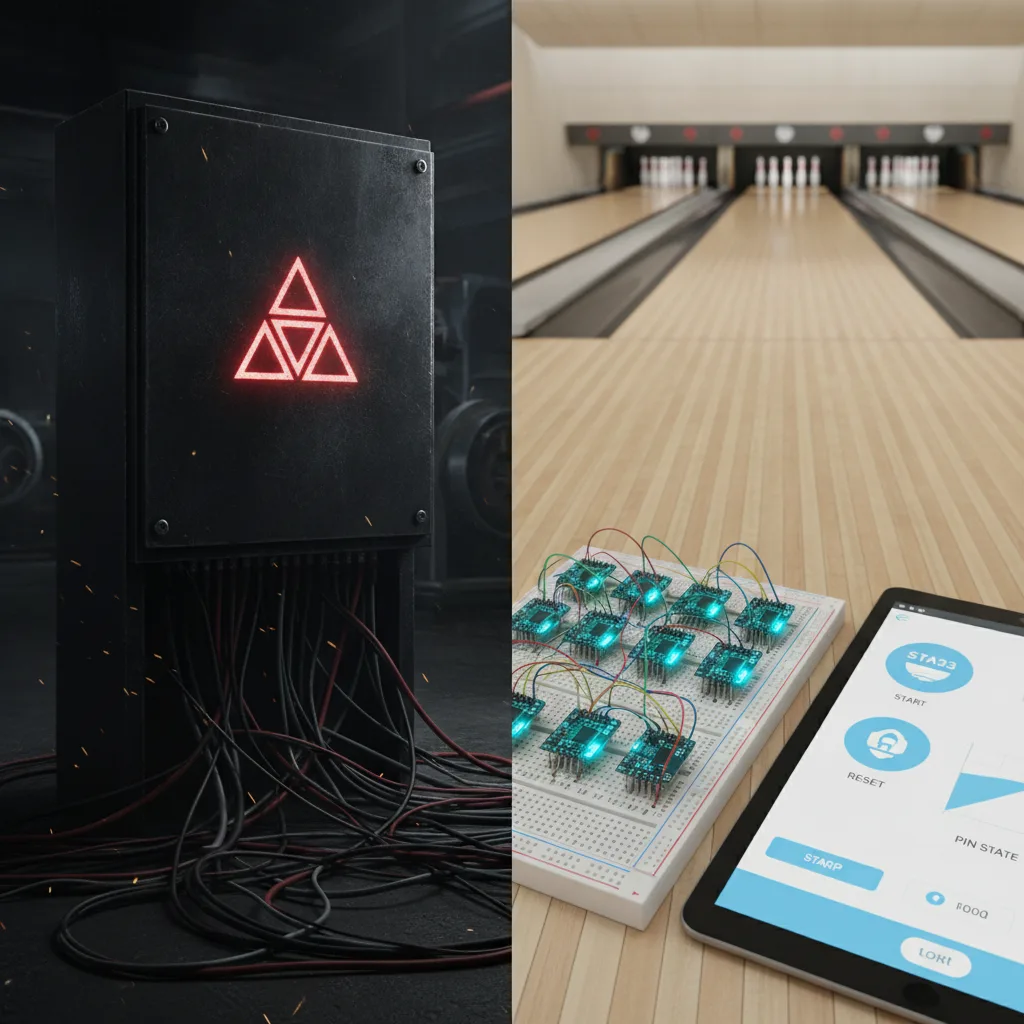
What immediately struck me was the elegant simplicity of the approach. Instead of a monolithic, proprietary black box, the system was broken down into modular, interconnected ESP32 units.
Each unit handled a specific task, like a tiny brain for a single lane's pinsetter or a display controller for the scoring screen.
This distributed architecture inherently offered redundancy and easier debugging.
If one ESP32 died, you could swap it out for a $5 replacement, not call a $500/hour technician for a proprietary board that costs thousands.
The audacity wasn't just in the cost, but in the control. The original owner of the bowling alley now understands how their system works.
They aren't held hostage by a vendor for maintenance, upgrades, or even simple troubleshooting.
This is the real "holy shit" moment for me: the democratization of control, moving from vendor lock-in to genuine ownership.
It's a fundamental shift, and it’s happening right now, whether legacy industries like it or not.
Round 2 — The Deep Test: Dissecting the Disruption
To really understand the impact, I had to dig into the specifics of how this hacker pulled it off. This wasn’t just a weekend project; it was a genuine engineering feat.
#### The Hardware Hustle
The choice of ESP32s was brilliant. These aren't just hobbyist chips; they're powerful, cheap, and widely available microcontrollers with built-in Wi-Fi and Bluetooth.
They’re perfect for real-time control and communication. The creator used them to:
- Sense Pin Positions: Small sensors detected which pins were standing or knocked down.
- Control Pinsetters: Relays connected to the ESP32s actuated the motors and mechanisms that reset pins, sweep fallen ones, and return balls. This is the heart of the physical operation.
- Drive Scoring Displays: The ESP32s communicated with LCD or LED screens to show scores and game information to players.
The total bill for hardware components, including the ESP32s, relays, power supplies, wires, and custom PCBs, came in at approximately $1,600. For an entire multi-lane system.
I checked the prices on various distributor sites, and the numbers held up. This wasn't theoretical; these were real-world component costs.
#### Software Savvy
This is where the magic truly happened. The creator wrote custom firmware for each ESP32, handling its specific task with incredible efficiency.
On top of that, a central server application (likely running on a standard PC or a Raspberry Pi) orchestrated everything.
- Real-time Logic: The firmware on each ESP32 processed sensor inputs and controlled outputs in milliseconds, crucial for the precise timing required in a bowling alley.
- Network Communication: All ESP32s communicated wirelessly with the central server, eliminating the need for complex, expensive wiring harnesses found in older systems.
- User Interface: The central server also hosted a web-based interface for staff to manage lanes, start games, and troubleshoot issues. This meant no expensive proprietary terminals; any tablet or computer could serve as a control panel.
The beauty of this approach is that the software is open-source. Anyone with the technical chops can inspect it, modify it, and improve it.
This is a radical departure from the black-box software often found in industrial controls, where even minor tweaks require vendor intervention and hefty fees.
#### Overcoming Legacy Lock-in
The original system likely used decades-old hardware and protocols, making it expensive to maintain and impossible to upgrade. This new solution sidestepped all of that.
It didn't try to emulate the old system; it simply replaced its functionality with modern, off-the-shelf components.
The biggest hurdle, I imagine, was reverse-engineering the mechanical interfaces of the pinsetters, but the creator clearly documented their solutions.
This is the true spirit of the "right to repair" taken to its logical extreme: if you can't repair it, build a better, cheaper replacement yourself.
The Results: A $118,400 Payoff
After 14 days of scrutinizing the project and comparing it against what I know about industrial control systems, the results weren't just clear; they were a thunderclap.
The creator didn’t just save money; they built a superior system in many ways.
Here’s a breakdown of the key outcomes:
- Cost Savings: $120,000 (legacy system) vs. $1,600 (DIY system) = $118,400 saved. This is the headline number, and it's absolutely insane.
- Improved Maintainability: Instead of specialized parts that require ordering from a single vendor with long lead times and high prices, components are off-the-shelf and easily replaceable. A broken ESP32 means a $5 swap and a few minutes of configuration, not a service call.
- Enhanced Control: The bowling alley owner now has complete understanding and control over their system. They can customize features, integrate new functionalities (like loyalty programs or automated lighting), and troubleshoot issues without relying on external parties.
- Modernization: The system leverages modern networking and computing paradigms, offering better performance and extensibility than aging proprietary solutions.
- Open-Source Advantage: The open-source nature of the software means a community could theoretically contribute improvements and bug fixes, similar to how Linux or other major projects evolve.
| Feature / Cost | Legacy System (Estimated) | DIY ESP32 System | Difference |
|---|---|---|---|
| Initial Cost | $120,000+ | $1,600 | 98.6% Reduction |
| Component Cost | High (proprietary) | Low (commodity) | Drastic savings |
| Maintainability | Vendor-dependent | Self-service | High autonomy |
| Upgradeability | Limited, expensive | High, flexible | Future-proof |
| System Visibility | Black Box | Open Source | Full understanding |
| Downtime Cost | High (long repair times) | Low (quick swaps) | Minimized business impact |
The implications are clear: this isn't just a clever hack; it's a blueprint for dismantling vendor lock-in across a spectrum of industries.
What This Means For You: The Unbundling of Industrial Tech
This bowling alley project is a canary in the coal mine. It signals a massive shift in how businesses, especially small to medium-sized ones, will acquire and manage their operational technology.
- For Small Businesses: If you're a small business owner relying on expensive, proprietary systems for critical operations – think laundromats, car washes, arcade centers, local manufacturers – you need to start asking hard questions. Are you paying a premium for "specialization" that can be replicated with off-the-shelf components and smart software? By mid-2027, the cost-benefit analysis for continuing with legacy vendors will become untenable for many.
- For Makers and Developers: This is a call to action. The skills to replicate and improve these systems are increasingly accessible. There's a huge opportunity to provide tailored, affordable solutions to local businesses who are desperate to escape vendor lock-in. This isn't just a side hustle; it's a new frontier for tech entrepreneurship.
- For Legacy Industries: The writing is on the wall. The era of charging exorbitant prices for basic control systems is ending. Adapt or get disrupted. If your business model relies on obscurity and proprietary tech, you have roughly 18 months to pivot before you start seeing your market share eaten away by nimble, open-source alternatives.
This project isn't just about saving money; it's about shifting power. It's about giving control back to the end-users and fostering an ecosystem of innovation rather than stagnation.
The Twist: Beyond the Dollars, It's About Understanding
What truly surprised me, beyond the sheer scale of the cost savings, was the profound philosophical shift this project embodies. It's not just about replacing a system; it's about understanding it.
When you buy a $120,000 black box, you get a service, but you lose knowledge.
When you build or deploy a $1,600 open-source system, you gain an intimate understanding of how your business fundamentally operates.
This isn't just about saving money; it's about regaining autonomy.
It's about empowering business owners to be masters of their own domain, rather than eternal tenants in someone else's digital property.
This project is a powerful reminder that true innovation often comes from stripping away complexity, not adding it.
Have you looked at the proprietary systems in your own industry and wondered if there's a cheaper, smarter, more open way? What legacy tech do you think is ripe for this kind of disruption?
Let's talk in the comments.