Ran Gemma 4 26B in Just 2GB RAM — On a Mac You Already Own
In this article
Bottom line: A Show HN post this week demonstrated an open-source inference engine running Google's Gemma 4 26B model — a 26-billion-parameter model — inside just 2GB of RAM on a stock M-series Mac, using aggressive quantization and memory-mapped weight streaming instead of loading the full model into memory at once.
The project hit the Hacker News front page with 736 points, drawing both excitement from developers who want to run frontier-adjacent models on laptops and skepticism about quality trade-offs at that compression level.
If it holds up under real-world testing, it changes the math on who can run serious local AI — no cloud API, no $4,000 GPU rig, just the Mac already sitting on your desk.
I was scrolling Hacker News on a Wednesday morning, coffee still too hot to drink, when a headline stopped me cold: someone had gotten a 26-billion-parameter model to run in 2GB of RAM.
For context, that's the kind of memory footprint you'd expect from a browser tab with too many photos open, not a language model that, in its uncompressed form, would need well over 50GB just to load.
By the time I finished my coffee, the post had climbed to 736 points and the comment section had turned into the kind of argument that only happens when a project threatens to make expensive hardware feel unnecessary.
What Actually Shipped
The project is an open-source inference engine, and the core trick isn't new in concept — it's aggressive quantization combined with memory-mapped weight streaming — but the execution is what's turning heads.
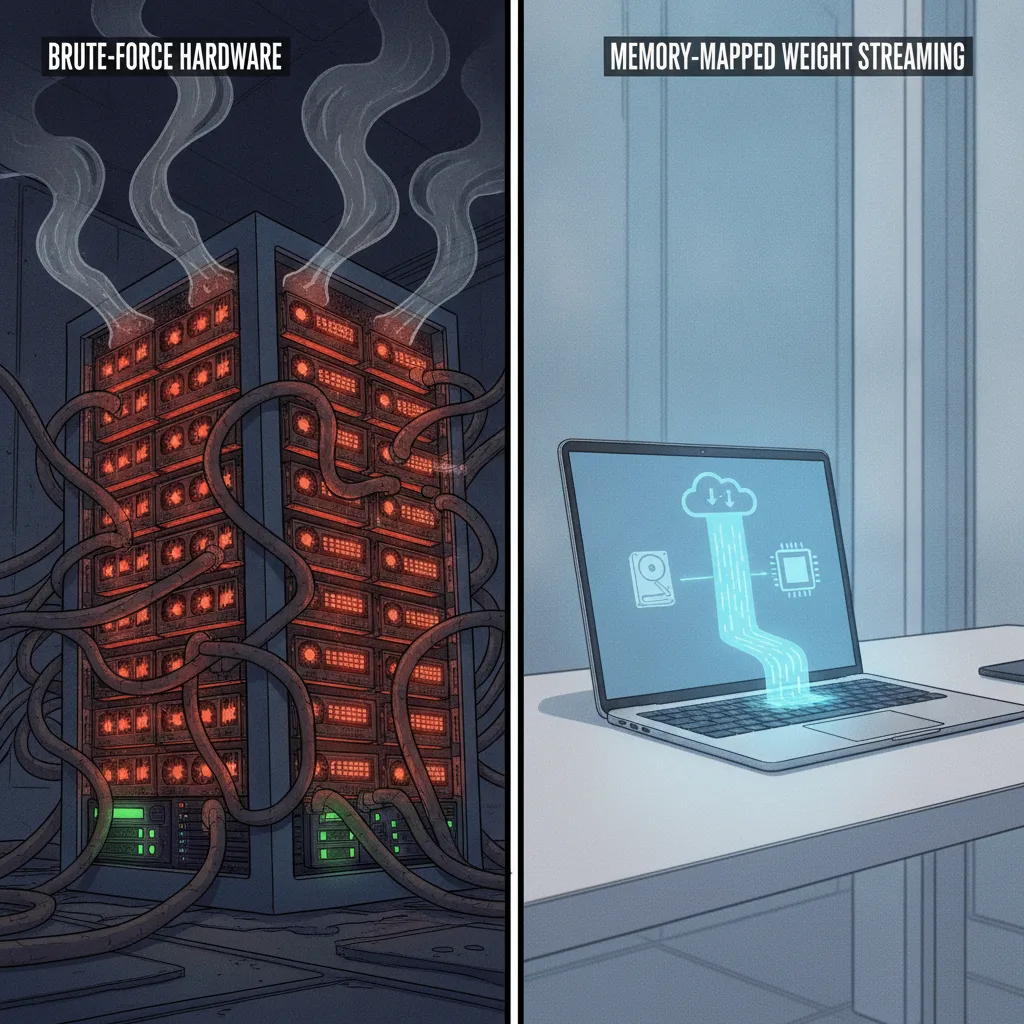
Instead of loading Gemma 4's full 26B parameters into RAM at once, the engine keeps most of the model on disk and streams the pieces it needs, layer by layer, while compressing the weights down far more aggressively than typical 4-bit quantization.
The result: a model that would normally need a workstation GPU runs on a base-model MacBook Air. That's the headline claim, and it's the part driving the engagement.
Apple Silicon's unified memory architecture — where the CPU and GPU share the same RAM pool instead of needing a dedicated VRAM transfer — is part of why this works specifically well on M-series chips.
This isn't the first attempt at squeezing big models onto small machines.
Projects like llama.cpp popularized running quantized models on consumer laptops years ago, and Apple's own MLX framework has been chipping away at the same problem.
What's different here is the RAM ceiling being targeted — 2GB is startlingly low, low enough to run alongside everything else you already have open.
Why Developers Are Paying Attention Right Now
Local AI has been the quiet obsession of a certain slice of the developer world for the past two years.
Every time a new open-weight model drops — Llama, Mistral, Gemma — someone tries to shrink it further, and every time, there's an audience desperate to run it without paying a cloud provider or maxing out a credit card on GPU rental.
The appeal isn't just cost. It's privacy, offline access, and control.
If your model runs locally, your prompts never leave your machine, there's no API rate limit, and there's no risk of a provider changing pricing or deprecating a model out from under you.
For developers building on top of ChatGPT 5 or Claude 4.6 today, that dependency is a real operational risk — one outage or pricing change away from a broken product.
A 26B model at 2GB RAM changes who gets to participate in that conversation. You no longer need a Mac Studio with 128GB of unified memory to experiment with a serious open-weight model.
You need whatever laptop you already own.
The Excitement — and the Skepticism
The top comment threads split roughly into two camps, and both make a fair point.
The optimists are treating this as proof that compression research has outpaced hardware requirements — that we've been overestimating how much RAM "big" models actually need to be useful, and that clever engineering can keep closing that gap faster than model sizes grow.
Several commenters pointed out that this pattern — new model ships, community shrinks it within weeks — has repeated with almost every major open-weight release since Llama 2.
The skeptics are asking the question that matters most: what does the model give up to fit in 2GB? Quantization this aggressive doesn't come free.
It typically costs accuracy, especially on tasks that require nuance — long-context reasoning, precise code generation, multi-step logic.
A model that technically "runs" isn't the same as a model that's actually useful for your workload, and several commenters flagged that the demo examples in the repo lean toward simple completions rather than the harder benchmarks that would reveal quality loss.
That tension — impressive engineering feat versus real-world usability — is exactly the kind of debate that fuels a 736-point thread. Nobody's wrong. They're just optimizing for different things.
What the Track Record Tells Us

This isn't a one-off stunt, even if it's an extreme version of the pattern. The broader trend of local, quantized, on-device inference has been building steadily:
- llama.cpp proved consumer CPUs could run models that once required data-center GPUs - Ollama turned that capability into a one-command install for non-experts - MLX gave Apple Silicon owners a native path to fast local inference - Quantization formats have gone from 8-bit to 4-bit to sub-4-bit schemes in the span of about two years
Each step made a bigger model runnable on smaller hardware.
This project is the most aggressive data point yet on that curve, and it's arriving at a moment when open-weight models themselves — Gemma, Llama, Mistral — are closing the capability gap with closed frontier models faster than most people expected a year ago.
The honest caveat: Show HN demos are demos.
The distance between "runs on stage" and "reliable in production" can be enormous, and the project will need independent benchmarking — on real tasks, not cherry-picked prompts — before anyone should treat 2GB-RAM Gemma 4 as a genuine replacement for a hosted API.
What This Means If You're Building Something
If you're a developer curious about local inference, this is a good moment to actually try it rather than just bookmark the repo.
Test it against your actual use case, not the demo examples in the README.
Run your real prompts, your real code-completion tasks, your real edge cases, and compare the output quality against whatever you're currently using through an API.
If you're building a product that depends on a hosted model, this is worth watching even if you don't switch.
The gap between "needs a data center" and "runs on a laptop" is shrinking every few months, and that has pricing implications — cloud providers can't charge indefinitely for capability that a hobbyist can replicate on a MacBook.
And if you manage infrastructure decisions, it's worth asking now: for which of your workloads is a slightly-more-compressed, locally-run model already good enough?
The answer for a lot of teams is probably "more than you think," even if it's not "all of them yet."
Where This Goes Next
The comment section on the original post is still active, and that's usually the more interesting part of a Show HN thread than the launch itself — that's where the real benchmarking happens, in public, argued out in real time by people with nothing to gain from overselling it.
What happens next depends on whether independent testers can replicate the quality claims outside the curated demo.
If they can, this becomes one of those quiet infrastructure shifts that developers look back on as the moment local AI stopped being a compromise and started being a real option.
Have you tried running a quantized model locally, and did the output actually hold up — or was it a "technically works" situation? I'd genuinely like to know what you found.
Let's compare notes in the comments.