Physicists Don't Know What 95% of the Universe Is Made Of
In this article
Bottom line: Physicists can measure the universe's composition to three decimal places — 4.9% ordinary matter, 26.8% dark matter, 68.3% dark energy — yet have never directly detected the two ingredients that make up 95% of it.
The Dark Energy Spectroscopic Instrument (DESI) released results in 2024 and 2025 suggesting dark energy isn't constant, as the standard cosmological model assumes, but may be weakening over cosmic time.
If that holds up under further data from the Vera C.
Rubin Observatory, it means the equation physicists use to describe the entire universe — Lambda-CDM — is measurably wrong, and nobody has a replacement yet.
This isn't a niche academic gap; it's the majority of existence, unexplained, 93 years after Fritz Zwicky first noticed something was missing.
We've mapped the human genome, split the atom, and built a chatbot that can write a sonnet about your dentist appointment. And we still cannot tell you what 95% of the universe is actually made of.
That sentence should stop you cold, and I don't think it does anymore, because we've all gotten comfortable saying "dark matter" and "dark energy" like they're settled science. They're not settled.
They're names.
Good names, precise names, mathematically load-bearing names — but names for a hole in our understanding, not descriptions of a thing anyone has ever seen, touched, or captured in a detector.
The Setup: A Universe We Can Weigh But Can't See
Here's what's not in dispute.
In the 1970s, astronomer Vera Rubin was measuring how fast stars orbit the edges of spiral galaxies and found something that shouldn't have been possible — the outer stars were moving just as fast as the inner ones, which meant either Newtonian gravity was broken or there was a huge amount of invisible mass holding those galaxies together.
Rubin's data, building on a "missing mass" problem Fritz Zwicky had flagged back in 1933, became the foundation for what we now call dark matter: an invisible substance that doesn't emit, absorb, or reflect light, but bends spacetime like anything else with mass.
Then in 1998, two independent teams studying distant supernovae found something even stranger — the universe's expansion isn't slowing down under gravity's pull, like everyone expected.
It's speeding up.
Something is actively pushing space apart, and we called that "dark energy." That discovery won a Nobel Prize in 2011, and it's now understood to make up roughly two-thirds of everything.

Add it up using the Planck satellite's precision measurements: 4.9% ordinary matter — stars, planets, you, me, every server rack running every model I've ever tested — 26.8% dark matter, and 68.3% dark energy.
We can weigh the universe to three significant figures. We cannot tell you what most of it is.
The Contrarian Reframe: We Didn't Discover Dark Matter, We Named a Gap
Here's where I think the popular science coverage gets it backwards, and it's the same mistake I see constantly in tech.
The framing you'll hear in most YouTube explainers is: "Scientists discovered dark matter." That's generous phrasing for what actually happened.
Scientists discovered that their equations didn't balance, and then named the discrepancy. Dark matter isn't a discovery — it's a receipt for a bill nobody has explained.
I'm not saying it doesn't exist.
The evidence that something with mass and gravitational pull is out there is enormous — gravitational lensing, the cosmic microwave background, galaxy cluster collisions like the Bullet Cluster, all consistent with a form of matter that doesn't interact with light.
But five decades of direct-detection experiments — underground xenon tanks, cryogenic crystal detectors, particle collider searches at the LHC — have found nothing.
Not a trace. Every leading dark matter particle candidate, from WIMPs to axions, remains hypothetical.
We built the idea of dark matter to patch a hole in general relativity's math, and the patch has held up remarkably well for 50 years of tests. That's genuinely impressive.
But "the patch keeps working" and "we know what the patch is made of" are two different claims, and treating them as the same claim is exactly how you get a headline that says "scientists find dark matter" every time an experiment merely fails to rule it out.
And now the patch is showing cracks anyway.
DESI, a spectrograph mounted on a telescope in Arizona that's mapping the 3D positions of tens of millions of galaxies, released results in 2024 and again in 2025 hinting that dark energy's strength may have changed over the past several billion years — not the fixed constant that Lambda-CDM, the standard cosmological model, assumes it to be.
If that result holds up as the Vera C.
Rubin Observatory in Chile comes fully online with its own decade-long sky survey, it doesn't just tweak a number.
It means the model physicists have used since the early 2000s to describe the entire history and fate of the universe needs to be rebuilt.
The Framework: The Label Trap
I want to give you a way to think about this that applies far beyond cosmology, because I've watched the same pattern play out in AI, in engineering, in every domain I've built in.
I call it the Label Trap, and it has three stages.
Stage One: Name the Gap
Something doesn't add up — a measurement, a behavior, a result you can't explain. Instead of leaving it unexplained, you give it a name.
"Dark matter." "Dark energy." In tech, this looks like calling an LLM's unpredictable output "hallucination," or calling a system's emergent behavior "alignment." The name feels like progress.
It isn't — it's a label on an unknown.
Stage Two: Build Around the Label
Once the gap has a name, you build models that incorporate it as a term in the equation.
Lambda-CDM literally has dark energy as the "Lambda" and dark matter as the "CD" (cold dark matter) right there in its name. The models work.
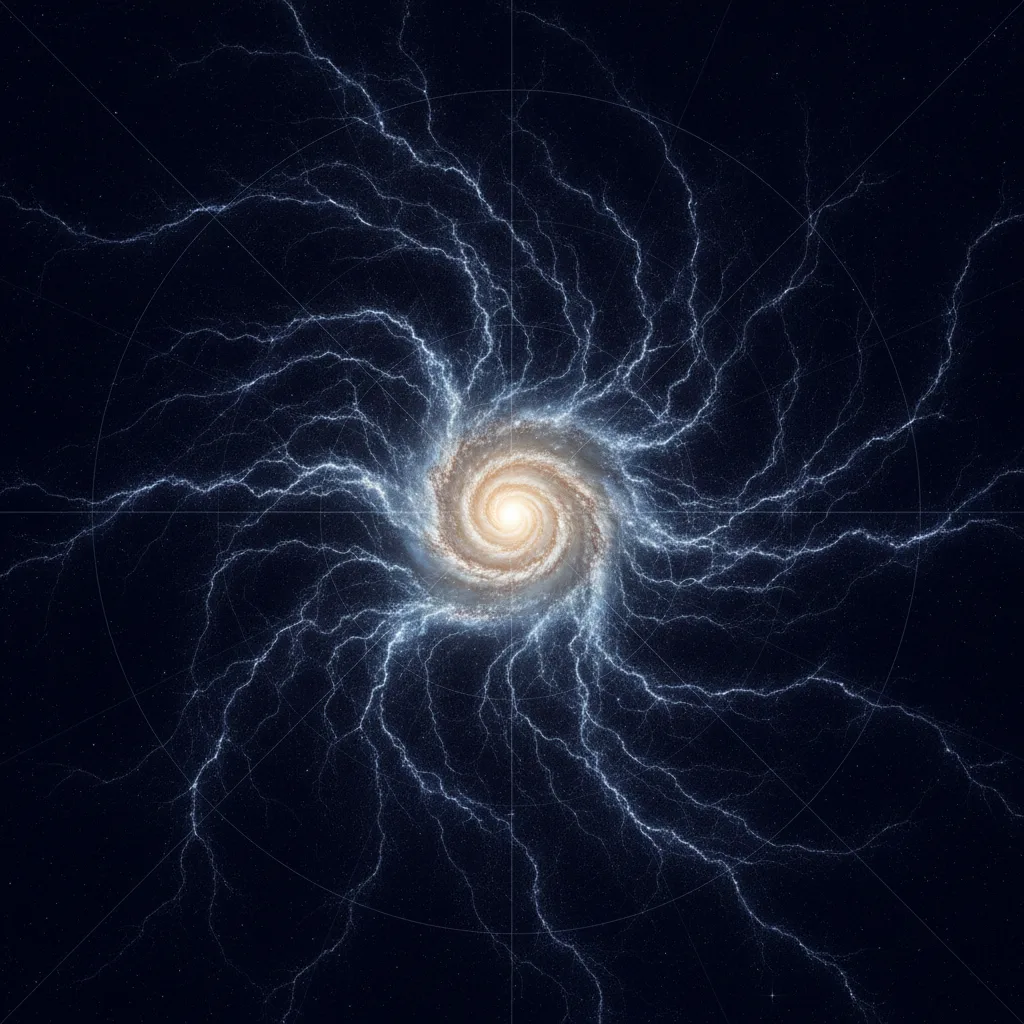
They predict things correctly — the cosmic microwave background, large-scale structure, the age of the universe. Working models create confidence.
Stage Three: Mistake the Model for Understanding
This is the trap.
Because the model predicts things well, everyone — scientists, journalists, YouTube commenters — starts talking about the label as if it were a known quantity rather than a placeholder that happens to make good predictions.
"The universe is 68% dark energy" gets reported with the same confidence as "the universe is 13.8 billion years old," but one of those is a direct, repeatedly-verified measurement and the other is a term we invented because our best model needs it to balance.
I see this same three-stage trap constantly with AI systems.
We name a failure mode, we build guardrails around the named failure mode, and then we talk about the guardrail as if it means we understand why the model failed in the first place. It rarely does.
What This Means If You Work in Tech
You might be thinking: fine, interesting trivia, but why does this matter to someone building software or running a team? Three concrete reasons.
First, the tools you rely on for "objective truth" are about to get a stress test. The Vera Rubin Observatory alone will generate roughly 20 terabytes of imaging data per night once fully operational — cosmology has quietly become a big-data and machine-learning problem.
Analyzing that firehose to find galaxy clusters, lensing events, and supernovae leans heavily on ML pipelines.
If you're an engineer with astrophysics curiosity, this is one of the biggest applied-ML opportunities in science right now, and it's mostly being built by physicists writing Python, not by dedicated ML teams.
Second, this is a live case study in "confident labels versus actual understanding," which is directly relevant if you work anywhere near AI evaluation.
When a benchmark says a model "understands" something, ask what stage of the Label Trap you're in.
Is the benchmark measuring the actual capability, or measuring that the model's outputs are consistent with a model of the capability — the same distinction between "the universe behaves as if dark energy exists" and "we know what dark energy is."
Third, if dark energy really is evolving rather than constant, the long-term fate of the universe changes — heat death under a cosmological constant looks different from a universe where the expansion rate itself is shifting.
That's not a today problem.
But it's a reminder that even our most trusted, most mathematically rigorous models of reality are provisional, and the confidence with which we state them in headlines usually outruns the confidence physicists actually have.
The Bigger Picture
What gets me about this story isn't the physics — it's the humility it demands from a field that gets to be right about almost everything else.
We can predict a solar eclipse to the second, land a probe on a comet, and simulate particle collisions to eleven decimal places.
And still, the majority of what exists is something we've only ever inferred from its shadow.
I think there's something worth sitting with in that.
In tech, we chase the feeling of certainty constantly — a green test suite, a benchmark score, a model card — and mistake it for actual understanding of the system underneath.
Cosmology has been living with exactly that gap, at civilizational scale, for over ninety years, and its response wasn't to pretend the gap didn't exist.
It was to keep naming it, testing it, and building instruments patient enough to eventually prove the label wrong.
So here's my question for you: where in your own work are you treating a name for a problem as if it were an explanation of the problem — and what would it take for you to actually find out?