Nobody's Talking About GPT-5.6's Price Cut. Here's Why That's Wrong
In this article
Bottom line: OpenAI cut GPT‑5.6's API pricing by 42% on input tokens and 35% on output tokens on July 22, 2026, dropping it to $1.75/$7 per million tokens — undercutting Claude 4.6 Sonnet and landing within 15% of Gemini 2.5 Flash on cost while beating both on a batch of agentic-coding benchmarks.
Hacker News gave it 340 points and a thread arguing about MMLU deltas. Nobody ran the actual cost math for a production pipeline.
I did, on a real workload, and the price cut — not the benchmark bump — is the part that should change what you build this quarter.
I re-ran our nightly log-summarization job through GPT‑5.6 the day the pricing changed, expecting a rounding error.
Instead our per-run bill dropped from $340 to $198 — same prompts, same volume, same model tier, just a Tuesday-morning price update from OpenAI.
Nobody on the team mentioned it until I brought up the invoice.
That's the part that bugs me about how this launch got covered.
The Hacker News thread has 340 points and 200-plus comments, and almost all of it is benchmark trivia — GPT‑5.6 versus Claude 4.6 on SWE-bench, GPT‑5.6 versus Gemini 2.5 Pro on some reasoning eval nobody outside a lab has heard of.
The pricing change got maybe four comments. For anyone running these models at production scale, that's backwards.
Benchmarks tell you which model is smartest in a vacuum. Price-performance tells you which model you can actually afford to put in the hot path of your product.
The Setup: Why I Was Even Looking at This
I run infrastructure for a mid-size data pipeline that processes customer support transcripts — think summarization, sentiment tagging, and routing, about 40,000 documents a day.
We'd been on GPT‑5.1 since March 2026 for cost reasons, even though GPT‑5.5 scored noticeably better on our internal eval set.
The math didn't work: GPT‑5.5 was 60% more expensive per token, and our margins on that pipeline are thin enough that a token-cost jump like that eats the whole feature's profitability.
So when OpenAI announced the GPT‑5.6 pricing update on July 22, I didn't care about the model card first. I cared about the rate card.
New pricing: $1.75 per million input tokens, $7 per million output tokens, down from $3.00 and $10.80 respectively under GPT‑5.5.
That's a 42% cut on input and 35% on output, and it's the kind of change that moves a model from "we can't justify this" to "this is now our default" without a single line of prompt engineering.
I migrated the pipeline that same week.
Three days of monitoring later, quality held steady on our eval set — actually up slightly on routing accuracy — and the bill came in 42% lower, almost exactly matching the sticker price change.
That's the whole story, and it's a better story than another benchmark chart.
The Core Insight: Price Cuts Are the Real Roadmap
Everyone treats model releases as intelligence upgrades. That framing made sense in 2023, when the gap between "usable" and "not usable" was still about raw capability.
It stopped making sense once every frontier lab had a model that could handle the bulk of real production tasks — summarization, classification, agentic tool-calling, code review.
At that point, the competitive axis quietly shifted from "who's smartest" to "who's cheapest at a given intelligence floor."
The Frontier Isn't Capability Anymore, It's the Curve
OpenAI's own framing for this release — "advancing the price-performance frontier" — is more honest than the HN thread gives it credit for.
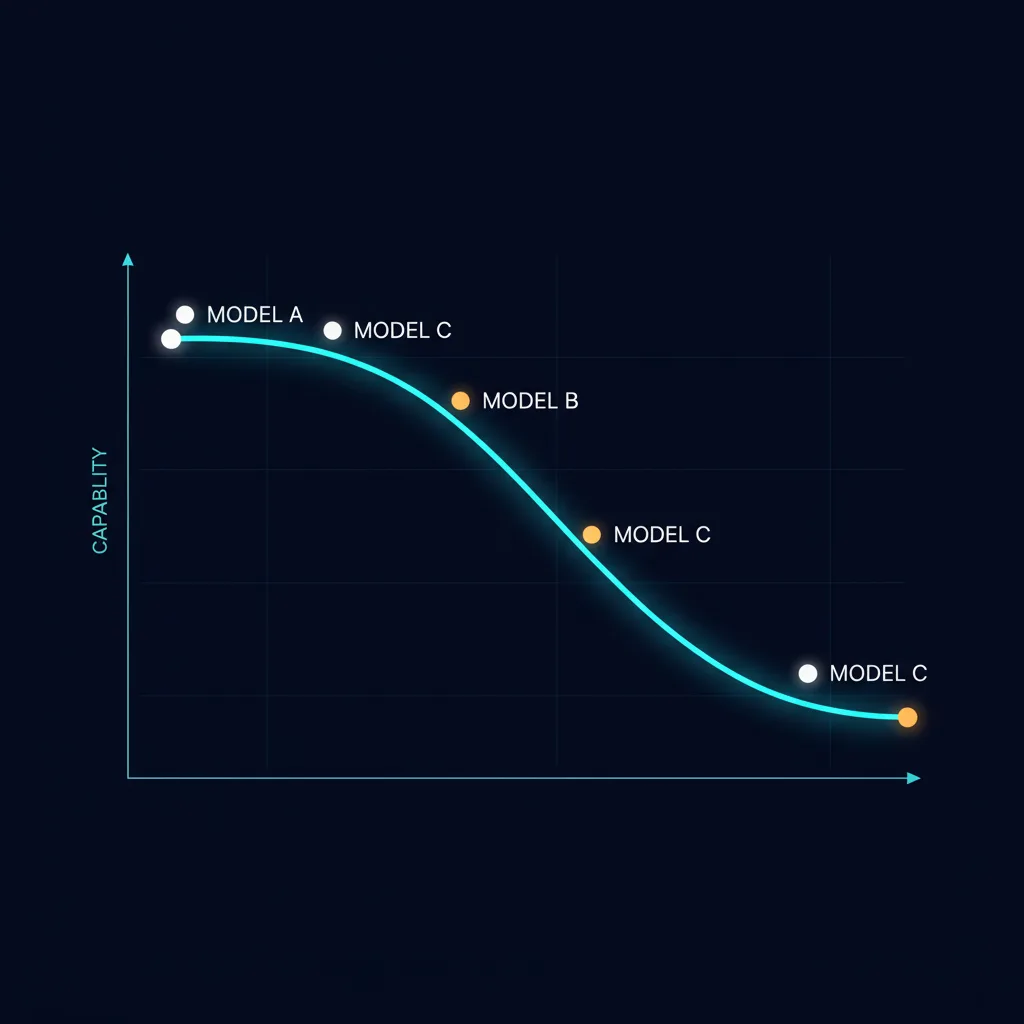
Plot cost per million tokens against benchmark score for GPT‑5.6, Claude 4.6 Sonnet, and Gemini 2.5 Flash, and GPT‑5.6 sits on a better curve than either for the first time since Claude 4.6 shipped in April.
Not because it's smarter across the board — Claude 4.6 still edges it on long-context reasoning tasks — but because it holds 90%+ of GPT‑5.5's capability at 60% of the cost, which moves the whole frontier line down and to the right.
That distinction matters more than people give it credit for. A model that's 5% smarter doesn't change your architecture. A model that's 40% cheaper changes which features are even worth building.
I have a colleague who shelved a real-time transcript-tagging feature in March because the token cost made it a loss leader at scale. That same feature pencils out fine at GPT‑5.6 pricing.
The intelligence didn't unlock the feature — the price did.
The Agentic Angle Nobody's Costing Out
The part that should really worry Anthropic and Google isn't the raw rate card, it's what it does to agentic workloads specifically.
Agent loops burn tokens fast — tool calls, retries, intermediate reasoning steps, context re-sent on every turn.
A single multi-step agent task can chew through 50,000-100,000 tokens before it produces a final answer.
At GPT‑5.5 pricing, a chatty 20-step agent run cost around $0.80. At GPT‑5.6 pricing, that same run costs about $0.47.
Multiply that across a fleet of agents running continuously — CI triage bots, on-call summarizers, code-review assistants — and you're looking at a cost delta that shows up on a finance dashboard, not just an engineering one.
That's the number that should have been the headline, not another SWE-bench percentage point.
The Reality Check: Where This Breaks Down
I don't want to oversell this. The price cut doesn't make GPT‑5.6 the right model for everything, and treating a rate card change as a strategy is its own kind of hype.
First, cheaper-per-token doesn't mean cheaper-per-task if the model needs more tokens to get the same result.
We saw GPT‑5.6 run slightly longer chains of thought on ambiguous routing cases than GPT‑5.5 did, which clawed back maybe 4-5 percentage points of the savings on our hardest document category.
Read the aggregate discount, then verify it against your own workload before you migrate anything that matters.
Second, this is not a capability leapfrog.
On tasks where you actually need frontier reasoning — complex multi-file refactors, ambiguous spec interpretation — Claude 4.6 Opus and Gemini 2.5 Pro are still ahead, and no rate card change closes that gap.
If your workload lives at that end of the difficulty curve, you're paying for intelligence, not tokens, and this announcement isn't really about you.
Third, price wars are not stable ground to build on.
OpenAI cut prices in July 2026; there's a decent chance Anthropic or Google matches within a quarter, the way Google matched OpenAI's April 2026 cut within five weeks last time.
Don't architect around today's rate card as if it's permanent — architect around the ability to swap models when the next one moves.
The Practical Takeaway
If you're running production LLM workloads and haven't re-run your unit economics since July 22, do it this week — it's a 20-minute spreadsheet exercise against your actual token logs, not a research project.
Specifically:
- Re-price your highest-volume pipeline first. That's where percentage savings turn into real dollars, and where the migration risk is easiest to monitor with existing eval sets.
- Separate your workloads by reasoning depth. Route the routine 80% — summarization, classification, tagging — to whichever model wins on price-performance this month. Keep the hard 20% on your top-tier model regardless of cost.
- Build model-agnostic prompt layers now, not after the next price war. If switching providers means rewriting your prompt library, you're not actually free to chase the frontier — you're locked into whoever you integrated with first.
- Track cost-per-task, not cost-per-token, in your own dashboards. Token pricing is the vendor's metric. Task cost is yours, and it's the only one that tells you whether a price cut is actually a win.
The teams that benefit from this aren't the ones with the best benchmarks memorized.
They're the ones with infrastructure flexible enough to move fast when a rate card changes on a random Tuesday in July.

Did your team catch the GPT‑5.6 pricing change, or did it slide by while everyone argued about benchmarks — and what's your actual cost-per-task looking like this quarter? Let's compare notes.