Nobody Warned You About the Amazon Tax. Here's What It's Costing You.
In this article
Bottom line: As of 2023, Amazon kept an estimated 45–51% of every dollar a third-party seller makes on its marketplace, once you add referral fees, fulfillment charges, storage costs, and mandatory advertising — up from roughly 30% a decade ago, according to marketplace analytics firm Marketplace Pulse.
Because Amazon's pricing algorithms have historically penalized sellers who list items cheaper elsewhere, that cut gets baked into the sticker price everywhere, not just on Amazon.
The FTC's September 2023 antitrust lawsuit against Amazon centers on exactly this mechanism.
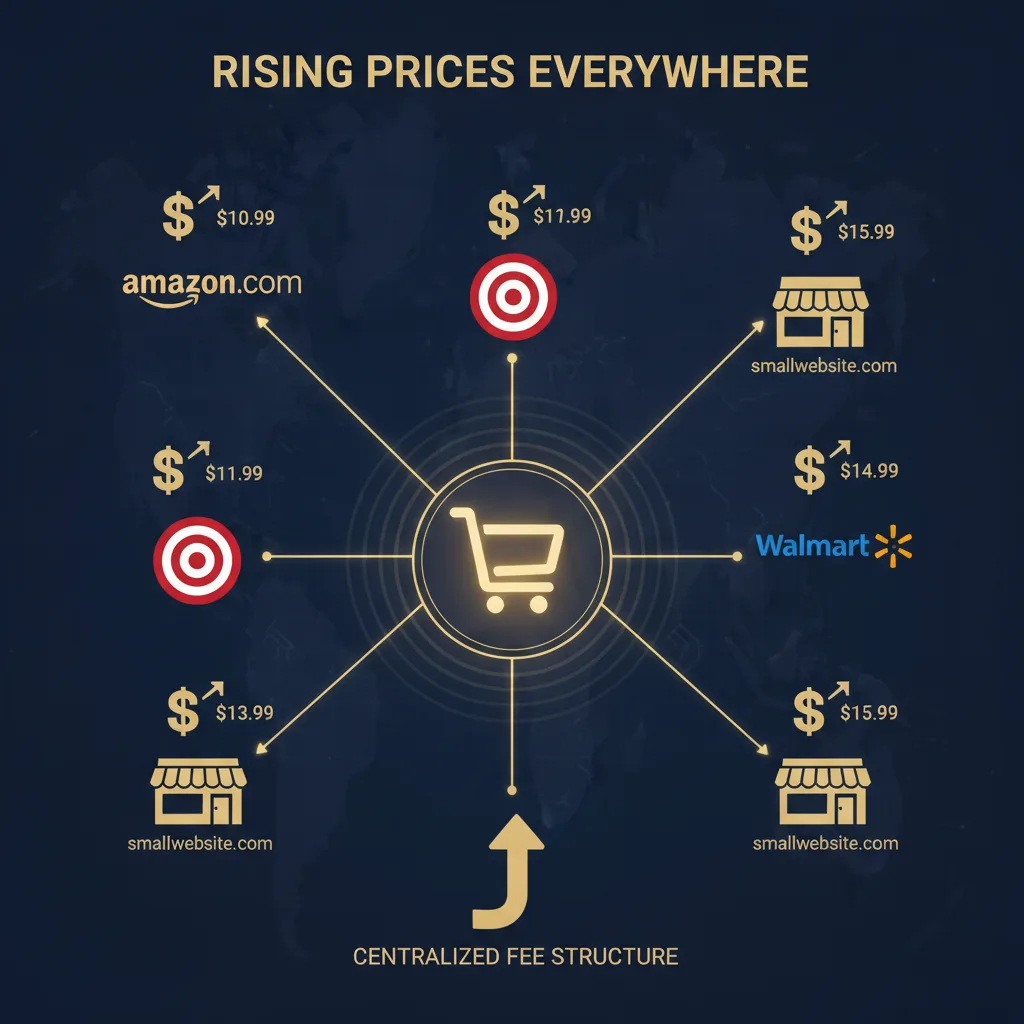
If you've noticed prices creeping up across the web — Target, Walmart, small business websites — some of that increase traces back to a fee structure you've never seen and never agreed to.
I asked a seller who's run a home goods storefront on Amazon since 2015 what percentage of a $40 item actually reaches them. They didn't have to check a spreadsheet.
"About eighteen bucks, if I'm lucky," they said. "And I still have to be the cheapest price on the internet or Amazon buries me."
That's the sentence that stuck with me. Not because it's shocking — sellers have grumbled about Amazon's cut for years — but because of the second half.
Being the cheapest price on the internet, not just on Amazon.
That's the mechanism behind what people are now calling the Amazon tax, and it's why a fee dispute between Amazon and its sellers ends up in your grocery bill even if you've never clicked "Add to Cart."
What the Amazon Tax Actually Is, and Why It's Back in the News
The term isn't new. Developers and economists have used "Amazon tax" loosely for years to describe the platform's rising fees.
But it's resurfaced hard this year, for a specific reason: the FTC's antitrust case against Amazon, filed in September 2023 alongside 17 state attorneys general, is grinding toward trial, and discovery has surfaced internal detail about exactly how the company enforces pricing across the web.
The core allegation is straightforward.
The FTC says Amazon used an internal algorithm — reportedly nicknamed "Project Nessie" — to detect when it could raise prices without competitors following, and separately, that Amazon's search and Buy Box ranking systems punish sellers who offer lower prices on other sites.
If you sell a blender on Amazon for $50 and on your own Shopify store for $45, Amazon's algorithm can bury your Amazon listing or strip your Buy Box eligibility.
The rational response, sellers say, is to just raise the price everywhere to $50.
That's the tax. It's not a line item. It's a price floor, enforced algorithmically, that ripples outward from one platform to the entire retail internet.
The Seller's View: A Slow Squeeze That Became a Structural Problem

The seller I spoke with put it in blunt terms: this isn't one fee, it's five, stacked.
There's the referral fee, which Amazon takes as a percentage of the sale price — typically 15% for most categories, though it ranges from 8% to 45% depending on what you sell.
Then there's fulfillment: if you use Fulfillment by Amazon (FBA), which most competitive sellers effectively have to, you're paying per-item picking and packing fees plus monthly storage costs that spike hard around the holidays.
Then advertising. This is the part sellers say has changed the most. A decade ago, ranking well on Amazon search was mostly about reviews and price.
Now, the seller told me, "if you don't advertise, you don't exist." Sponsored placements have become close to mandatory for visibility, and sellers increasingly describe their ad spend — often 10 to 15% of revenue — less as marketing and more as a toll for being findable at all.
Add it up, and Marketplace Pulse — a research firm run by e-commerce analyst Juozas Kaziukėnas that has tracked Amazon seller economics for years — has estimated Amazon's effective take rate climbed to somewhere between 45% and 51% of a typical sale by 2023, up from around 40% in 2020 and roughly 30% in 2016.
Amazon disputes framing its fees this way, arguing sellers voluntarily choose optional services like FBA and advertising.
But sellers I've heard from describe those services less as optional and more as the price of remaining visible on a platform that, in many categories, is the only place their customers are actually looking.
"You can absolutely sell without FBA and without ads," the seller said. "You'll also sell almost nothing."
The Counter-Argument: Amazon Says This Is How Marketplaces Work
Not everyone frames this as extraction.
Amazon's own public position, echoed by some retail analysts, is that its fees reflect real infrastructure costs — warehousing, two-day shipping, customer service, fraud protection — that sellers would otherwise have to build themselves, often at higher cost and lower quality.
A marketplace consultant who advises direct-to-consumer brands on channel strategy told me the comparison she uses with clients is instructive: running your own fulfillment and driving your own traffic can easily cost more than Amazon's cut, once you price in warehouse leases, a logistics team, and paid search on Google, which isn't exactly cheap either.
There's also a genuine counterpoint on the price-parity allegations specifically: Amazon has said its ranking systems are designed to protect customers from being shown a worse deal than what's available elsewhere, not to punish sellers arbitrarily.
Whether that's a customer-protection feature or a de facto price-fixing mechanism is precisely the question the FTC's case is trying to answer, and it hasn't been resolved by a court.
It's worth being honest about that: the "Amazon tax" framing assumes the FTC's theory of the case is correct. It's a serious, well-evidenced allegation — not yet a legal finding.
Still, even the more sympathetic read doesn't really dispute the arithmetic. It disputes whether the arithmetic is fair.
What the Evidence Actually Shows
Strip away the framing fights and a few things are well documented.
Amazon's referral and fulfillment fee schedules are public and have risen multiple times in recent years, including new charges introduced in 2024 for low-inventory levels and returns processing.
Advertising has gone from a niche tool to, per seller surveys cited across trade press, a near-universal cost of doing business on the platform.
And the FTC's complaint — a public document, not speculation — explicitly alleges that Amazon's anti-discounting tactics have kept prices elevated "not just on Amazon.com, but across the internet," because retailers that also sell through Amazon are effectively locked into matching Amazon's price floor everywhere they sell.
That last point is the crux of why this isn't just a seller-forum complaint.
If a company sets its price based on the platform demanding the highest cut, and that price becomes the price on its own website too, then someone who has never bought anything from Amazon in their life is still paying Amazon's toll.
It shows up wherever that seller does business.
What This Means If You're Building or Buying
If you're a developer or founder building a DTC brand, the practical lesson from every seller I've talked to is the same: model your Amazon channel and your direct channel as genuinely separate businesses with separate pricing logic, and go in eyes open about what "channel parity" enforcement can do to your margins elsewhere.
Several sellers described intentionally building their non-Amazon storefronts around bundles or slightly different SKUs specifically so pricing algorithms can't do an apples-to-apples comparison — a workaround, not a solution.
This is part of a developer's story.
If you're a consumer, the honest takeaway is less actionable but worth knowing: "shopping around" only escapes the Amazon tax if the retailer you're comparing against isn't also selling on Amazon.
Increasingly, that's a smaller and smaller set of retailers.
Where This Goes Next
The seller I opened with isn't waiting on the FTC to fix this.
They're diversifying — building an email list, testing Walmart Marketplace, slowly weaning revenue off Amazon dependency, one percentage point at a time.
It's slow, unglamorous work, and they're not confident it'll be enough before the next fee increase lands.
"Everyone talks about Amazon like it's just where you shop," they told me near the end of our conversation. "For us it's the landlord, the toll booth, and the competitor, all at once."
Have you noticed prices creeping up at stores that have nothing to do with Amazon — or is that just where you happened to be shopping anyway?