Nobody Talks About This 2-Minute Productivity Secret. This Changes Everything.

I lost an entire Tuesday to a single email.
It wasn’t even a particularly difficult email; it was a simple request for a project update that landed in my inbox at 10:14 AM while I was halfway through a deep-dive analysis into London’s shifting gallery culture.
By 10:16 AM, I had replied. By 10:17 AM, I was staring at a tab I didn't remember opening, wondering why I was suddenly researching the best espresso tonics in Marylebone.
The "Two-Minute Rule"—that darling of the early 2010s productivity movement—told me to do it. If it takes less than two minutes, do it now, they said.
It sounds efficient, logical, and almost dangerously simple.
But in the hyper-fragmented reality of April 2026, where ChatGPT 5 and Claude 4.6 can generate a week’s worth of work in seconds, our problem isn't "getting things done." Our problem is the wreckage we leave behind in the gaps between those things.
We have been sold a lie about efficiency that is quietly destroying our ability to think deeply.
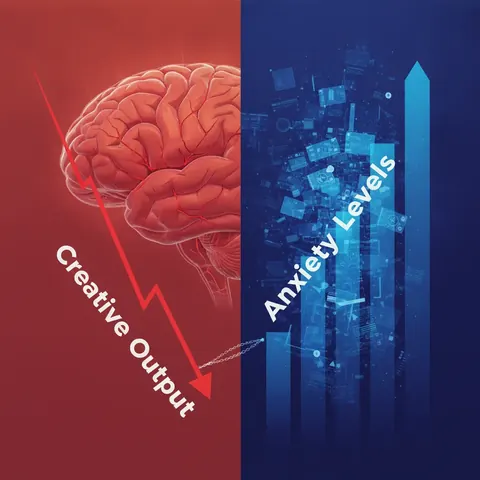
After a month of failing to maintain any semblance of creative flow, I realized that the "do it now" mantra is a cognitive trap.
True productivity isn't about the two minutes you spend doing the task; it’s about the two minutes you spend protecting the transition.
The Myth of the Seamless Switch
We like to imagine our brains as sleek, high-performance processors, capable of switching from a complex spreadsheet to a Slack message with the flick of a digital toggle.
In reality, our grey matter is more like a heavy freight train. You cannot slam it into reverse at sixty miles per hour without the entire system screaming in protest.
Psychologists call this "attention residue," the lingering ghost of the previous task that haunts your brain long after you’ve clicked "send."

When you "just quickly" handle a two-minute task in the middle of something else, you aren't just losing two minutes.
You are incurring a cognitive tax that can last up to twenty minutes as your brain struggles to re-orient itself to the original goal. In 2025, we could perhaps afford this leak.
In 2026, with the sheer volume of information being pushed through our neural pathways by autonomous agents, this attention residue is becoming a terminal condition for focus.
I spent weeks observing the most effective people I know—the ones who seem to inhabit a different time zone than the rest of us.
They weren't faster at typing, and they weren't using more sophisticated AI wrappers. They simply refused to acknowledge the two-minute rule as it was originally written.
They had replaced it with something far more potent, something I’ve started calling The Two-Minute Tilt.
Why Conventional Wisdom Is Failing Us in 2026
The world has changed more in the last eighteen months than it did in the previous decade.
We are now living in an era where the "cost of doing" has dropped to near zero, while the "cost of deciding" has skyrocketed.
Because it’s so easy to generate content, emails, and code, we are flooded with "small" tasks that masquerade as progress.
If you follow the traditional two-minute rule today, you will spend your entire life doing small things and never accomplish anything great.
The Two-Minute Tilt is the opposite of the "do it now" reflex.
It is the intentional practice of using those 120 seconds to decompress from what just happened and calibrate for what is about to happen. It is a palate cleanser for the mind.
Instead of rushing to the next item on the digital conveyor belt, you pause to ensure the "residue" of the last task is fully cleared.
I tested this protocol for thirty days, and the results were almost embarrassing. I didn't work more hours; in fact, I worked about two fewer hours per day.
Yet, for the first time in years, I finished my days feeling energized rather than hollowed out. I stopped being a slave to the "quick win" and started mastering the art of the intentional transition.
The Framework: Mastering The Two-Minute Tilt
To implement this, you have to be willing to look a bit "slow" to the outside world. You have to ignore the ping.
You have to let the "quick question" sit in the notification shade for just a moment longer.
The Tilt is a three-part choreography that takes exactly two minutes, but it rewires how your brain approaches the subsequent hour of work.
Step 1: The Tactical Exit (40 Seconds)
Most of us "end" a task by simply stopping. We close the tab and jump. This is a mistake.
The Tactical Exit requires you to spend forty seconds summarizing the state of the task you are leaving. If you were writing, what is the very next sentence you intended to write?
If you were coding with Claude 4.6, what was the last prompt you were refining?
By externalizing the "next step" before you leave, you signal to your brain that it is safe to let go of the current context.
You are essentially "saving" your progress in your physical memory so your working memory can be wiped clean. This prevents the "did I forget something?" itch that usually derails the next task.
Step 2: The Biological Reset (40 Seconds)
This is the part everyone skips because it feels too simple to be effective. For forty seconds, you must physically disconnect from the screen.
In my flat in London, this usually means staring at the rain-streaked window or the way the light hits the brickwork across the street.
The goal is to reset your visual focus from the "near-field" of the monitor to the "far-field" of the world.
This isn't just "mindfulness" fluff; it’s a physiological necessity.
Constant screen-staring keeps your nervous system in a state of low-level "fight or flight." By shifting your gaze and taking three deep, deliberate breaths, you drop your cortisol levels and tell your brain that the "emergency" of the previous task is over.
Step 3: The Intentional Entry (40 Seconds)
Finally, you spend the last forty seconds defining the success metric for the next task.
Before you open that new tab or join that Zoom call, ask yourself: "What is the single most important outcome of the next thirty minutes?" Don't list five things. Pick one.
If you can't define it in forty seconds, you aren't ready to start the task.
This step acts as a filter. Often, during this forty-second Tilt, I realize that the task I was about to "quickly" do isn't actually necessary at all.
It’s just a distraction wearing a "two-minute" mask. By forcing this moment of intentionality, you ensure that you are the architect of your day, not just its janitor.
The Cultural Resistance to Silence
The hardest part of adopting The Two-Minute Tilt isn't the technique itself; it’s the cultural pressure to be "always on." In a city like London, where everyone is performing a version of "busy" that feels increasingly like a stage play, choosing to spend two minutes doing nothing looks like a radical act of defiance. We have become terrified of the gap.
We fill every transition with a scroll through Threads or a quick check of the headlines. We think we are "resting" our brains, but we are actually just feeding them more data to process.
The Tilt requires you to be comfortable with the silence between the notes. It requires you to trust that your value isn't measured by how quickly you reply, but by the quality of the thought you bring to the table once you do.
Since I started Tiling, I’ve noticed that my interactions with AI have changed as well.
Instead of throwing "quick" prompts at Gemini 2.5 and hoping for the best, I find myself entering the interaction with a level of clarity that produces far better results.
Better inputs require a quiet mind. You cannot give a machine clear instructions if your own internal signal is drowned out by the static of a dozen unfinished "two-minute" chores.
Real-World Application: The 2026 Lifestyle
If you’re working in a high-pressure tech environment or a creative field, you might think you don't have time for this. You might think your manager expects an instant response.
But I’ve found that people actually respect a slightly delayed, high-quality response more than an instant, shallow one. It signals that you are a person of deep work, not a person of frantic reaction.
I started applying the Tilt to my personal life too. When I get home to my partner, I take a Two-Minute Tilt in the hallway.
I exit the "writer" persona, reset my biology from the commute, and enter the "partner" role with intention.
The difference in our evening conversations was immediate. I was actually there, rather than being a ghost haunted by my own unfinished paragraphs.
We are living in an era of infinite leverage. One person with a clear head and a suite of AI tools can out-produce a hundred-person agency from 2020.
But that leverage only works if you are the one pulling the lever, not the one being crushed by it. The Two-Minute Tilt is how you stay on top of the mechanism.
Why This Changes Everything
It sounds small. It sounds like something you’ve heard before, but I promise you, you haven't—not in this way. We have spent years trying to squeeze more into our time.
The secret to 2026 isn't more stuff; it’s more space.
The space is where the insight happens. The space is where you realize that the "urgent" email can wait, and the "important" project needs a different approach entirely.
By reclaiming these two-minute windows, you aren't just becoming more productive. You are becoming more human. You are refusing to let the algorithms dictate the pace of your nervous system.
You are choosing to live in the tilt, rather than the tumble.
I’ve found that my most profound ideas don't come while I'm typing. They come during those forty seconds of staring at the brickwork in Marylebone. They come because I gave them a place to land.
Stop trying to save two minutes and start trying to save your mind. Everything else will follow.
Have you noticed your focus slipping into the "two-minute trap" lately, or have you found another way to protect your deep work in 2026?
I’d love to hear how you’re navigating the noise—let’s talk in the comments.