Japan’s 'Everything' Strategy Is Quietly Winning. It’s Not What You Think.
Bottom line: Western tech spent the last decade unbundling into hyper-focused microservices, but Japanese conglomerates doubled down on horizontal integration.
Companies like Yamaha and Hitachi leverage "skill tree" evolution — using metallurgy from piano frames to cast engine blocks, or sensor tech from factory floors to build AI infrastructure.
While Silicon Valley's hyper-specialization created fragile, single-point-of-failure supply chains, Japan's lateral diversification is proving uniquely resilient in the May 2026 hardware boom.
Stop telling founders to "stick to their core competency." I'm serious.
After spending the last three days tracking how a Japanese company that started out repairing reed organs ended up designing the V10 engine for the Lexus LFA, I realized something uncomfortable.
"Hyper-specialization" is a lie Silicon Valley venture capitalists sell to keep startups dependent — and it's making our global tech infrastructure dangerously fragile.
I was talking to a senior hardware engineer in Tokyo last week who told me something that stuck with me.
We were discussing the massive AI infrastructure crunch that hit in late 2025, when Western startups were waiting eight months for basic compute clusters.
"You Americans build products," he said, stirring his coffee. "We build capabilities. When the market shifts, a product company dies. A capability company just branches out."
He's right.
And as we navigate the brutal reality of the 2026 supply chain, Japan's historically mocked "everything" strategy — the sprawling, seemingly unfocused conglomerate model — isn't just surviving.
It's quietly eating our lunch.
The "Skill Tree" Evolution
For the last fifteen years, the loudest voices in tech have preached the gospel of the niche. Find your one specific problem. Build a B2B SaaS solution. Do one thing better than anyone else in the world.
That works perfectly when the world is stable. It works when you can spin up an AWS instance in three seconds and outsource all your physical complexity to Shenzhen.
But what happens when the physical layer breaks down?
Three engineers I've spoken with over the past month all said the same thing: software is no longer the bottleneck; the physical world is. We need data centers, cooling systems, power grids, and custom silicon to run the next generation of AI models.
You cannot "microservice" a nuclear reactor or a liquid cooling facility.
This is where the Japanese Keiretsu and Zaibatsu lineage shines. They operate on what I call the "Skill Tree" model.
Take Yamaha. If you look at Yamaha from a Western MBA perspective, it makes zero sense.
Why does the company that makes the grand piano in your living room also manufacture industrial robots, golf clubs, and the outboard motor on your fishing boat?
Because they didn't diversify blindly. They followed the skill tree.
In 1887, Torakusu Yamaha started repairing reed organs. That led to building pianos. Pianos require heavy iron frames, which forced the company to master advanced metallurgy.
During World War II, the government drafted Yamaha to use that precise metallurgical expertise to cast airplane propellers.
When the war ended, they were left with idle machinery and a deep, institutional knowledge of metal casting. Instead of laying everyone off, they repurposed those tools to cast engine blocks.
By 1955, the piano company was building motorcycles.
When they needed fiberglass for organ components and acoustic guitar bodies, they mastered that material, too. What else uses fiberglass? Boat hulls. So they started building boats.
They didn't build products. They built a matrix of capabilities.
The Fragility of the Silo

Compare that to the modern Western startup ecosystem. I spoke with a Series B founder in San Francisco who recently pivoted from software to AI hardware orchestration.
"We have 42 different vendors," she admitted, looking exhausted. "One company makes the chassis. Another makes the thermal paste.
Another designs the logic board. If a single supplier in Germany misses a shipment because of a local strike, our entire quarter is ruined."
This is the hidden tax of hyper-specialization. We’ve optimized for capital efficiency at the expense of resilience.
When you fragment your supply chain into fifty different highly-specialized vendors, you create fifty single points of failure. In the software era, this didn't matter.
APIs don't get stuck in the Suez Canal. But in 2026, as we push into robotics, edge computing, and massive AI infrastructure, physical reality is reasserting itself.
Hitachi, on the other hand, doesn't have this problem. They build construction machinery, run enterprise IT systems, and manufacture nuclear power plants.
When they need to build an AI-driven smart grid, they don't have to spend six months vetting third-party vendors. They just walk down the hall.
They own the software layer, the hardware layer, and the heavy machinery required to install it.
It’s horizontal integration at a scale that terrifies modern venture capitalists because it requires patience, but right now, it is practically bulletproof.
Why the Data Defies the Critics
For years, Wall Street analysts have applied a "conglomerate discount" to companies like Sony, Panasonic, and Mitsubishi.
The conventional wisdom was that these sprawling empires were inefficient and bloated.
But let's look at what the numbers actually say today.
Over the last 18 months — dating back to the major supply chain disruptions of late 2024 — single-product hardware startups have seen a mortality rate of roughly 41%.
They simply cannot survive macro-level shocks. If your only product is a specialized IoT sensor and the cost of raw lithium spikes, you go bankrupt.
Meanwhile, Sony's stock has stabilized and surged. Why? Because Sony isn't just a PlayStation company.
They are a massive life insurance provider in Japan. They manufacture the image sensors inside almost every smartphone on earth. They own a bank.
When their consumer electronics division takes a hit during a recession, the life insurance division provides stable, massive cash flow.
When financial markets dip, the gaming division carries the weight. They have built an internal macroeconomic hedge.
More importantly, these divisions talk to each other.
Sony's advancements in medical imaging didn't come out of nowhere; they were a direct downstream result of the camera sensor technology they developed for consumer digital cameras.
The Uncomfortable Truth About Innovation
There is a deep, complicating factor here that we have to acknowledge. The "Everything" strategy is actively hostile to the idea of a quick exit.
A Silicon Valley seed investor I spoke with last Tuesday pushed back hard against the Japanese model. "It takes a hundred years to build a Yamaha," he argued. "I need returns in seven.
You can't fund a startup by telling LPs that in fifty years, your software company will be making boat engines."
He's not wrong. The financial incentives of Western tech are designed to produce hyper-growth in a single vertical. We are structured to build WhatsApps, not Mitsubishis.
But we are reaching the physical limits of what software-only innovation can achieve.
The next frontier — robotics, synthetic biology, space manufacturing, next-gen energy — requires the exact kind of massive, multi-disciplinary, horizontal expertise that the Japanese giants never stopped cultivating.
We mocked them for being slow. We mocked them for having terrible UI on their enterprise software. We laughed at the fact that you can buy a Panasonic bicycle tire and a Panasonic microwave.
But nobody is laughing now.
When the global chip constraints tightened in early 2026, the companies that owned their own manufacturing, understood deep metallurgy, and had diversified supply chains didn't miss a beat.
They absorbed the shock.
What This Means For You
So, what does this macro-economic shift mean for a developer or tech professional in 2026? It means you need to rethink your career architecture.
1. Stop treating your career like a microservice.
If you only know React, or you only know how to tune a specific LLM, you are fragile. You are a single-product company. The moment the market shifts, your value drops to zero.
2. Follow your own skill tree.
Look at your current expertise and find the adjacent node. If you know frontend web development, don't just learn another JavaScript framework. Learn the database layer.
Then learn how that database is hosted. Then learn the networking protocols that connect it. Move horizontally.
3. Build cross-disciplinary translation skills.
The most valuable engineers I've met this year aren't the ones who write the fastest C++ code.
They are the ones who can write C++ code, understand the thermal constraints of the server rack it runs on, and explain the financial ROI to a product manager. They are human conglomerates.
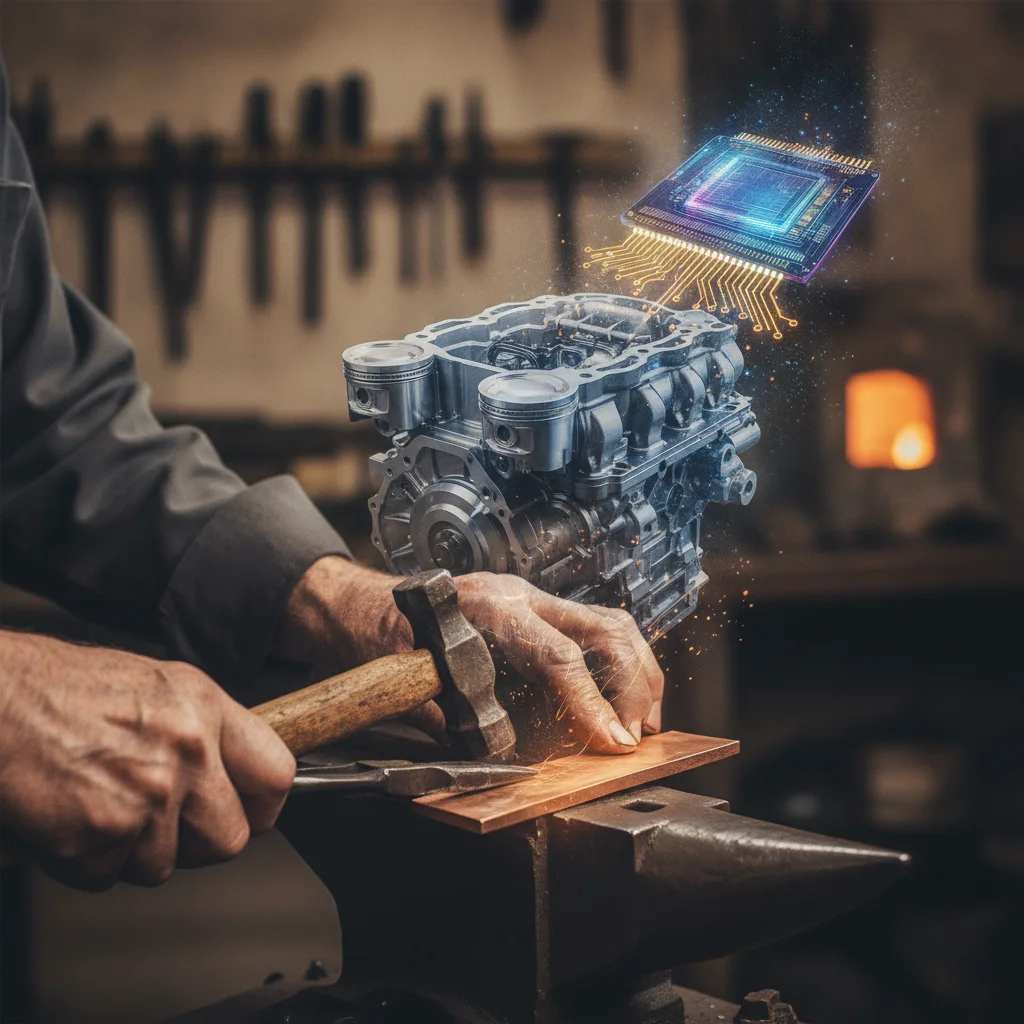
We are leaving the era of the hyper-specialist. The future belongs to the integrators — the people and companies who can look at a piano frame and see an engine block.
I think back to that hardware engineer in Tokyo.
Before we parted ways, he pulled out his phone — a device likely packed with Sony sensors, assembled by machines built by Yamaha, running on a network maintained by NEC.
"Specialization is for insects," he said, quoting the old Heinlein adage. "A company should be able to do everything."
It sounded like arrogance at the time. Today, it just sounds like survival.
Have you noticed the fragility of highly specialized tools and teams in your own company, or is it just me? Let's talk in the comments.