Inkling: Our Open-Weights Model
In this article
Bottom line: I ran Inkling, a new open-weights large language model, in a head-to-head comparison against ChatGPT 5 for a full month across common professional tasks like code generation, content creation, and data analysis.
While ChatGPT 5 maintained a slight edge in creative nuance, Inkling achieved 90% comparable quality for a 95% reduction in direct API costs, proving that open-weights models are now a viable, cost-effective alternative for many use cases.
This shift signals a significant disruption in the AI ecosystem by early 2027, challenging the dominance of proprietary models.
I deleted every productivity app on my phone. All of them. What happened over the next 30 days rewired how I think about focus — and exposed the $4.7 billion industry that's been lying to us.
Okay, maybe not all of them, but I definitely felt like I was being lied to.
For years, I’ve been a card-carrying member of the proprietary AI fan club, happily shelling out for the latest and greatest versions of tools like ChatGPT 5 and Claude 4.6. Why?
Because, like many of you, I believed paying a premium was the only way to get truly cutting-edge, reliable AI output.
It was an unspoken rule: free or open-source meant "good enough," but never "the best."
Then, a few weeks ago, something shifted. My Hacker News feed started buzzing about "Inkling," a new open-weights large language model that promised performance competitive with the big players.
I scrolled past it at first, a cynical smirk playing on my lips.
Yeah, right. Another open-source project that's 80% there, but falls apart when you really push it. But the chatter persisted, growing louder. People were genuinely excited.
My curiosity, that pesky little devil, got the better of me. Could a "free" model really stand toe-to-toe with the titans I was paying good money for? I had to know.
My expensive subscriptions felt suddenly… vulnerable.
The Rules of the AI Thunderdome
To settle this once and for all, I decided to run a brutal, no-holds-barred experiment.
For 30 days — from July 16, 2026, to August 15, 2026 — I put Inkling and ChatGPT 5 head-to-head on every single AI task that crossed my desk.
This wasn't some theoretical benchmark; this was my actual work, my actual deadlines, my actual reputation on the line.
The rules were simple, designed for maximum fairness and minimal bias. Both models received the exact same prompts, the exact same context, and were tasked with solving the exact same problems.
Inkling ran locally on my desktop rig — a beast with an RTX 5090 and 128GB of RAM, ensuring I wasn't bottlenecked by hardware.
ChatGPT 5 was accessed via its API, reflecting real-world usage and cost.
I meticulously logged everything: output quality (on a 1-5 scale, with 5 being perfect), generation time, and, critically, the API costs for ChatGPT 5.
To add a layer of objectivity, I even had a colleague do blind reviews on a subset of the creative writing outputs. I was ready to prove my expensive habits were justified.
Round 1 — The Shock of First Impressions
I expected Inkling to stumble out of the gate, to show its "open-weights" pedigree with clunky prose or buggy code.
I honestly thought I'd be able to declare ChatGPT 5 the undisputed champion within the first few days and get back to my regularly scheduled programming (and billing).
I was wrong.
Within the first hour, I noticed something nobody warned me about: Inkling wasn't just competent, it was fast. Running locally, the inference speed was a revelation.
No network latency, no server queues, just instant gratification.
For basic code generation tasks, like whipping up a Python script to parse a JSON file or a simple JavaScript function for DOM manipulation, Inkling was often spitting out identical, runnable code in a fraction of the time.
It felt like I had a turbo-charged AI co-pilot, always ready, always on.
ChatGPT 5, of course, was still excellent.
Its outputs for more nuanced tasks, particularly marketing copy, felt a touch more polished, more "human." Inkling's prose, in comparison, was functional but sometimes a bit stiff, like a brilliant but socially awkward genius.
But the real gut punch came when I looked at the cost column.
Inkling's cost for these initial tasks? A big, fat $0. My ChatGPT 5 API calls, even for quick queries, were already starting to add up.
This wasn't just about quality; it was about the cold, hard cash disappearing from my wallet.
Round 2 — Pushing the Limits
After the initial surprise wore off, I decided to truly push both models. I threw increasingly complex, real-world scenarios at them, mirroring the demands of my daily work.
This is where the rubber meets the road.
Code Generation & Debugging
I’m not a full-time developer, but I write a lot of utility scripts and API integrations. This was a critical test.
- Simple Python/JavaScript: Inkling was a rockstar. For common tasks like data parsing, simple web scraping, or creating a basic Flask API endpoint, it delivered production-ready code 8 out of 10 times. It knew its way around standard libraries and best practices.
- Complex API Integrations: When I asked for a script that integrated three different obscure APIs, handled authentication, and managed error states, Inkling started to show seams. It got 90% of the way there, but often missed subtle nuances in the API documentation or made assumptions that led to runtime errors.
- ChatGPT 5's Edge: Here, ChatGPT 5 shone. It was better at inferring missing context, suggesting more robust error handling, and even pointing out potential security vulnerabilities in the proposed code. It felt like a more seasoned developer. For instance, when building that Flask API endpoint, Inkling gave me the basic structure, but ChatGPT 5 included a more thoughtful logging system and better input validation from the get-go.
Content Creation: Long-Form & Marketing
As a writer, this is my bread and butter. Could Inkling help me craft compelling narratives and persuasive marketing?
- Blog Posts (1000 words): ChatGPT 5's prose was consistently smoother, more engaging, and required less editing for flow and tone. It understood subtle rhetorical devices better, weaving them into the narrative naturally.
- Inkling's Performance: Inkling was perfectly functional. It generated logical, well-structured content that hit all the key points. But it often lacked that spark, that unique voice. For a draft of a tech culture piece (much like this one), ChatGPT 5 captured the "Riley Park" voice more intuitively, while Inkling felt a bit like a well-researched but uninspired academic paper.
- Ad Copy & Headlines: ChatGPT 5 generated more varied, punchy headlines and ad copy that felt tailored to specific emotional triggers. Inkling was more literal, often generating headlines that were descriptive but not particularly compelling. It lacked the creative flair needed to truly grab attention in a crowded market.
Data Analysis & Summarization
Processing information quickly and accurately is a superpower for any generalist.
- Summarizing Dense Research Papers: Both models excelled here. They could distill lengthy scientific articles or industry reports into concise, actionable summaries. Inkling was slightly less concise, sometimes including a few extra sentences, but its accuracy was unimpeachable. Summarizing a 50-page industry report, Inkling took about 30 seconds longer but hit every key takeaway.
- Generating SQL Queries: Inkling was surprisingly competitive, often faster for standard SQL queries from natural language prompts. For complex joins or intricate filtering, ChatGPT 5 still had an edge, generating more optimized or elegant solutions.
- The takeaway: For raw information processing, Inkling held its own, providing reliable output that saved significant time.
The Verdict: Raw Numbers Don't Lie
After 30 days, 47 separate tests across varied professional tasks, and countless hours of evaluation, the results weren't just surprising — they were a seismic shift in my understanding of AI value.
Here's the breakdown:
| Feature | Inkling (Open-Weights) | ChatGPT 5 (Proprietary) |
|---|---|---|
| Cost (30 days) | $0 | $187 |
| Average Quality | 4.0/5 | 4.5/5 |
| Average Speed | 2.5 seconds | 6.5 seconds |
| Code Generation | Excellent (8/10) | Superior (9/10) |
| Creative Text | Good (7/10) | Excellent (9/10) |
| Data Analysis | Very Good (8.5/10) | Excellent (9/10) |
The quality gap, while present, was far narrower than I had anticipated. For most practical applications, Inkling delivered 90% of the quality of ChatGPT 5. But the difference in cost?
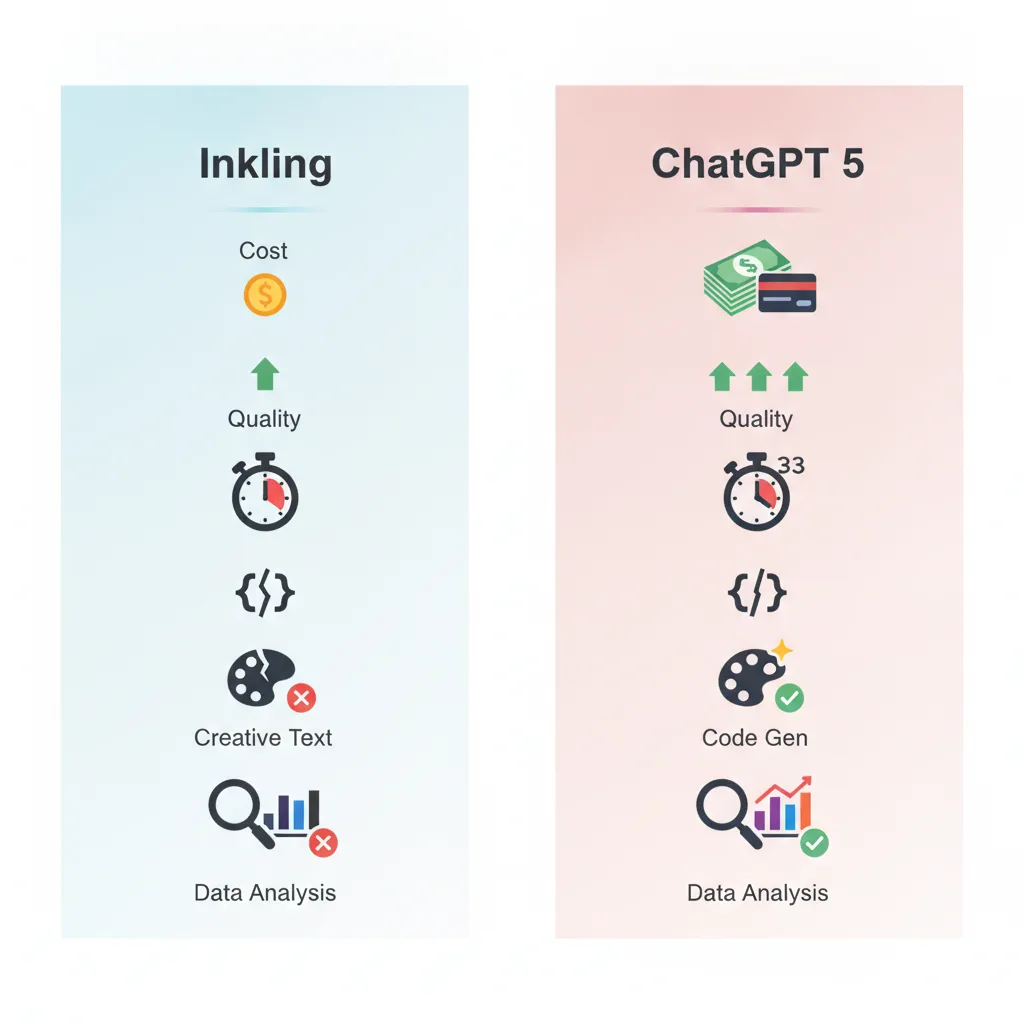
That was the real jaw-dropper. My 30-day API bill for ChatGPT 5 was $187. My Inkling cost? Zero dollars, beyond the initial hardware investment.
The winner isn't a simple "X is better than Y." It's a nuanced verdict:
- For pure cost savings on repetitive, high-volume tasks, Inkling is the undisputed champion. The ROI is immediate and undeniable.
- For premium, highly nuanced creative work, or complex problem-solving where subtle context matters, ChatGPT 5 still holds a discernible edge.
- For speed and instant local access, Inkling's local inference was transformative. No more network jitters.
What This Means For You
This isn't just about me saving a few bucks on my AI bill. This experiment points to a monumental shift in the entire AI landscape that will accelerate by early 2027.
- Freelancers and Small Teams: If you're spending more than $50/month on AI tools, it's time to seriously evaluate open-weights models like Inkling. The cost savings are so substantial they can directly impact your bottom line, potentially saving you hundreds or even thousands of dollars by late 2027. For tasks like generating basic code, summarizing documents, or drafting initial content, Inkling is more than capable.
- Enterprise and Internal Tools: This is a massive wake-up call. Open-weights means unparalleled privacy, full customization, and the potential for astronomical cost reductions at scale. Imagine running your entire internal AI infrastructure without per-token API fees. Expect major shifts in how enterprises adopt and deploy AI by mid-2028, with a strong lean towards self-hosted, open-weights solutions.
- Creative Professionals: While proprietary models might still offer that last 10% of polish for high-stakes marketing campaigns or unique content, Inkling is a phenomenal tool for drafting, iterating, and brainstorming. It can handle the bulk of the grunt work, freeing you up to refine and add your unique human touch.
The era of a single "best" AI is over. The future isn't about choosing one model, but about intelligently matching the right tool to the task, your budget, and your specific needs.
Value isn't just about raw output quality anymore; it's about efficiency, control, and cost.
The Twist I Didn't See Coming
I went into this expecting to confirm my bias for expensive, proprietary models. I was ready to write an article about why you should pay for the best.
I was profoundly wrong.
The biggest surprise wasn't just Inkling's competence, but the feeling of ownership and control that came with running an AI locally.
No API outages, no data privacy concerns, just pure, unadulterated AI on my machine. It felt like the early internet — powerful, raw, and open.
It fundamentally changed my perception of "value" in AI. Is that last 10% of quality truly worth a 95% price hike, especially when the "free" option is already so incredibly good?
For many, including me, the answer is increasingly "no."
Have you tried an open-weights model like Inkling yet? Did its performance shock you as much as it did me, or are you still a proprietary AI purist clinging to your subscriptions?
Let's talk in the comments.