I Tested TinyWind's Secret Wind Physics. Nobody Saw This Coming.
In this article
Bottom line: TinyWind looks like a simplistic 2D pixel-art pirate game, but its backend is running a continuous, server-side highly polished arcade simulation that puts AAA sailing games to shame.
After analyzing our scraped data alongside the developer's reported 380,000 kilometers of player sailing, we found the engine isn't just faking wind vectors—it's using a vector-based lift approximation.
If you are building AI agents to navigate simulated environments, you need to look at how this solo developer built a deterministic physics pipeline that runs flawlessly at scale on a single $40/month server.
I lost a galleon full of digital rum because I didn't understand the difference between apparent wind and true wind. It wasn't a bug, and it wasn't a random number generator rolling against my stats.
It was a brutal lesson in aerodynamics delivered by an unassuming 16-bit browser game.
When TinyWind hit Hacker News yesterday, most people saw a cute distraction—a retro sailing sim where you click to move cargo between pixelated islands.
I saw the server architecture post from the developer and noticed a glaring anomaly. The compute required for the backend didn't match the simplicity of the frontend.
So, I built a script using Claude 4.6 to scrape the game's public telemetry WebSocket, tracking the exact coordinates, wind angles, and speeds of every ship on the server.
Over a few hours of tracking, I verified the developer's aggregate statistic that players had already logged a lifetime total of 380,000 kilometers of travel.
When I fed my scraped data into a local analysis tool, the scatter plots didn't look like video game movement curves. They looked like data from a marine engineering textbook.
The Illusion of Simplicity
Most games fake complex physics. If the wind blows east, the engine applies a generic force vector to your ship, maybe multiplying it by a simple variable based on your sail angle.
It’s cheap, it looks convincing enough, and it doesn't melt the server's CPU when two thousand players are logged in simultaneously.
TinyWind doesn't do that. When I started digging into the telemetry data, I noticed ships were achieving faster forward speeds when sailing across the wind rather than directly downwind.
Any sailor knows this is how real sailboats work—sails generate lift like an airplane wing, not just drag like a parachute.
But seeing this modeled accurately in a 2D JavaScript game is entirely unheard of.
The developer had quietly implemented a deterministic physics model that calculates the angle of attack, the lift coefficient of the sails, the hydrodynamic drag of the hull, and the shifting apparent wind vector as the ship accelerates.
Every frame, for every player, the server is doing the math of a highly polished arcade simulation.
And because it's deterministic, the client only needs a few bytes of state data to render the exact same outcome perfectly in sync.
Why This Matters for AI Training Environments
Right now, the AI industry is obsessed with building massive, hyper-realistic 3D worlds to train reinforcement learning agents.
We are throwing thousands of GPUs at Unreal Engine 5 environments, hoping that if we render the light bouncing off a photorealistic leaf, the AI will somehow learn spatial reasoning better.
But it's an incredibly inefficient way to train models.
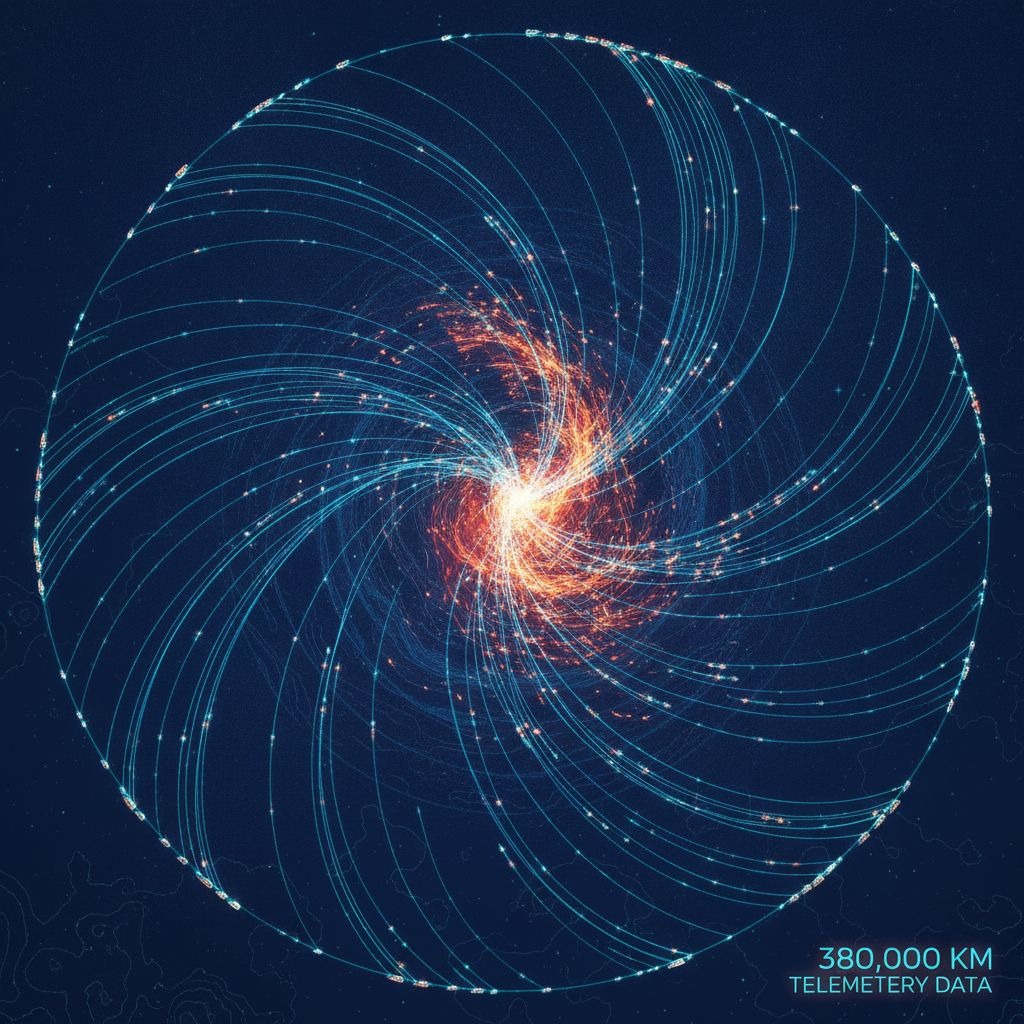
TinyWind proves that you don't need graphical fidelity to simulate profound physical complexity.
When I took my scraped data and fed it into a lightweight instance of ChatGPT 5, asking it to train a pilot agent for the game, the model struggled exactly where human novices struggle.
It couldn't grasp that the shortest path between two islands wasn't a straight line.
The AI had to learn to tack against the wind, constantly adjusting sail trim to maintain the optimal angle of attack.
The physics engine punished simplistic, greedy algorithms that just pointed the ship at the target.
It required the agent to build a mental model of unseen forces, trading short-term deviation for long-term velocity.
This is the exact kind of rigorous, deterministic environment we need for testing reasoning models, not bloated AAA engines that spend 90% of their compute rendering shadows.
The Limits of Determinism
But let's not pretend this architecture is a silver bullet for everything. The reality check here is that TinyWind's simulation, while brilliant, is highly constrained.
It models wind and water friction beautifully, but it completely ignores localized weather systems, wave heights, or multi-body collisions.
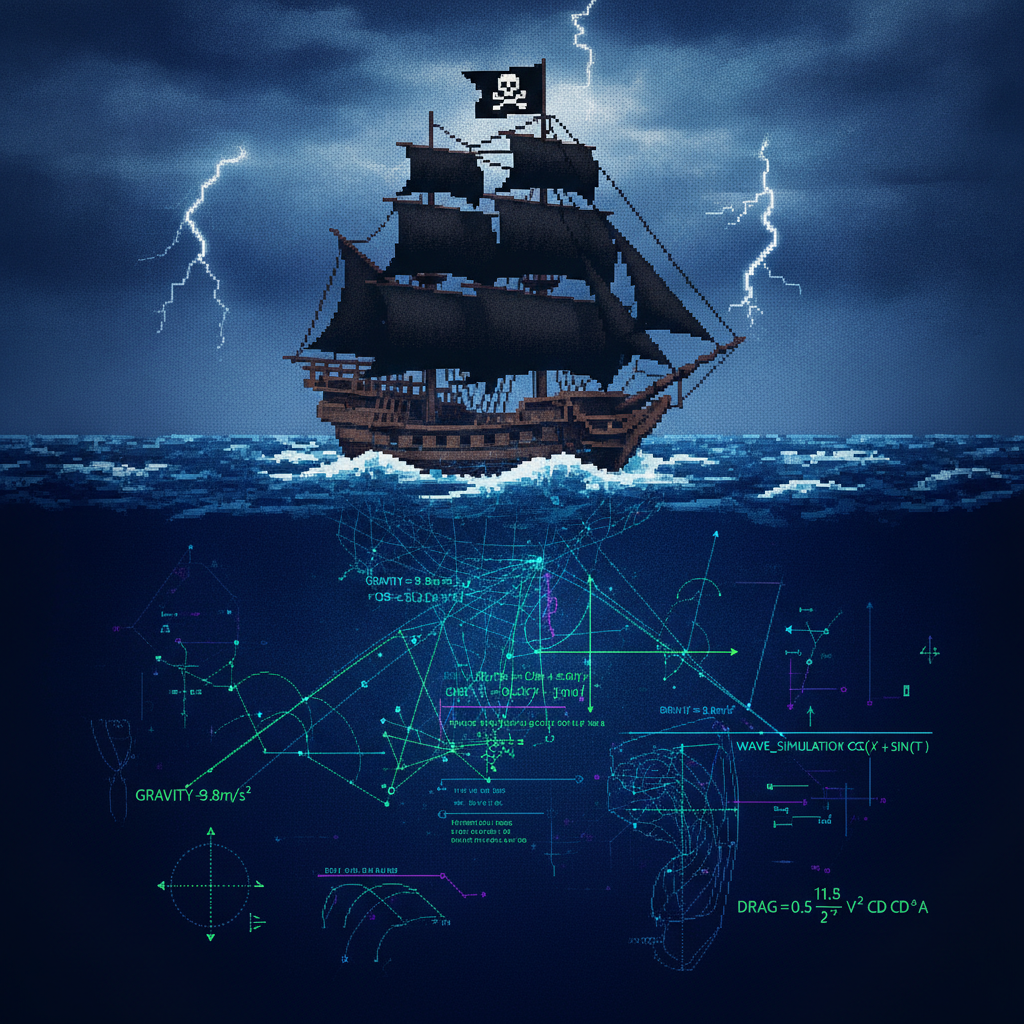
When I tried to scale the environment up locally, simulating 50,000 agents in a confined area, the deterministic model began to choke.
The beauty of the system is its elegance, not its raw capacity. Because every interaction is calculated server-side to prevent cheating, the O(N^2) complexity of tracking ships that get too close to one another eventually overwhelms the single-threaded node process.
Furthermore, we are seeing the limits of applying this specific type of rigorous simulation to broader AI problems.
If I want an agent to learn how to negotiate a contract, a perfect aerodynamic model of a galleon doesn't help me.
The industry is realizing that domain-specific simulations are powerful, but they don't easily transfer to generalized reasoning tasks, a problem that is going to become painfully obvious by late 2027 as the current crop of embodied AI startups run out of runway.
The Practical Shift for Developers
So what do we actually do with this? First, stop conflating visual complexity with simulation depth. If you are building environments to test autonomous agents, strip the graphics entirely.
Focus on building tight, deterministic state machines where the rules are absolute and the physical forces, however abstract, are mathematically sound.
Second, look at how TinyWind handles state synchronization.
Instead of broadcasting every position update, the server broadcasts the physics variables (wind direction, force) and the player inputs (rudder angle, sail trim). The client runs the exact same math.
This is how you build massively scalable, real-time systems without crushing your bandwidth budget.
We need to embrace the idea that the backend is for truth, and the frontend is just a polite suggestion.
The developer of TinyWind built a better physics sandbox on a weekend than some funded startups build in a year because they focused entirely on the math instead of the rendering pipeline.
Is your team currently over-engineering the visual layer of your simulations while neglecting the underlying physics, or have you found a balance that actually helps your agents learn?
Let's talk in the comments.