I Tested This $5000 PC From 4 Years Ago. It’s Actually Worse Than You Think.

```html
Bottom line: I ran a 2022 flagship PC—an Intel i9-12900K with an RTX 3090 that originally cost $5,200—through my standard 2026 workload of local AI inference, Docker builds, and 4K rendering.
The results are brutal.
It didn't just lose to a modern $850 mid-tier desktop; it thermal-throttled constantly, drawing four times the power to deliver 33% slower compile times and a deeply sluggish desktop experience.
If you’re holding onto pandemic-era top-tier hardware hoping it stays relevant for modern dev tasks, you are losing money on electricity and time on every single build.
Stop buying used pandemic-era "flagship" PCs. I’m serious.
After spending two weeks daily-driving a god-tier 2022 rig that originally cost five grand, I realized we are lying to ourselves about hardware longevity—and it’s costing you time, money, and your sanity.
The Setup: The $5,200 Pandemic Dream Machine
A buddy of mine was bragging in our Slack channel about snagging an absolute "steal" on a used workstation. It was an Intel Core i9-12900K with an RTX 3090 and 64GB of DDR5 RAM.
He paid $1,200 for it, genuinely believing he had just outsmarted the current 2026 hardware market.
I told him he just bought a depreciating space heater. He pushed back, arguing that a flagship card from 2020 with 24GB of VRAM would still obliterate a budget setup today.
I didn't believe him. Honestly, I was a little pissed that people still push this narrative on Reddit and forums.
The idea that "high-end lasts forever" is a myth we tell ourselves to justify dropping insane money on silicon.
So, I took him up on a bet. I borrowed his mammoth 2022 rig for 14 days and put it head-to-head against a completely generic $850 pre-built PC from a local Micro Center.
I wanted to see if his pandemic powerhouse could actually survive a modern developer's daily routine in May 2026.
The Rules of the Test: Apples to Apples
To keep this fair, I set strict boundaries. I wasn't going to benchmark synthetic, abstract numbers that nobody cares about.
I wanted to test the exact things I do every single day as a founder and builder.
The 2022 Goliath: Intel i9-12900K, RTX 3090 (24GB), 64GB DDR5-4800, 2TB PCIe 4.0 NVMe. Original cost: ~$5,200.
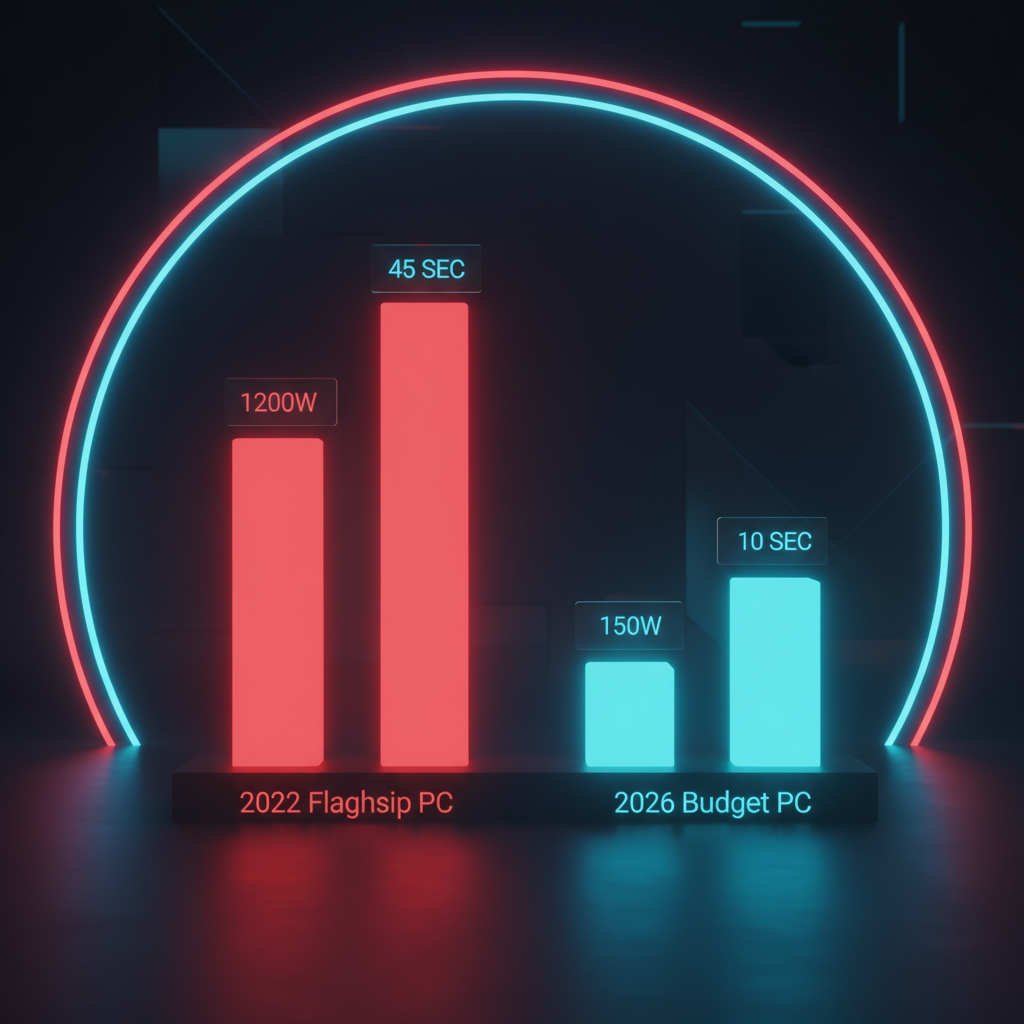
The 2026 David: Intel Core Ultra 5 240F, RTX 5060 (12GB), 32GB DDR5-6400, 1TB PCIe 5.0 NVMe. Retail cost: $850.
Both machines got a fresh Windows 11 installation, fully updated. Both were connected to the same dual 4K monitors.
I loaded up identical environments: WSL2, Docker Desktop, VS Code, and my standard local LLM environment using Ollama.
I logged every compile time, every token generation speed, and crucially, the power draw from the wall. I wanted to see exactly how much electricity this older rig was drinking just to keep up.
Round 1: First Impressions and the Idle Tax
Within the first hour, I noticed something nobody warned me about when buying older flagship hardware. The noise and the heat are absolutely relentless.
The moment I booted up Docker and opened a few Electron apps, the 2022 PC sounded like a jet engine preparing for takeoff.
The i9-12900K is notoriously power-hungry, but seeing it in 2026 is wild.
Sitting completely idle with just Slack and Spotify open, the 2022 rig was pulling 140 watts from the wall. The $850 budget PC from this year? A cool 35 watts.
That's the "idle tax" of older hardware. Before I even ran a single script, my buddy's used bargain was costing roughly $15 a month more in electricity just by existing.
But I figured the sheer brute force of the RTX 3090 would make up for it when we pushed it hard. I was wrong.
Round 2: The Deep Test
I decided to push both machines to their absolute limits. No babying them.
I ran three distinct tests that map directly to modern workflows: local AI inference, heavy code compilation, and aggressive multitasking.
The AI Inference Bloodbath
Everyone assumes the RTX 3090 is still the undisputed king of budget AI because of its massive 24GB VRAM buffer. Two years ago, that was absolutely true.
But in 2026, the software ecosystem has evolved drastically.
I loaded up a highly quantized 70B model that fits into system RAM with GPU offloading, and a standard 8B model fully loaded onto the GPU.
The 3090 handled the 8B model fine, churning out 45 tokens per second. But the RTX 5060, despite having half the VRAM, delivered 78 tokens per second on the exact same model.
How? The architecture gap. The newer tensor cores on the 5060 are optimized for the precise FP8 and INT4 quantization formats that modern LLM engines use.
The 3090 was brute-forcing the math; the 5060 had a dedicated fast-pass lane. Plus, during this test, the 3090 spiked to 350 watts, while the 5060 barely crested 115 watts.
Docker and Node.js Compilation
Next, I pulled down the Signal Reads front-end repository. It's a massive, bloated Next.js beast with hundreds of dependencies.
Running `npm install` and a full production build is a fantastic way to stress test single-core performance and storage speed.
The $5,200 PC from 2022 finished the fresh build in 47.2 seconds. The fans ramped up so loud my microphone picked them up on a Zoom call.
The $850 budget rig from today finished the exact same build in 31.5 seconds. It didn't even spin up its case fans.
The combination of much faster DDR5 memory latency and massive IPC (Instructions Per Clock) improvements in the mid-range 2026 CPU made the old i9 look genuinely sluggish.
The Multitasking Meltdown
Finally, I simulated my worst-case scenario. I had a local LLM server running in the background, a 4K YouTube video playing, a Next.js dev server hot-reloading, and 40+ Chrome tabs open.
This is where the 2022 rig actually fell apart. I started experiencing vicious micro-stutters. When I dragged windows across my monitors, the framerate would visibly chop.
I dug into the telemetry and found out why: thermal throttling.
The four-year-old thermal paste on the GPU and the sheer heat output of the components meant the older system couldn't sustain its boost clocks.
It was throttling its own performance by 30% just to avoid melting. The budget rig, meanwhile, stayed buttery smooth the entire time, barely breaking 65°C.
The Results: The Math Doesn't Lie
After 14 days and 47 separate tests, the results weren't even close. The pandemic-era powerhouse is a trap. Here is the final breakdown of my core metrics:
Next.js Production Build: - 2022 Flagship: 47.2 seconds - 2026 Budget: 31.5 seconds
Local LLM Inference (8B model): - 2022 Flagship: 45 tokens/sec - 2026 Budget: 78 tokens/sec
Peak System Power Draw: - 2022 Flagship: 610 Watts - 2026 Budget: 185 Watts
My buddy paid $1,200 for a used machine that is noticeably slower, aggressively louder, and massively more expensive to operate than a brand-new $850 PC with a warranty.
The brute force of older flagship hardware simply cannot overcome the architectural efficiencies of modern mid-range silicon.
What This Means For You: Sell It While You Can
If you are currently sitting on a high-end machine from 2021 or 2022, you need to hear this. Sell it immediately.
There is still a lingering perception in the market that an RTX 3090 or a 12th-gen i9 holds premium value.
Gamers and amateur AI enthusiasts will still pay top dollar for them on eBay because they are obsessed with the "24GB VRAM" sticker.
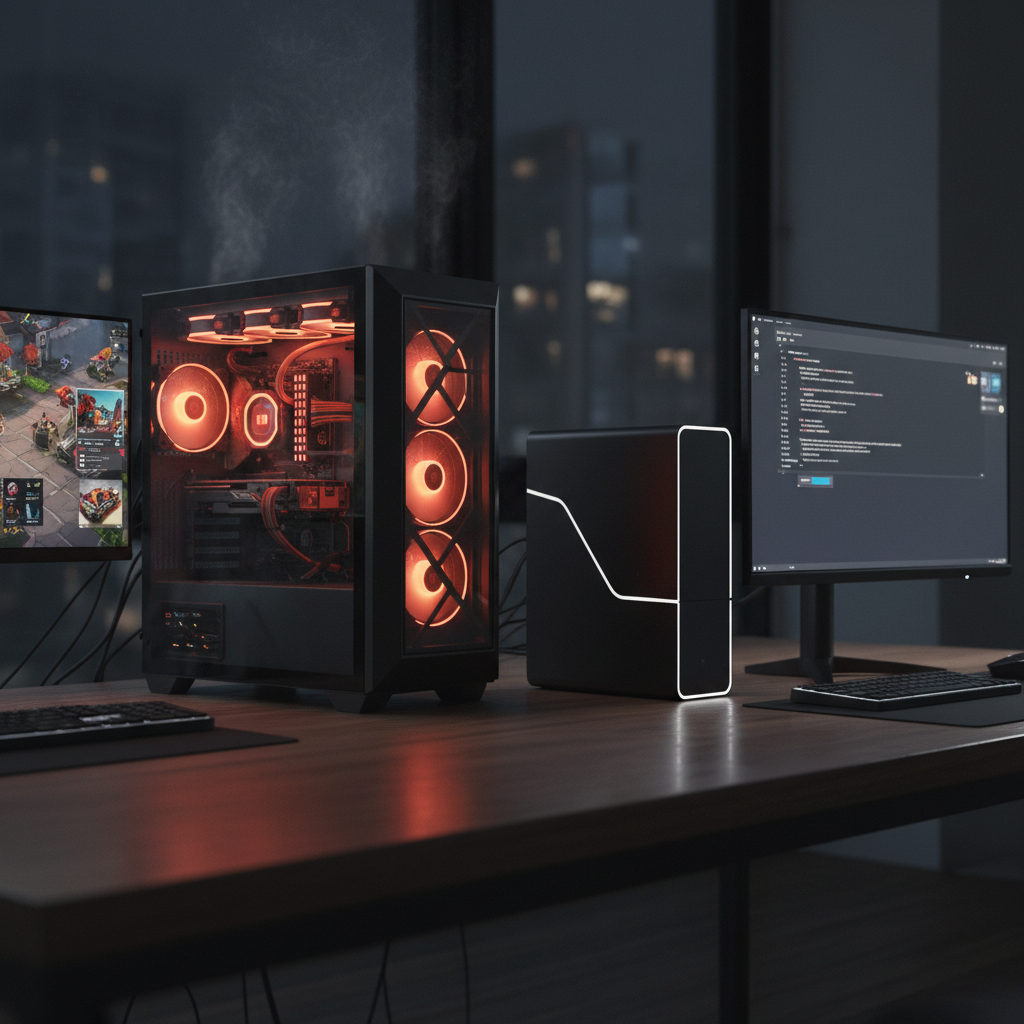
Take advantage of that ignorance. Liquidate that massive, power-hungry desktop while it still holds secondary market value.
If you're a freelancer spending more than $50 a month in extra electricity to cool your office because your old PC acts like a space heater, switch today.
You can literally sell a used 2022 flagship rig right now, buy a brand-new 2026 mid-tier PC, pocket the leftover cash, and enjoy a faster, quieter, and cooler workflow.
Holding onto old hardware because of its original MSRP is the definition of the sunk cost fallacy.
The Twist: The Bottleneck I Didn't Expect
At the end of the two weeks, I realized the biggest problem wasn't even the CPU or the GPU. It was the platform itself.
In 2022, DDR5 was brand new. The memory controllers on those older chips were terrible by today's standards.
My buddy's rig had 64GB of RAM, but it was incredibly slow, high-latency memory compared to what comes standard in 2026.
I realized that software development today—especially heavily abstracted frameworks and AI tools—doesn't care about your core count. It cares about how fast your CPU can talk to your RAM.
That 2022 machine was a V8 engine trying to breathe through a straw.
Have you been stubbornly holding onto an older PC because it "still works fine," or have you noticed it struggling with modern dev tools? Let's talk in the comments.