I Spent 3 Days at MIT — The Robot Hype Is Worse Than You Think
In this article
Bottom line: I spent three days walking labs at MIT's robotics campus in July 2026, and the humanoid robots everyone's excited about still can't reliably fold a towel, open an unfamiliar door, or work for more than 90 minutes without a battery swap or a human minder nearby.
The demo videos you're seeing from Figure, Tesla, and 1X are real, but they're curated the way a magic trick is curated — one clean take out of dozens of failed ones.
The industry raised more than $2 billion in humanoid robotics funding in the last 18 months on the promise of general-purpose labor, but the actual bottleneck isn't hardware anymore — it's that nobody has solved reliable manipulation in unstructured environments, and that problem has been "five years away" for over a decade.
If your retirement plan or your company's headcount strategy assumes humanoids replacing warehouse or factory workers by 2028, you're planning around a demo reel, not a product roadmap.
Stop believing the robot videos. I'm serious.
I've spent 12 years building and shipping software products, I've sat through enough VC pitch decks to smell a narrative before the slide changes, and after three days at MIT this July, watching actual robotics researchers work with actual robots, I'm telling you: the humanoid robot hype cycle is one of the most successful pieces of theater the tech industry has pulled off since the metaverse.
The Sacred Cow Everyone's Grazing On
You've seen the videos. A humanoid robot folds laundry. Another one sorts packages in a warehouse, smooth as a dancer.
Elon Musk says Optimus will be Tesla's biggest product ever. Figure AI is valued in the billions after a single demo of a robot making coffee.
1X's Neo glides through a living room doing chores like it walked out of a Pixar film.
And look, I get why people believe it. Five years ago, "robots will do our jobs" was science fiction.
Then generative AI happened, transformer models got good at reasoning, and it felt like the missing piece — the "brain" — had finally arrived.
If ChatGPT can write code and pass the bar exam, surely bolting that intelligence onto a robot body solves the rest, right?
That's the pitch. It's a good pitch.
Venture capital has poured over $2 billion into humanoid robotics startups since early 2025, according to industry funding trackers, on the strength of exactly that logic.
The problem is the logic skips a step — a really, really hard step — and almost nobody outside the labs is talking about it honestly.
What Three Days on Campus Actually Showed Me
I didn't go to MIT for a press demo.
I sat in on lab sessions, talked to grad students and postdocs who spend their actual working lives on manipulation and locomotion problems, and watched a lot of robots fail in ways that never make it into a highlight reel.
The "one clean take" problem
Every viral robot video you've watched is the survivor of dozens of takes.
One researcher told me flatly that a 45-second demo clip can represent an afternoon of resets — a dropped object, a gripper that slipped, a path-planning failure that sent an arm into a table.
That's not dishonest, exactly.
It's how demos have always worked.
But when a company's stock narrative or funding round rides on that one clean take, the gap between "demo" and "product" stops being a technical footnote and starts being the whole story.
Manipulation is still the wall, not the brain
The thing that surprised me most: nobody in the labs I visited thinks language-model-style "intelligence" is the bottleneck anymore. It's touch. It's grip force.
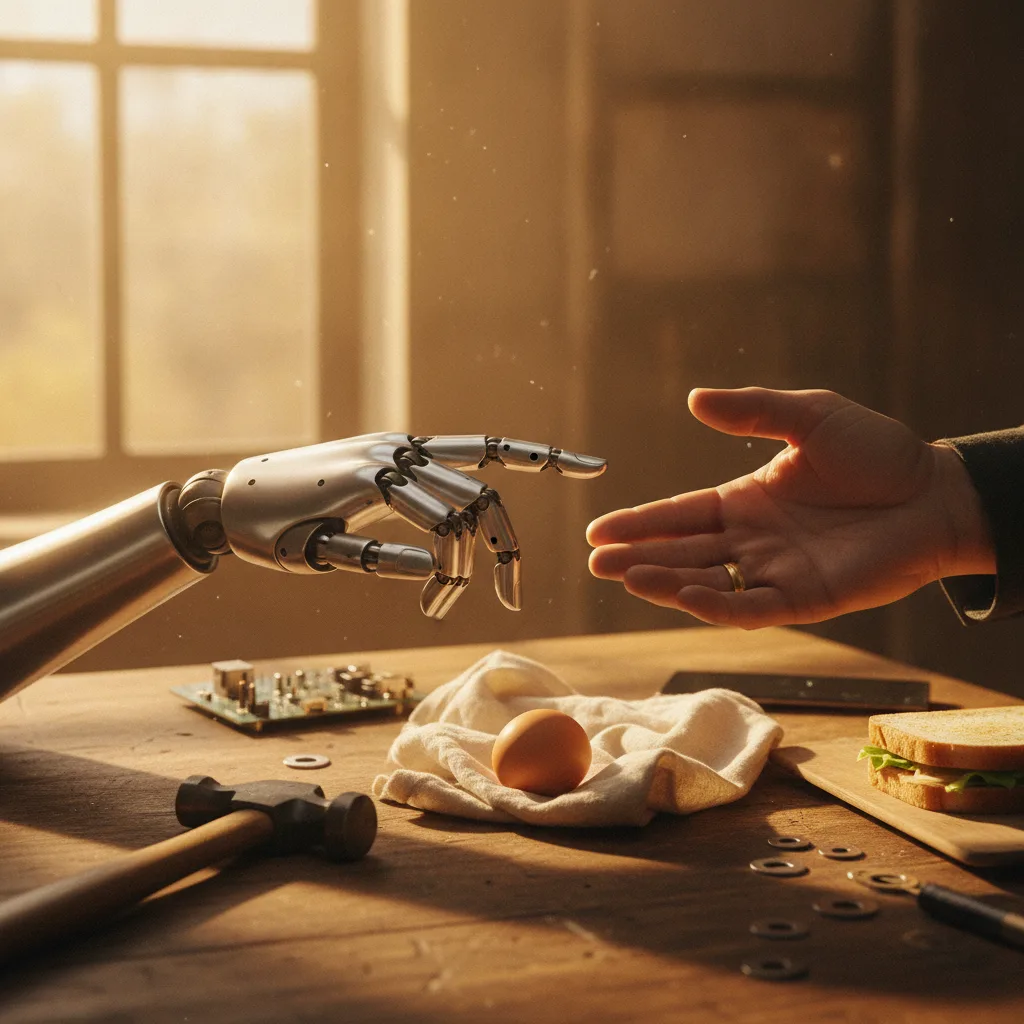
It's the fact that a human hand can pick up an egg and a hammer with the same five fingers, adjusting pressure in milliseconds based on feel, and no robotic gripper on the market does that reliably across varied, unfamiliar objects.
Warehouse-grade robots like Agility Robotics' Digit have been piloted at real facilities — GXO and Amazon among them — but even those deployments are narrow: moving totes in structured, controlled zones, not general-purpose labor.
Battery life kills the fantasy of the tireless worker
The pitch is "a robot that works 24/7 and never complains." The reality I watched: most humanoid platforms run somewhere in the neighborhood of 60 to 90 minutes of active operation before needing a charge or a swap.
A human warehouse worker on an eight-hour shift doesn't have that problem.
Nobody puts battery-swap logistics in the sizzle reel because it isn't sexy, but it's the difference between a lab demo and a production line.
The "five years away" clock has been running since 2013
Boston Dynamics has been showing off jaw-dropping locomotion — backflips, parkour, dancing — for well over a decade, and it still isn't selling a general-purpose humanoid for commercial labor.
MIT's own legged-robot research (the Cheetah and Mini Cheetah lineage) has produced genuinely stunning locomotion breakthroughs since the mid-2010s. Locomotion is closer to solved than it's ever been.
Manipulation and reliable autonomy in messy, real-world environments are not, and every "five years out" estimate I've heard from serious researchers has been "five years out" since roughly the Obama administration.
The Real Problem Nobody Talks About
Here's the thing that actually bothers me, and it's not that the robots don't work yet. Robots not working yet is normal — that's what R&D looks like.
The real problem is we've stopped distinguishing between research progress and product timelines, and an entire funding and hiring ecosystem is now being built on top of that confusion.
Companies are writing five-year workforce plans assuming humanoid labor at scale. Cities are debating labor policy around robot displacement that hasn't happened and, based on what I saw, isn't close.
Investors are pricing in Boston Dynamics parkour and delivering Roomba-with-arms reliability.
The gap between "a robot can do this in a lab, once, under ideal lighting" and "a robot can do this in a Cincinnati fulfillment center at 2 a.m.
in July" is the entire ballgame — and almost none of the public narrative accounts for it.
This isn't new, either.
It's the exact same pattern self-driving cars went through starting around 2015: "full autonomy in five years" became a running joke by the time 2022 rolled around, because the last 5% of the problem — the unstructured, unpredictable, real-world 5% — turned out to be harder than the first 95%.
Robotics researchers know this pattern intimately. Robotics investors, it seems, keep forgetting it.
What You Should Actually Do Instead
I'm not telling you to write off robotics. I'm telling you to stop planning around the demo reel. Here's what I'd actually do with this information:
- If you're evaluating robotics vendors for your company, ask for uptime data and failure rates in production environments, not demo footage. Ask how many takes the demo took. A vendor who won't answer that question is telling you something.
- If you're a developer or engineer curious about the space, the actual frontier work right now is in manipulation, tactile sensing, and sim-to-real transfer — not in flashy end-to-end humanoid demos. That's where the interesting, fundable, career-relevant problems are.
- If you're an investor or a founder pricing risk, treat "commercial-scale general-purpose humanoid labor" as a 2030s conversation, not a 2028 one, and price accordingly. The narrow, structured deployments (Digit-style tote-moving) are real and near-term. The general-purpose office-and-warehouse humanoid is not.
The Uncomfortable Truth
We keep doing this. We did it with self-driving cars. We did it with the metaverse.
We're doing it right now with humanoid robots — watching one gorgeous, curated video and extrapolating a fully automated future from it, because the story is more exciting than the lab notebook.
I walked out of MIT more optimistic about robotics as a field of research and more skeptical of robotics as an investment narrative than I walked in — and those are two very different things that the current hype cycle keeps flattening into one.
How many of the "five years away" predictions in your industry have you actually gone back and checked against what happened five years later — or are you just waiting for the next demo video to reset the clock?