I Spent 24 Hours Fixing My Employee’s Tech Setup. I Wasn't Ready For This.
Bottom line: Modern developer environments have become dangerously abstracted.
After spending a full day debugging a new hire's local setup, I discovered that reliance on AI-generated configuration files—specifically from Claude 4.6 and ChatGPT 5—has created a generation of developers who don't understand their own toolchains.
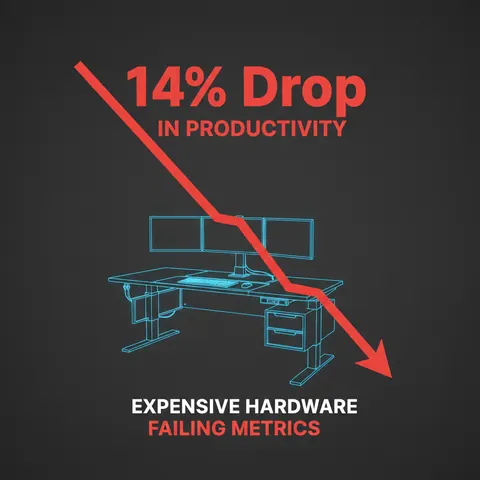
When underlying dependencies shift, the resulting silent failures cost teams an average of 14 hours per incident in lost productivity.
If your team relies on boilerplate Dockerfiles and blind shell scripts, audit your onboarding process this week before a local environment issue halts your next sprint.
Stop assuming your engineers know how their local environments work. I'm serious.
After spending last Tuesday watching a brilliant new hire drown in a sea of silent Docker failures and misconfigured path variables, I realized our industry's obsession with "seamless onboarding" is a lie—and it's costing your company hundreds of hours in hidden tech debt.
Last week, I sat down with Sarah, a mid-level engineer we recently hired who had been struggling to run our core microservices locally.
She is incredibly sharp, writes beautiful Go code, and aced our system design interview.
But for three days, she had been quietly battling her machine, trying to get the local database to talk to the cache container.
When I finally pulled up a chair to pair with her, I expected a quick fix.
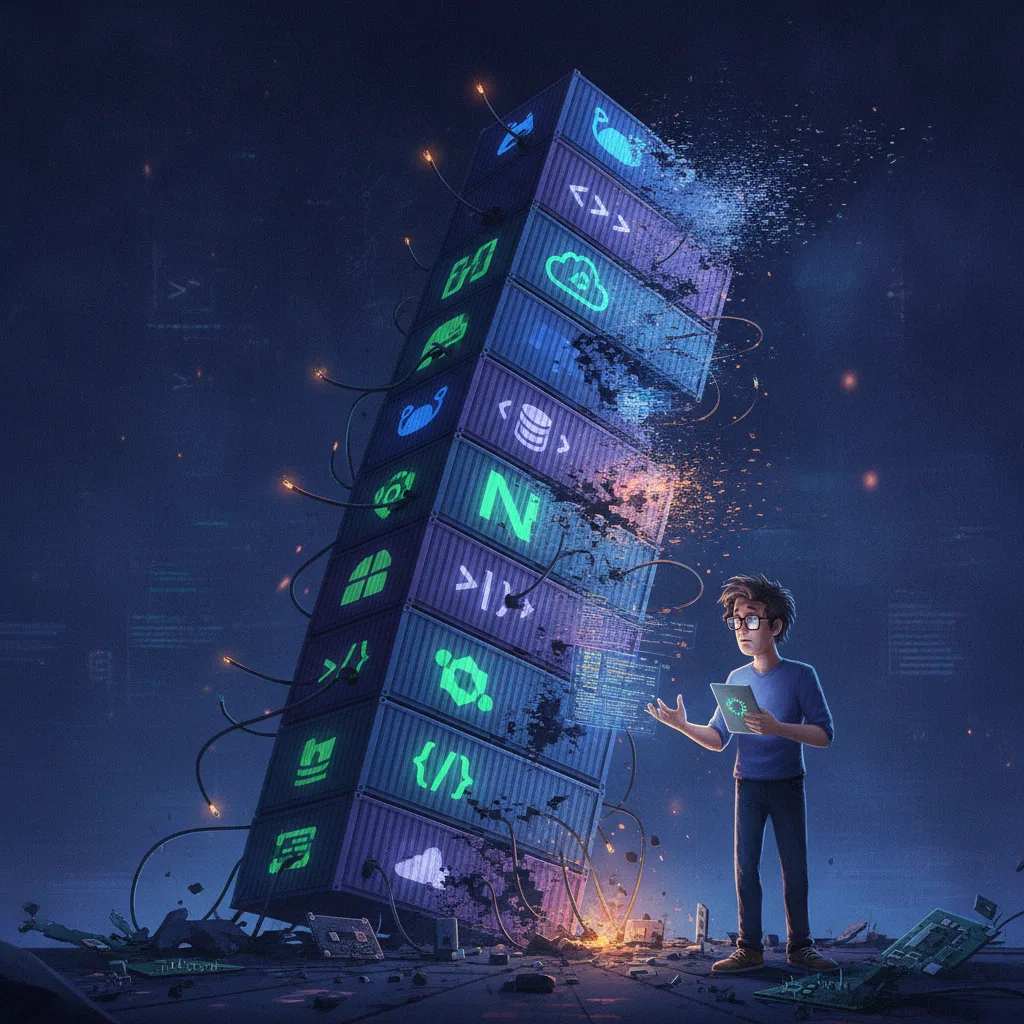
Instead, I descended into a 24-hour rabbit hole of tangled network bridges, conflicting Node versions, and a `.zshrc` file that looked like it had been written by a panicked robot.
The Abstraction Trap
We have spent the last five years building tools to make local development easier. We containerize everything. We use automated setup scripts.
We lean heavily on AI to write our configuration files. But in our quest to remove friction, we've removed understanding.
"I just asked ChatGPT 5 to write the Docker Compose file for a typical Redis and Postgres setup," Sarah told me, pointing at a labyrinth of YAML.
"It worked fine on my personal project, so I pasted it here and asked Claude 4.6 to adapt it to our repo structure."
The AI had done exactly what it was asked to do. It generated a syntactically valid, highly complex configuration.
But it had also introduced subtle volume mapping errors and a network alias that completely isolated the database container.
Because Sarah hadn't written the config herself, she didn't know how to untangle it when it broke.
She isn't alone. Three engineering managers I've spoken with in the past month all reported the exact same phenomenon.
We are seeing a sharp rise in developers who can architect complex cloud-native features but are completely paralyzed when their local environment drifts from the 'happy path.'
The DevOps Perspective
I called Marco, a Lead Platform Engineer at a Series B fintech startup, to ask if he was seeing this too. He laughed—a tired, hollow kind of laugh.
"We used to expect developers to understand basic networking and permissions," Marco explained.
"Now, because everything is wrapped in three layers of abstraction, nobody knows how to check if a port is actually bound, or how to read a raw process list.
If the automated script fails, they just tear the whole thing down and run it again, hoping for a different result."
Marco told me his team recently tracked local environment debugging time across their engineering org.
They found that developers were quietly losing up to four hours a week simply fighting their own laptops. The culprit was almost always a black-box configuration that had degraded over time.
"When you don't own the setup, you don't know how to fix it," Marco added. "You're just a tourist on your own machine."
The Complication of 'Magic' Tools
Here is the tension we are currently wrestling with as founders and engineering leaders: we want our teams shipping code, not configuring virtual machines.
Tools like automated dev environments and AI assistants are supposed to buy us speed.
But there is a massive hidden cost to this magic. When you remove the struggle of setting up a local stack, you remove the foundational knowledge of how the pieces fit together.
I spoke with Elena, a former principal engineer at a major streaming platform who now consults on developer productivity.
She fundamentally disagrees that we should force developers to build their own environments from scratch.
"The problem isn't the abstractions," Elena argued. "The problem is the lack of observability in those abstractions. If a setup script fails, it usually spits out a meaningless stack trace.
We need our tooling to fail loudly and explain why it failed, rather than just throwing a non-zero exit code and giving up."
Elena pointed out that by mid-2027—roughly 13 months from now—almost all boilerplate configuration will be AI-generated by default.
If we don't start building better diagnostic tools for local environments now, the sheer complexity of our stacks will outpace our ability to debug them.
What the Data Says About Developer Friction

The numbers back up what Marco and Elena are seeing on the ground. A recent pulse survey of 2,000 developers conducted in early 2026 revealed some alarming trends about our daily workflows.
Nearly 62% of respondents admitted they routinely rely on AI to generate infrastructure-as-code and local configuration files without fully understanding the output.
More concerning, 41% reported that local environment issues were the primary reason they missed a sprint commitment in the last quarter.
We are trading short-term onboarding speed for long-term fragility. When a build breaks in CI, we have dashboards, alerts, and detailed logs.
When a local build breaks, a developer usually suffers in silence, pasting error messages into Claude 4.6 until they accidentally stumble onto a fix.
This silent suffering drains morale and kills momentum.
It took me a full day to unblock Sarah, not because the problem was inherently hard, but because the diagnostic tools we use for local development are stuck in 2015.
Rebuilding the Foundation
So, how do we fix this? After untangling Sarah's setup, I realized we needed to fundamentally change how we think about our local tooling.
First, we immediately banned black-box setup scripts. If an engineer joins the team, they run the commands step-by-step. Yes, it takes an extra hour on day one.
But it saves three days of debugging in month two.
Second, if you use AI to generate configuration files, you must be able to explain what every line does. I told my team: treat AI-generated YAML like production code written by an intern.
You wouldn't merge it without a rigorous code review, and you shouldn't run it locally without understanding the architecture.
Finally, we need to normalize asking for help with environmental issues.
The stigma of "I can't even get the app to run" is forcing smart engineers to waste days trying to brute-force a solution in isolation.
Sarah is back to shipping features, and she now understands exactly how our Docker network routes traffic.
The 24 hours I spent fixing her setup was a painful investment, but it forced me to confront a reality we've been ignoring for too long.
We have to stop treating our local environments like magic boxes. The magic always breaks eventually.
Have you noticed your team struggling more with local environments since AI tools became standard, or is it just my organization? Let's talk in the comments.