I Quit Silicon Valley's Favorite App. Here's What I Wasn't Ready For
In this article
Bottom line: I deleted ChatGPT from every device I own on June 2, 2026, after catching myself asking it to finish a text message to my own mother.
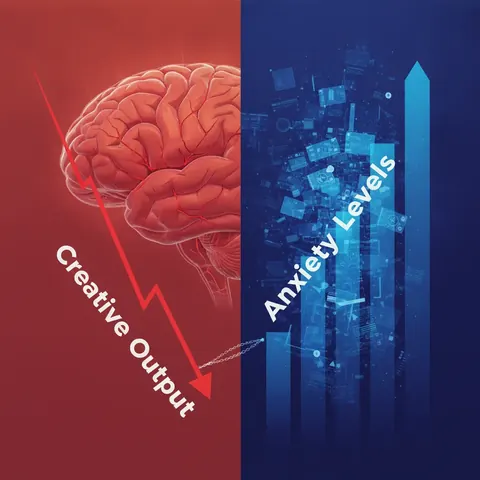
Thirty days in, the hardest part wasn't boredom — a widely cited 2025 MIT Media Lab study had already found that people who leaned on ChatGPT to write essays showed weaker neural connectivity than those who wrote unassisted, and I felt that gap in real time, sentence by sentence.
What surprised me wasn't how much time I got back.
It was discovering how much of what I called "my voice" had quietly become a collaboration I never agreed to. I got it back in nineteen days, not thirty.
Here's the sentence that stopped me cold: "Can you make this sound more like me?"
I'd typed it into ChatGPT at 11:40pm on a Tuesday, about a birthday text to my mother. Not an article. Not a pitch.
A text message, to the woman who taught me to write in the first place, and I'd outsourced the sounding like me part to software. I stared at the cursor for a long moment.
Then I closed my laptop, opened Settings on every device I own, and deleted the app that half of Silicon Valley — and, depending on whose numbers you trust, well over a billion people a week by mid-2026 — now treats as a reflex rather than a tool.
I didn't expect it to be hard. I write for a living. Surely I, of all people, still knew how to think without a co-pilot.

I did not.
The Part Nobody Warns You About
We talk about AI addiction like it's a productivity story — hours saved, inboxes cleared, decks built in minutes instead of days.
That framing is comfortable because it makes the habit sound like a win.
What it leaves out is subtler and, I'd argue, more expensive: the quiet outsourcing of the small daily frictions that used to be where thinking actually happened.
The MIT study that got passed around tech Twitter (or X, or whatever we're calling it lately) last year measured something specific — brain connectivity in people writing essays with and without ChatGPT's help.
The unassisted group showed stronger, more integrated neural engagement. The assisted group, over repeated sessions, showed less.
Researchers called it "cognitive debt" — you borrow ease now and pay it back later, in a diminished capacity to do the thing yourself.
I'd read that study when it came out and nodded along, the way you nod at a warning label on a cigarette pack you have no plans to buy.
Then I spent eighteen months writing captions, brainstorms, even condolence messages with an assistant quietly finishing my thoughts before I'd fully had them. The debt collector doesn't send a letter.
It just shows up one Tuesday night when you can't write four sentences to your own mother without help.
The Reframe: It Was Never About Time
Here's what I got wrong for a year and a half.
I thought the trade I was making was time for quality — a fair swap, I told myself, because the drafts still sounded like me, mostly, after I'd tidied the AI's version.
The actual trade was friction for fluency, and those are not the same currency.
Friction — the uncomfortable, slightly boring minutes of staring at a blank page, rejecting your first three ideas, circling back — isn't a bug in the writing process. It's the process.
It's where you find the sentence you didn't know you had. Skip it enough times and you don't get faster at writing.
You get worse at starting, because starting was always the friction, and you've spent eighteen months automating it away.
The problem was never discipline. It was that I'd optimized for the wrong thing entirely — output, when the thing actually worth protecting was the muscle that produces it.
Nobody in Silicon Valley is going to tell you this, because the entire business model depends on you never noticing the muscle is gone until you go looking for it.
The Nineteen-Day Framework
I didn't quit cold with a plan. I quit cold, panicked by day three, and built the plan retroactively, out of what actually got me through.
I've since given it a name, mostly so I'll remember it myself next time I feel the pull back: the Friction Ledger.
1. Name the outsourced moments, don't judge them
For the first three days, every time I reached for the app out of habit, I wrote down what I'd been about to ask it. Not to feel guilty — to see the pattern. Mine wasn't big decisions.
It was small ones: opening lines, text replies, the first idea in a brainstorm. That list told me more about where my thinking had gone soft than any productivity app ever has.
2. Sit in the gap for ninety seconds before you fill it
This sounds almost embarrassingly simple, and it is. When the urge to ask for help hit, I set a timer for ninety seconds and just sat with the blank page.
Most of the time, an idea — usually a worse first idea than the AI would have given me, and that was the point — showed up anyway.
Worse first drafts you actually wrote beat polished first drafts you didn't.

3. Keep one "outsourced" task as a control
I didn't quit AI entirely — I kept using it for one narrow, low-stakes task (formatting a spreadsheet) so I could compare, honestly, what I missed and what I didn't.
I missed almost nothing about the spreadsheet. I missed a great deal about the sentences.
4. Rebuild in public, badly, on purpose
Around day twelve I started sending unedited first drafts to one trusted friend before I touched them again — no smoothing, no assist. Humiliating.
Also the fastest thing that rebuilt the muscle, because an audience of one raised the stakes just enough to make the friction matter again.
5. Reintroduce the tool as a last step, not a first one
By day nineteen, the app went back on my phone — but only for the very end of a process, checking a fact or tightening a paragraph I'd already fully written myself.
The rule I gave myself: nothing gets to think before I do.
What This Actually Looks Like
Two weeks ago, a friend in product at a well-known AI company (she'd rather I not name it, and I don't blame her) told me she now writes every difficult email longhand first, on paper, before she's "allowed" to open her laptop.
Not because paper is magic. Because it removes the option to ask for help before she's had the thought.
Try this today, not next Monday: pick one recurring task where you reach for an AI assistant out of pure habit — a reply, a caption, a to-do list — and do it the slow way, once, with a timer running.
Notice how long the discomfort actually lasts. Mine was ninety seconds, most days.
Yours might be five minutes. It will not be forever.
I'm not anti-AI. I use it now, deliberately, for the last ten percent of a task instead of the first ninety.
The difference between those two uses is the difference between a tool and a crutch, and I only learned to tell them apart by walking without the crutch for nineteen days and noticing which parts of me still worked.
What's the one app or habit you know is quietly doing your thinking for you — the one you'd feel a little exposed without? I'd genuinely like to know. Tell me in the comments.