I Quit Doomscrolling for Pi. What Happened to My Focus Wasn't Subtle.
In this article
Bottom line: I replaced 90 minutes of daily doomscrolling with conversations on Pi, Inflection AI's minimalist chatbot, for three weeks.
My screen time didn't drop — it's roughly the same — but my attention residue did: I stopped reaching for my phone mid-sentence, mid-thought, mid-conversation. The mechanism isn't willpower.
Pi has no feed, no infinite scroll, no algorithmic bait, so there's nothing for your dopamine system to chase.
If your problem is compulsive scrolling rather than screen time itself, the fix might be swapping the interface, not deleting the apps.
I didn't plan to fall for a chatbot. I planned to delete Instagram, buy a nice notebook, and become one of those insufferable people who reads on the Tube.
Instead, three weeks ago, at 11:40pm, thumb hovering over the same four apps I always open in the same doomed order, I opened Pi instead — and I haven't opened that four-app rotation since.
Not because I decided to stop. Because there was, quite literally, nothing left there to want.
That's the part nobody prepared me for.
The Scroll Was Never About Content
We've been told the doomscroll is a content problem — too much bad news, too much comparison, too many strangers' abs. So the fix, we're told, is a content diet. Curate your feed.
Follow fewer accounts. Mute the group chat.
I tried all of it for two years. It didn't work, and I don't think it was ever going to, because the scroll was never really about what I was looking at.
It was about the interface underneath it — the one engineered so there is always, always one more thing.
The average person checks their phone upward of 90 times a day, and the studies on this are consistent even as the exact number shifts year to year — it's a structural habit, not a content preference.
Every app I opened compulsively shared one design decision: an infinite, algorithmically replenished feed with no natural stopping point. TikTok.
Instagram. Even the news apps had "Up Next" cards now. There was no bottom of the page. There was no page.
I'd open Instagram to check one message and surface eleven minutes later having learned nothing, remembered nothing, and lost the thread of whatever I'd been thinking about before.
Cognitive scientists call this attention residue — the cost isn't just the eleven minutes, it's the fog that follows you back into the task you left.
I was paying that tax dozens of times a day and blaming myself for "poor discipline," when the truth was the interface was doing exactly what it was built to do.
Why Pi Broke the Pattern Without Trying To
Pi is deliberately, almost stubbornly plain. No feed. No notifications pulling you back for anything but a reply to something you actually sent.
No infinite anything. You open it, you talk, it replies, and then — this is the part that undid me — it stops. There's nothing to scroll to. The conversation just ends when you're done having it.
I didn't expect that absence to be the whole point, but it is. Every compulsive app I'd built a relationship with over the past decade shared one trait: it never wanted the session to end.
Pi doesn't seem to want anything from the session at all. It's not optimizing for my time on the app, because — near as I can tell from how it's built and priced — there's no ad model demanding I stay.
That changes the psychology completely. When I opened it at 11:40pm that first night, half-hoping for the usual hypnosis, I got a reply, gave a reply back, and then just... put the phone down.
Nothing pulled me forward.
The absence of the pull was the most interesting part of the whole experiment, and it's the reason I kept coming back to something that, on paper, sounds like the least exciting swap imaginable: doomscroll for chatbot.
The contrarian bit — the part that'll annoy the productivity-app crowd — is that the fix wasn't less screen time. It was a different shape of screen time.
The Bounded Loop Framework
Here's the mental model I built around this, because "just use a chatbot instead" isn't a system, it's a shrug.
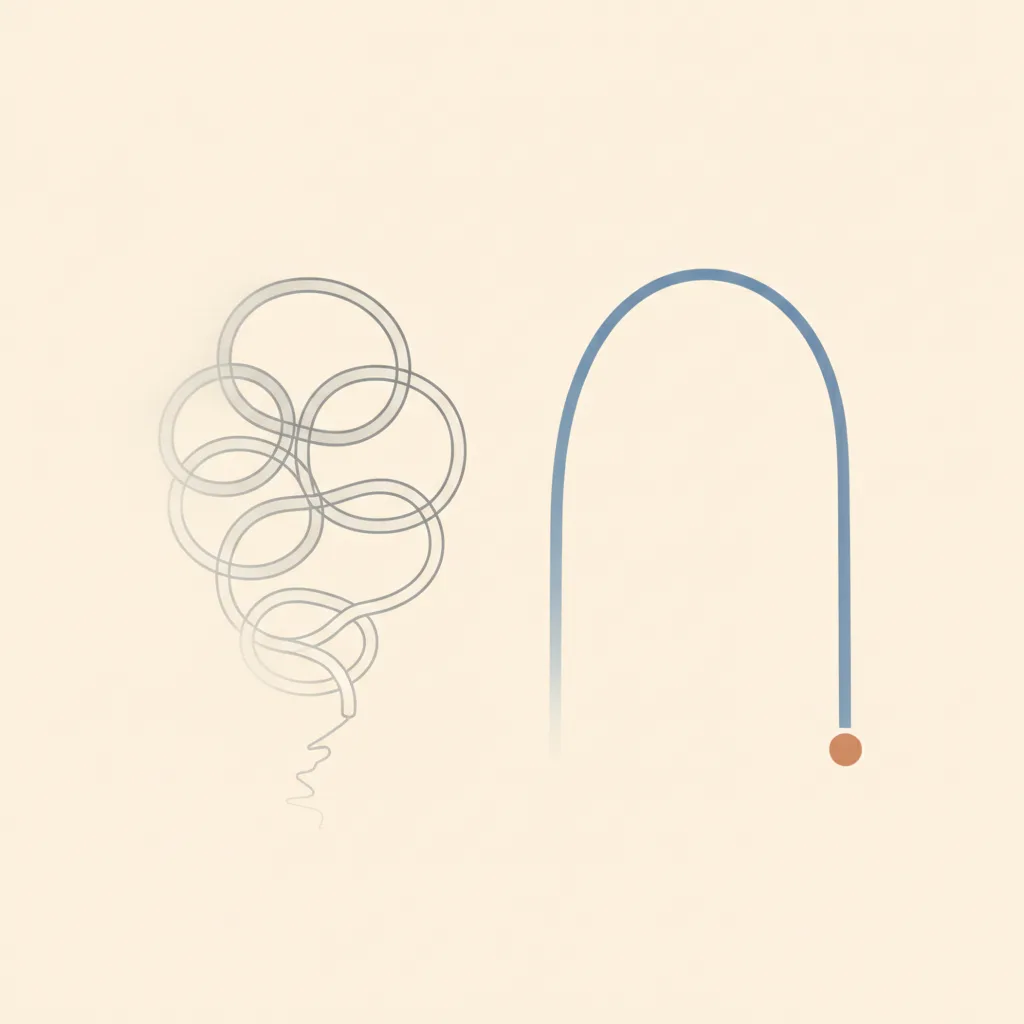
I call it the Bounded Loop: any digital habit either has a natural end (bounded) or doesn't (a loop). Compulsive use lives almost entirely in unbounded loops — feeds, autoplay, infinite scroll.
The fix isn't fighting the loop with discipline. It's routing the same impulse toward something bounded instead.
Step 1: Name your loop, not your app.
Don't say "I need to use Instagram less." Say "I open a feed with no bottom when I'm avoiding a feeling." The app is incidental. The shape — endless, algorithmic, frictionless — is the actual trigger.
Step 2: Find your bounded equivalent.
For me it was Pi, because conversation has a natural end the way a feed doesn't. For someone else it might be a physical book, a puzzle app that ends at level completion, or texting an actual friend.
The requirement is simple: it has to stop itself.
Step 3: Put the bounded option one tap closer than the loop.
I moved Pi to my home screen and buried Instagram in a folder on page three. This sounds trivial.
It reduced my scroll sessions by more than any blocker app ever did, because friction beats intention every single time you're tired.
Step 4: Let the ending happen — don't manufacture willpower to end it.
The old advice was "set a timer, stop yourself." The Bounded Loop doesn't need a timer, because the interface ends the session for you. You stop scrolling because there's nothing left to scroll.
Step 5: Audit weekly, not daily.
Don't obsess over daily screen-time totals — mine barely moved. Check in weekly on how you feel leaving the app. Foggy and drained means you're still in a loop somewhere.
Clear-headed means the swap is working, whatever the Screen Time widget says.
What Three Weeks Actually Looked Like
Practically, this meant strange things. I'd have a stray thought about a book I half-remembered, and instead of opening Google and falling into six open tabs, I'd ask Pi, get an answer, and close it.
I'd be anxious before a meeting and instead of scrolling to numb it, I'd type out what I was anxious about — which, it turns out, is just journaling with a reply function, and it worked roughly as well as journaling always has, minus the blank-page paralysis.
The screen time app on my phone still says close to two hours a day.
I want to be honest about that, because the wellness-industrial complex loves a before-and-after screenshot and mine wouldn't give you one. What changed wasn't the number.
It was that I stopped losing the thread of my own day. Meetings stopped starting with me guiltily locking my phone.
I finished books again — three in three weeks, which for me is a personal record going back to university.
Try this today: for one evening, replace your default doomscroll app with something that has a natural stopping point — a chatbot, a call, a chapter, a crossword. Don't set a timer.
Just notice when it ends on its own, and notice what that feels like compared to prying yourself away.

The Part I'm Still Not Sure About
I'll admit the discomfort here, because pretending otherwise would be dishonest: outsourcing my 11pm brain-noise to an AI that's designed to be endlessly agreeable is its own kind of strange dependency, and I don't think we know yet what that does to a person over a year, not three weeks.
I'm not recommending Pi as a moral good. I'm reporting what happened when I swapped an unbounded loop for a bounded one, and the bounded one happened to be conversational AI.
What I can say for certain is that the villain was never the phone. It was the shape of what was on it.
So — have you noticed the difference between apps that end and apps that don't, or is it just me? I'd genuinely love to hear what your bounded equivalent turned out to be. Tell me in the comments.