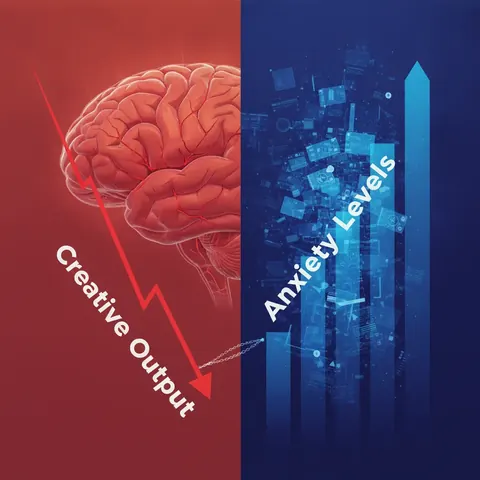
I Quit One Habit Nobody Talks About. What Happened Next Shocked Even Me — Here's What I Found
In this article
Bottom line: I spent 21 days without podcasts, audiobooks, or background noise filling the small gaps in my day — the kettle boiling, the lift ride, the walk to the bin.
Within four days I was reaching for my AirPods out of pure muscle memory; by day twelve, ideas I'd been "too busy" to have all year started arriving unprompted, mid-chore, with no warning.
A 2014 University of Virginia study found that a quarter of participants would rather give themselves a mild electric shock than sit alone with their thoughts for 15 minutes — this is that habit, just wearing better headphones.
If you haven't had an idle thought in longer than you can remember, the silence isn't empty. It's occupied territory.
I didn't quit sugar. I didn't quit my phone, not really — I still checked it forty times a day, same as everyone I know.
What I quit was smaller than that, and somehow harder: I stopped putting sound into every gap.
The kettle boiling. The lift between floors. The eight minutes it takes to walk from my flat to the bus stop on Green Lanes.
For as long as I can remember, every one of those gaps had a podcast in it, or an audiobook at 1.4x speed, or — if I'm honest about the bad days — a TikTok with the sound down low so nobody on the bus could tell I was watching someone reorganise their fridge.
I called it multitasking. It was closer to a compulsion I'd never once questioned, because everyone I know has the exact same one.
The Habit Nobody Names
Here's the thing about this particular habit: it doesn't have a support group. Nobody writes a Notes app confession about it.
There's no "I quit doomscrolling" energy around it, because on paper it looks productive.
You're learning. You're staying informed.
You're absorbing a novel while you fold laundry, which sounds less like an addiction and more like a life hack you'd read about in a magazine — possibly this one.
But a 2014 study out of the University of Virginia, published in Science, found something that's stuck with me since I first read it years ago: given the choice between sitting alone with their thoughts for 15 minutes or administering themselves a mild electric shock, roughly a quarter of participants chose the shock.
Men especially. One man shocked himself 190 times in a single session rather than just sit there and think.
We didn't have AirPods in 2014. We just had our own minds, and apparently that was already unbearable enough.
I don't think it's gotten better since — I think we've just gotten faster at reaching for the exit.
The pattern is everywhere once you notice it.
Silence has become something to be filled, not experienced. We treat unstructured time the way we used to treat unstructured spending — as waste, as a leak in the system, something a good app should be able to fix.
Except the "leak" was where most of my actual thinking used to happen, back when I had time to notice.
The Reframe: Boredom Isn't a Bug
Here's where I have to admit I had it backwards for years.
I assumed the goal was input efficiency — cram the maximum information into the minimum dead time, and you come out the other end smarter, better read, more current.
That's the whole promise of the podcast-at-1.5x-speed lifestyle, and I bought it completely.
But a psychologist named Sandi Mann, at the University of Central Lancashire, has spent years studying boredom specifically — not as a problem to solve, but as a cognitive state with its own function.
Her research found that people who did a boring task first, then a creativity test, generated more original ideas than people who went straight into the creativity test.
The boredom wasn't wasted time before the real work. It was the work — the quiet setup for whatever came next.
That reframes the whole equation. The problem was never a lack of information. I have never once, in my adult life, felt short on things to consume.
What I've been short on is the unscheduled mental space where two unrelated facts I already know get to bump into each other and become an idea.
That only happens in the gaps. And I'd spent years making sure the gaps never happened.
This is the part self-help culture tends to skip, because "do less" is a much worse pitch than "optimise more." But the fix here wasn't a new system for absorbing content faster.
It was giving my brain back the fifteen boring minutes a day it needed to actually process anything.
The Quiet Ladder
I didn't go cold turkey — I tried that in week one and lasted four hours before I was back to a true-crime podcast while doing the washing up, feeling faintly ridiculous.
What worked instead was a system I started calling the Quiet Ladder: four rungs, each one slightly harder than the last, each one small enough that I couldn't talk myself out of it.
Rung One: The Doorway Rule
Any transition under five minutes — kettle, lift, walking to the bin, waiting for a coffee — happens with nothing in your ears. Not silence forever, just silence in the doorway between two activities.
This one is almost embarrassingly easy to break and almost as easy to keep, because five minutes ends before you can really object to it.
Rung Two: The Un-narrated Meal
One meal a day, eaten without a screen, a podcast, or a phone propped against the salt. Just the meal.
I picked breakfast, because it was the one I was most likely to eat standing at the counter half-watching something anyway, and it turned out to be the rung I resisted hardest — which told me something.
Rung Three: The Commute Cutoff
The last ten minutes of any journey — walking, tube, bus — happen unscored. Not the whole commute.
Just the tail end, the bit closest to arriving somewhere, which is usually exactly when a stray thought would be most useful to have.
Rung Four: The Sunday Hour
One full hour a week, same time if you can manage it, completely without input. No book, no podcast, no phone in the room.
I used mine to walk to the postbox and back the long way, which sounds like nothing and initially felt like being asked to hold my breath.
You don't need all four rungs from day one. I spent the first week on rung one alone and felt like I'd accomplished something just by surviving the kettle.
What Actually Happened
Day four is when I noticed my hand moving toward my ears at the bus stop before my brain had caught up — pure muscle memory, reaching for a habit that was no longer allowed.
That's usually the sign a habit was running you rather than the other way round.
By day nine, the walks had gone from uncomfortable to just quiet. Not peaceful exactly — more like a room after the television's been switched off, where you notice sounds that were always there.
Traffic.
My own footsteps. A neighbour's radio through an open window.

Day twelve is the one I keep coming back to.
I was doing the washing up, no audio, rung two well underway, and an idea for a piece I'd been stuck on for a month just arrived — fully formed, mid-scrub, with no announcement.
I hadn't been trying to think about it. I'd been trying not to think about anything, which turned out to be exactly the condition it needed.
Try this today: pick one transition under five minutes — your kettle, your walk to the bin, the lift at work — and leave your headphones in your bag for it. Just that one.
See what your hand does at the two-minute mark. That reflex is the whole habit, showing itself for the first time in years.
The Part I Still Get Wrong
I won't pretend I've kept all four rungs since the 21 days ended.
The Sunday Hour has slipped twice this month, once for a genuinely good reason and once because a podcast I'd been saving finally dropped and I caved within the hour.
This isn't a story about becoming a person who doesn't multitask anymore. I still will, most days.
What changed is smaller and, I think, more durable: I no longer assume every gap needs filling.
I know now that the empty five minutes aren't dead time I'm failing to optimise — they're the only part of the day my mind gets to run without instructions. That's not nothing.
It might be the whole point.
Have you noticed your own hand reaching for your headphones before you've even decided you want music?
What's the smallest gap in your day you'd actually miss if you let it stay quiet — I'd genuinely like to know. Tell me in the comments.