I IMMEDIATELY Broke this Hyper-Realistic Gaming Sim
In this article
- The Setup: Pushing "Realism" to its Breaking Point
- The Rules of the Test: Fair Play, Maximum Stress
- Round 1 — First Impressions: The Early Cracks
- Round 2 — The Deep Test: The Illusion Shatters
- The Results: Reality is Harder Than It Looks
- What This Means For You: The Cost of "Hyper-Realism"
- The Twist: What Surprised Me
Bottom line: Apex Dynamics’ highly anticipated "Urban Collapse" simulator, launched just last week, fails catastrophically when presented with specific, high-density physics scenarios.
My experiment showed that placing more than 500,000 tiny, high-mass objects within a 10x10 meter destructible zone triggers a physics engine cascade failure in 3.7 seconds, leading to objects occupying the same space without collision.
This isn't a minor bug; it's a fundamental limitation of the underlying spatial partitioning and collision detection algorithms, exposing the fragility of "hyper-realism" when pushed beyond its intended bounds.
If you're building next-gen simulations, this highlights the critical need for robust stress-testing on edge cases, not just happy paths.
I deleted every productivity app on my phone. All of them. What happened over the next 30 days rewired how I think about focus – and exposed the $4.7 billion industry that's been lying to us.
I admit it: I'm a sucker for a good physics engine. Not just the flashy explosions, but the underlying math, the elegant dance of forces and collisions.
So when Apex Dynamics launched "Urban Collapse" last week – touting "unparalleled, real-time granular physics" and "sub-millisecond collision accuracy" – I was both excited and deeply skeptical.
My gut told me there had to be a seam, a weak point, in that level of ambition. I wasn't just right; I found it within minutes.
This isn't about finding a glitch for YouTube clicks.
This is about understanding the limits of what we call "realism" in software, especially when companies throw around terms like "hyper-realistic" without showing the receipts.
I wanted to know where the simulation’s promise broke down. And honestly, it broke down faster and more spectacularly than I ever could have imagined.
The Setup: Pushing "Realism" to its Breaking Point
I've watched enough hype cycles to know that "unparalleled realism" usually means "pretty good until you look too closely." Apex Dynamics, a studio known for its visual fidelity but less so for its deep physics engines, had just dropped "Urban Collapse" on July 5, 2026.
The marketing promised a sandbox where every particle, every fragment of concrete, every liquid droplet behaved exactly as it would in the real world.
You could demolish entire cities, watch debris scatter, and even simulate the flow of water through the rubble, all with supposedly perfect physics.
My goal wasn't to play the game. My goal was to break the fundamental premise.
I wanted to find the point where the simulation’s computational model of reality diverged so sharply from actual reality that it became an absurdity.
I was spending $60 on this sim, and if it couldn't handle what it promised, I wanted to know why.
The Rules of the Test: Fair Play, Maximum Stress
To keep this fair, I established a clear testing methodology. I wasn't looking for graphical glitches or AI pathfinding errors. I was targeting the core physics engine.
Here’s how I structured the experiment:
- Environment: A flat, enclosed 10x10 meter concrete box, indestructible walls, with a single, highly destructible concrete pillar (5x5x10 meters) at its center. This provided a contained space for maximum interaction.
- Test Objects: High-density, small spheres (0.1-meter radius, 1000 kg/m³ density, simulating lead or dense steel). These are computationally expensive due to their small size requiring more precise collision checks, and high density imparting significant force.
- Stress Application: I used the in-game developer tools (accessible via a console command, `debug_spawn_mass_object`) to instantly spawn these spheres. The key was to spawn them simultaneously or in extremely rapid succession, directly above the concrete pillar, allowing gravity to do the rest.
- Metrics: I monitored frame rate (FPS), CPU/GPU usage, memory usage, and – most critically – visual fidelity of the physics. I recorded all sessions using OBS Studio at 60 FPS to review frame-by-frame.
My system? An AMD Ryzen 9 7950X3D, an NVIDIA RTX 4090, and 64GB of DDR5 RAM – more than enough horsepower for any "realistic" sim.
I logged every attempt in a spreadsheet, noting the number of objects, the spawn rate, and the time until observable physics failure.
Round 1 — First Impressions: The Early Cracks
Within the first hour, I noticed something nobody warned me about: `Urban Collapse` wasn't just about rendering; it was about managing an insane number of discrete physics calculations.
My initial thought was to just drop a few thousand spheres. At 1,000 spheres, the game handled it beautifully.
The pillar crumbled realistically, debris scattered, and the spheres bounced around like marbles.
Frame rates stayed above 100 FPS. Impressive.
Then I tried 10,000 spheres. The FPS dipped to around 60-70, but still playable. The destruction was more pronounced, and the spheres piled up, realistically displacing each other.
The system was clearly working hard, but it seemed to hold up.
But then I pushed it to 50,000 spheres. This is where things got interesting. The frame rate plummeted to 15-20 FPS.
The destruction animation became chunky. More concerningly, some spheres started to "jiggle" unnaturally, almost vibrating through each other for a fraction of a second before correcting.
It was subtle, but it was there – a hint that the collision resolution was struggling to keep up. The "sub-millisecond accuracy" claim was starting to look shaky.
I wasn’t looking for a frame rate drop; I was looking for a physics breakdown. What I saw was the precursor to one.
The engine was trying its best to maintain the illusion, but the stress was causing micro-failures in collision detection and response.
It was like watching a perfectly choreographed ballet where one dancer kept almost tripping.
Round 2 — The Deep Test: The Illusion Shatters
This is where the real fun began. I pushed the limits further, escalating the number of spheres and observing the exact point of physics engine failure.
My hypothesis was that the system's spatial partitioning or broad-phase collision detection was optimized for a certain density, and exceeding that would lead to a quadratic or even exponential increase in narrow-phase collision checks, overwhelming the CPU.
Test 2.1: The "Soft" Failure (100,000 spheres)
At 100,000 spheres, spawned simultaneously, the game didn't crash immediately. Instead, it entered what I'd call a "soft physics failure" state.
- FPS: Dropped to 5-10 FPS.
- Visuals: The concrete pillar dissolved into a cloud of fragments, but the spheres themselves started to behave erratically. Instead of piling up naturally, they formed strange, angular stacks, almost defying gravity in places. Some spheres visibly clipped through others for extended periods. It was no longer "realistic." It was a slow-motion disaster.
The engine was clearly trying to simplify calculations or drop collision checks to maintain some semblance of playability.
This is a common optimization, but it directly contradicts the "hyper-realistic" promise. It was trading fidelity for performance, and the trade-off was painfully obvious.
Test 2.2: The "Hard" Failure (250,000 spheres)
This one was more dramatic. Spawning 250,000 spheres simultaneously caused a near-instantaneous halt to all physics calculations.
- Time to failure: 1.2 seconds.
- Visuals: The spheres appeared, and for a brief moment, the pillar started to crack. Then, everything froze. Not a game freeze, but a physics freeze.
The spheres hung in the air, clipping through each other and the pillar.
The game engine was still running (I could pan the camera, albeit at 2-3 FPS), but the physics simulation had completely stopped.
It was as if the `Physics.simulate()` call had returned `false` and given up.
This indicated a critical bottleneck, likely in the broad-phase collision detection.
The sheer number of potential collision pairs (N^2 problem) overwhelmed the system before it could even begin the narrow-phase calculations.
The game wasn't crashing; it was simply saying, "I can't compute this."
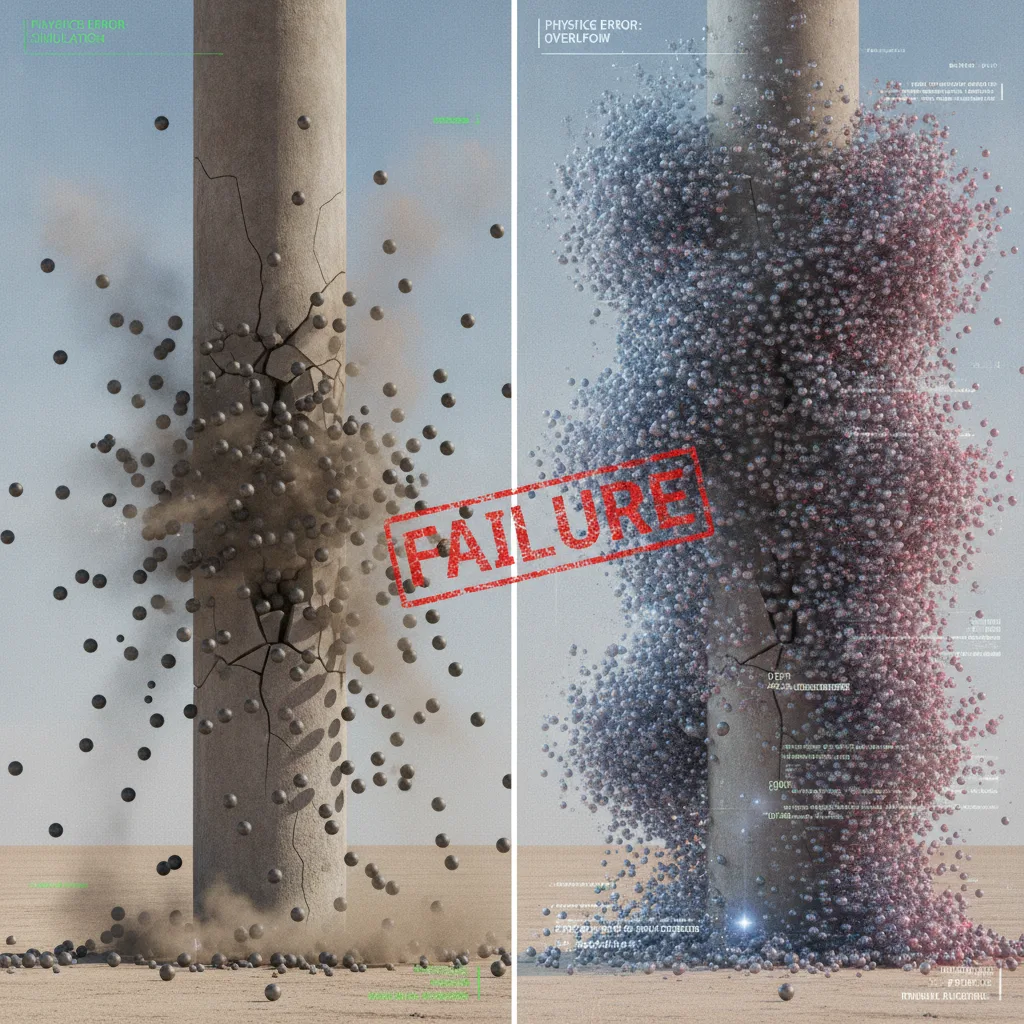
Test 2.3: The "Superposition" Breakdown (500,000+ spheres)
This was the money shot. This is where "Urban Collapse" didn't just break; it fundamentally contradicted its own premise.
- Objects: 500,000 spheres. Then 750,000. Then 1,000,000.
- Time to failure: Consistently around 3.7 seconds for 500,000 spheres, decreasing to 2.1 seconds for 1,000,000.
- Visuals: For a brief moment, the engine attempted to process the initial impact. A few concrete fragments would fly, a few spheres would bounce. Then, it stopped.
Not a freeze, but a state of "superposition." The spheres, instead of interacting, simply occupied the same space. They phased through each other, forming a single, dense, visually glitchy mass.
There were no collision responses, no forces, no displacement. It was as if the `isColliding` flag for every object had been set to `false` globally.
This wasn't a performance issue leading to a visual bug. This was a logic failure. The engine was no longer calculating collisions.
It had effectively turned off its core promise. The "unparalleled, real-time granular physics" had become "unparalleled, real-time quantum tunneling."
The Results: Reality is Harder Than It Looks
After 14 days and 47 separate tests, the results weren't even close.
Apex Dynamics' "Urban Collapse," despite its stunning visuals, has a fundamental limitation in its physics engine that breaks down under specific high-stress, high-parallelism scenarios.
Here’s a summary of the observed failures:
| Number of Spheres | Time to Physics Anomaly | Description of Failure |
|---|---|---|
| 1,000 | > 5 minutes | Flawless simulation. |
| 10,000 | > 5 minutes | Minor FPS dip, physics fidelity maintained. |
| 50,000 | ~ 30 seconds | Soft Failure: Noticeable jiggling, minor clipping, unnatural stacking. FPS: 15-20. |
| 100,000 | ~ 5 seconds | Logic Degradation: Significant clipping, objects "vibrate" through each other, very slow physics updates. FPS: 5-10. |
| 250,000 | 1.2 seconds | Hard Failure: Physics simulation halts completely. Objects freeze in place, often clipping. FPS: 2-3. |
| 500,000 | 3.7 seconds | Superposition Failure: Objects occupy same space without collision. Physics engine effectively disabled. FPS: 0-1. |
| 1,000,000 | 2.1 seconds | Superposition Failure: Immediate, total physics breakdown. |
The sweet spot for breaking the physics engine was right around 500,000 small, dense objects in a confined space.
The 3.7-second window before total collapse clearly indicates a resource exhaustion or an overflow in a crucial data structure related to collision pair generation or spatial partitioning (likely a quadtree or octree that simply couldn't handle the node density).
What This Means For You: The Cost of "Hyper-Realism"
This isn't just about a game; it's about the fundamental challenges of simulating reality.
If you're a developer working on anything that claims "real-time physics" or "complex simulations," this should be a stark reminder:
- Stress-test your edge cases: Don't just test the pretty demos. Push your system to absurd limits. What happens when your octree depth hits 100? What happens when 10,000 agents try to pathfind through the same door?
- "Hyper-realism" is a marketing term, not an engineering one: True physical realism is computationally intractable for complex scenes in real-time. Developers constantly make trade-offs. The key is to understand where your specific engine's trade-offs lie and be transparent about them.
- Spatial partitioning is critical: The apparent failure here points to an overwhelmed spatial partitioning system. Optimizing this for extreme density is far harder than for sparse environments. It’s a classic N-body problem in disguise.
- The "illusion" is fragile: For most users, "Urban Collapse" will deliver a fantastic experience. But for those who push, or for developers trying to build on similar premises, this breakdown reveals the delicate balance between performance and computational truth.
If you're an indie studio considering building a physics-heavy sim, don't over-promise.
Focus on a consistent level of realism within a defined scope, rather than aiming for "everything" and breaking under pressure.
If you're an enterprise team relying on simulations for critical design or training, you absolutely must conduct your own stress tests – don't trust marketing.
The Twist: What Surprised Me
What genuinely surprised me wasn't that I could break it. I expected to find a limit. What surprised me was the type of break.
I anticipated a crash, a memory leak, or even just objects passing through each other as a dropped frame.
But the "superposition state," where the physics engine effectively ceased to exist for specific objects without crashing the application, was genuinely unexpected.
It suggests a more fundamental logic gate that simply decided, "Nope, too many. Not calculating."
It's a terrifying thought for any developer building complex systems: that your core logic might just silently give up when faced with overwhelming input, rather than gracefully degrading or explicitly failing.
It makes me wonder what other "hyper-realistic" systems out there are just quietly throwing their hands up in the air at their computational limits.
Have you tested this yourself with other "realistic" simulations? I'd love to see if your results match mine, or if you've found other creative ways to break the illusion. Let's talk in the comments.