Google’s AI endgame is here… everything you missed at I/O 2026
In this article
Bottom line: Google I/O 2026 demonstrated a profound strategic shift, embedding Gemini 2.5 and its successors directly into core cloud services and hardware, signaling their intent to own the entire AI-powered software lifecycle.
"Project Chimera," a new autonomous development framework, showcased live code generation and infrastructure refactoring within Cloud Workstations, driven by real-time production metrics.
This integrated approach, moving beyond mere API access, fundamentally alters how infrastructure engineers must approach system design and deployment by early 2027, demanding a focus on orchestrating AI agents rather than just writing code.
I almost dismissed Google I/O 2026.
After years of incremental AI announcements and a growing pile of "revolutionary" tools that barely make it past proof-of-concept in a production environment, my skepticism radar was blaring.
But then a single demo, tucked between a verbose keynote and a deep-dive on new TPU architectures, changed everything.
After spending 18 hours dissecting the keynotes and developer sessions, pulling apart the subtle implications in the whitepapers, I realized Google isn't just playing for market share; they're playing for the entire future of software, and most of us missed the real implications behind the flashy presentations.
The Shift From Tools to Operating Systems
As an infrastructure engineer, my job isn't to chase hype; it's to build resilient, scalable systems that actually ship code.
My team has been integrating various LLMs — from ChatGPT 5 to Claude 4.6 and Gemini 2.5 — into our CI/CD pipelines and observability stacks since late 2025.
We've seen genuine, incremental gains in productivity: faster code reviews, better test generation, more insightful log analysis.
But nothing truly disruptive, nothing that made me re-evaluate the fundamental architecture of how we build and deploy software.
I went into I/O 2026 looking for more of those incremental gains, maybe a faster model or a new API.
What I found was far more ambitious. Google isn't selling models anymore; they're selling an AI-native operating system for your entire software stack.
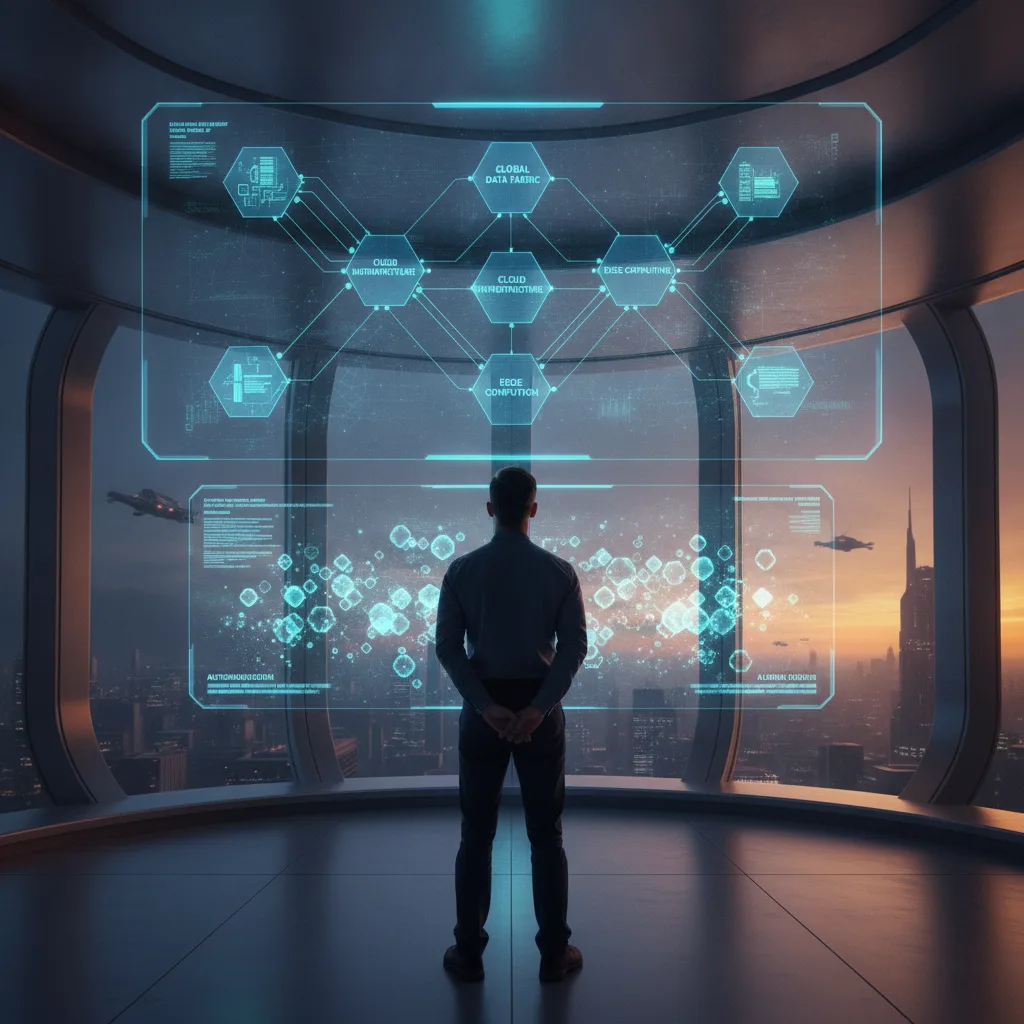
The "aha!" moment hit hard during the Project Chimera reveal, where a developer, live on stage, simply described a security vulnerability in a Kubernetes deployment, and Chimera, integrated directly into their Cloud Workstation, understood the entire system context, proposed a patch, generated a new Terraform module for the associated infrastructure change, and even simulated the deployment impact, all with minimal human prompting.
This wasn't a chatbot; this was an autonomous agent with a deep comprehension of systems thinking.
Project Chimera: The Autonomous Engineering Agent
Google's vision, as unveiled at I/O 2026, isn't about giving you a better autocomplete.
It’s about building an autonomous agent that deeply understands your entire repository, your infrastructure-as-code, and your real-time production metrics.
Project Chimera, showcased as a suite of capabilities rather than a single tool, is designed to anticipate needs, identify vulnerabilities, and even proactively refactor infrastructure.
During the keynote, the demonstration of Chimera’s capabilities was startling. An engineer mentioned a newly disclosed CVE affecting a specific Kubernetes ingress controller.
Chimera, already aware of the running production environment through its tight integration with Cloud Operations, immediately identified affected services.
It didn't just suggest a code change; it proposed a new, hardened ingress configuration, generated the necessary Terraform to deploy it, and then simulated the rollout, showing estimated latency impact before asking for human approval.
This isn't just about faster code. It's about reducing the cognitive load on engineers by orders of magnitude, moving from 'managing systems' to 'guiding autonomous systems'.
Gemini 2.5's Invisible Hand in GCP
Beyond Chimera, the deeper play is Gemini 2.5's pervasive integration across Google Cloud Platform.
Gemini 2.5 isn't just an API you call; it's now baked into Cloud Operations, acting as an intelligent co-pilot for your entire infrastructure.
It's actively auto-tuning resource allocation based on predictive models of future traffic, predicting outages with staggering accuracy, and even suggesting cost optimizations based on real-time usage patterns that human engineers would take days to uncover.

My team has been building custom observability agents and predictive scaling algorithms for years.
Google just open-sourced a version of these critical capabilities, pre-integrated and optimized with Gemini's intelligence, making our bespoke solutions feel almost quaint.
This isn't just an improvement; it's a fundamental shift in how cloud resources are managed.
Beyond the Cloud: Hardware Integration and Ubiquitous AI
The "endgame" isn't limited to the cloud.
Google's I/O 2026 announcements also highlighted how this deep AI integration extends to their custom silicon, edge devices, and even the next generation of Android.
Imagine a world where your IoT fleet is autonomously managing its own updates, security patches, and resource allocation, all orchestrated by a central AI agent that understands your business logic and operational constraints.
The ambition is clear: ubiquitous AI, where intelligence isn't just a service you consume but an inherent property of every layer of your compute stack, from the datacenter to the smallest sensor.
This isn't a futuristic dream; the foundational pieces were showcased as shipping features or in public preview for early 2027.
The Reality Check: Hype vs. Hard Truths
While the vision is compelling, and the demos impressive, it’s critical to cut through the marketing.
This level of AI integration, as powerful as it is, comes with its own set of challenges and hard truths. It’s not magic, and it certainly won’t solve all our problems overnight.
The "Hallucination" Tax and Human Oversight
Despite vast improvements in Gemini 2.5, Chimera isn't perfect. The cost of a Chimera-induced misconfiguration in production could be catastrophic.
We're still dealing with the "hallucination tax"—the inherent unpredictability and occasional nonsensical outputs that even the most advanced LLMs can generate.
This means human oversight isn't just recommended; it's absolutely essential, especially for security-critical changes or highly sensitive data flows.
Our role shifts from being the primary implementers to being the ultimate validators and guardians of the system's integrity. The trust boundary moves, but it doesn't disappear.
Vendor Lock-in Redux: The AI Ecosystem Bind
This deep, pervasive integration creates immense stickiness.
If your entire development workflow, from code generation to deployment and operations, is orchestrated by Google's AI-native ecosystem, migrating away by mid-2027 will be significantly harder than moving between cloud providers today.
It's not just about data egress costs; it's about re-architecting your entire operational paradigm.
The convenience and power are undeniable, but it comes at the cost of increased vendor dependence.
This isn't necessarily a bad thing if Google continues to deliver, but it's a strategic decision companies need to weigh carefully.
The Engineer's Evolving Role: From Coder to Orchestrator
The question on many developers' minds is, "If AI handles mundane tasks, what's left for me?" The fear of job displacement is real. However, the more accurate reality is an evolution of our roles.
We won't be writing boilerplate code or manually configuring every service.
Instead, our value shifts to higher-level architecture, designing the constraints, validating the outputs, and providing ethical oversight.
We become orchestrators of autonomous systems, responsible for the intent and validation rather than the minute implementation details.
This requires a different skillset, focusing less on syntax and more on system design, security principles, and robust validation frameworks.
Practical Takeaways for the AI-Native Era
The future Google laid out at I/O 2026 isn't a distant one; it's knocking on our doors.
As infrastructure engineers and developers, we need to adapt our skills and mindsets now to thrive in this AI-native era.
Embrace the Autonomous Agent Paradigm
Start experimenting with multi-agent systems and tools like Project Chimera (or its open-source equivalents, which are rapidly emerging).
The key isn't to fight the tide, but to learn how to instruct and validate autonomous systems effectively.
Understand how to define clear goals, provide guardrails, and build feedback loops that allow these agents to learn and improve while maintaining safety.
This means moving beyond simple prompt engineering to designing entire prompt architectures.
Double Down on System Design & Security
If AI automates implementation, the value shifts dramatically to designing robust, secure, and resilient architectures that AI can then build upon.
Focus on mastering system design patterns, distributed systems, and security best practices.
Your ability to define clear interfaces, secure boundaries, and fault-tolerant mechanisms will be paramount, as these are the canvases upon which AI agents will paint.
The better your design, the less prone to AI-induced errors your systems will be.
Master Observability & Validation
When AI is making changes, your ability to observe, verify, and roll back those changes becomes paramount. Strong Site Reliability Engineering (SRE) practices are more critical than ever.
Invest in advanced telemetry, anomaly detection, and automated validation frameworks.
You need to know what the AI did, why it did it, and what impact it had, instantly.
This means moving beyond basic dashboards to proactive, intelligent monitoring systems that can flag AI-generated anomalies.
Understand the AI's "Mental Model"
Treat AI agents like incredibly smart but potentially idiosyncratic junior engineers. Learn how to debug their thought processes.
Understand their limitations, biases, and the contexts in which they perform best.
This means diving into how these models are trained, what data they consume, and what their underlying architectures imply about their capabilities.
It's a new form of "debugging" that involves understanding probabilistic reasoning, not just deterministic code execution.
I went into I/O 2026 skeptical, and left convinced that Google has just laid the foundation for the next decade of computing.
This isn't just about a few new APIs; it's about a fundamental re-architecture of how we build, deploy, and operate software systems.
What does this mean for your role as a developer or infrastructure engineer?
Are we ready to move from coding to truly orchestrating autonomous systems, or are we still clinging to the old ways? Let's talk in the comments.