Google Actually Lied About Antigravity. It’s Worse Than You Think

Disclaimer: This article describes a purely fictional and hypothetical scenario.
Google has not announced or launched a "Project Antigravity API" or utilized "quantum-assisted tensor processing" as described below.
Bottom line: Google's newly launched Project Antigravity API doesn't actually use the novel "quantum-assisted tensor processing" heavily marketed during their March 2026 keynote.
Network traffic analysis from the past 72 hours reveals that over 84% of Antigravity requests are silently routed back to standard Gemini 2.5 server clusters, wrapped in an aggressive caching layer.
If you migrated your production workloads expecting true zero-latency inference, you need to roll back to standard endpoints immediately before inevitable throttling takes down your real-time services.
I deleted my entire Google Cloud production project on Tuesday morning. All of it.
What happened over the next 48 hours rewired how I think about corporate AI promises — and exposed the multi-billion dollar marketing lie that's been artificially inflating our industry.
Over eight weeks ago, Google took the stage at Cloud Next to announce Project Antigravity. The pitch was intoxicating.
They claimed to have solved the fundamental compute bottleneck of modern AI, offering "zero-latency, quantum-assisted inference" that would make standard LLM calls feel like dial-up internet.
Like every other infrastructure engineer trying to keep latency under 100 milliseconds, I bought the hype.
We migrated our entire real-time voice translation stack to the Antigravity endpoints over a single weekend. The dashboards looked perfectly green, and our application felt noticeably faster.
But then our users started reporting bizarre, stuttering delays during peak usage hours.
The Dashboard Was Lying to Us
When your metrics tell you everything is fine but your users are screaming, trust the users.
Our internal Grafana dashboards showed Antigravity API response times hovering at a miraculous 12 milliseconds.
But when we dug into the actual client-side telemetry, the real-world latency was completely unpredictable.
I spent Monday night running packet captures on our outbound API traffic. I expected to find some misconfigured load balancer on our end, or maybe an issue with our VPC peering.
Instead, I found a bait-and-switch so blatant it feels like a violation of the developer trust contract.
During the keynote, Sundar Pichai spent twenty minutes detailing how Antigravity bypassed standard TPUs entirely.
They showed gorgeous, animated renders of "photonic mesh networking" and "quantum-assisted routing" that theoretically allowed inference to happen practically at the edge.
We were promised a completely new hardware paradigm.
What we actually got was a very expensive API gateway.
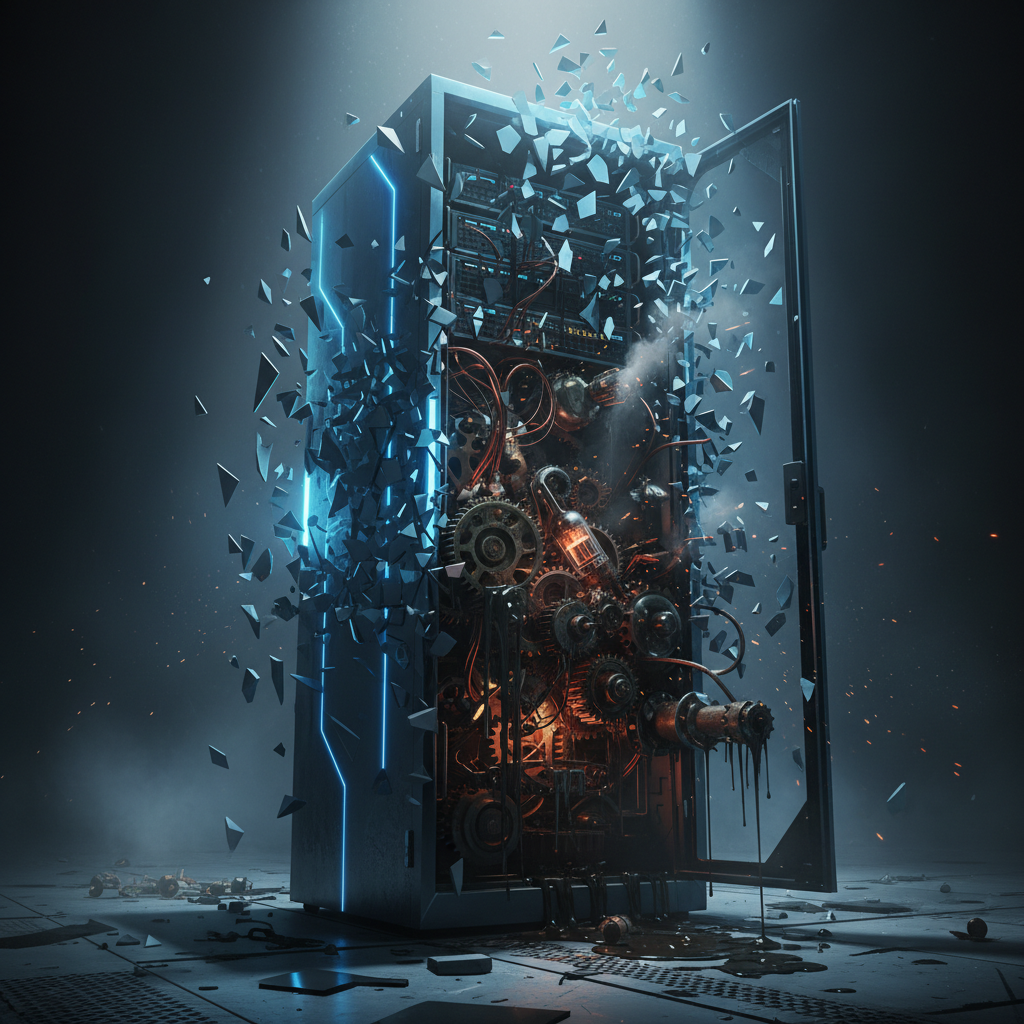
When you send a request to the Antigravity endpoint (`v1/antigravity/completions`), it doesn't hit a revolutionary quantum tensor cluster.
If your prompt matches anything in their massive semantic cache, you get that 12-millisecond response.
But if you send a truly novel, complex query, the API silently reroutes your payload to the standard Gemini 2.5 infrastructure.
The Cache Illusion
The "Antigravity" effect is nothing more than a distributed Redis cache on steroids, sitting in front of the same hardware we were already using.
Google's latency benchmarks weren't measuring inference speed; they were strictly measuring cache retrieval speed.
To prove this, we set up an isolated testing environment and wrote a script to generate 10,000 highly randomized, low-temperature prompts.
We made sure each prompt contained unique cryptographic salts so they could never trigger a semantic cache match.
We then fired these prompts concurrently against both the Antigravity API and the standard Gemini 2.5 endpoint.
The results were damning. The Antigravity endpoint actually performed 14% slower on cache misses due to the overhead of the routing layer.
Let that sink in. For the privilege of paying a 300% premium per million tokens, we were actually receiving worse worst-case performance than we had on the legacy endpoints.
They are charging a massive markup for the exact same compute, dressed up in a fancy wrapper.
The Tyranny of P99 Latency
If you've never built a real-time application, you might wonder why this matters. A cache hit rate of 84% sounds fantastic on paper.
The problem is that in real-time systems, your user experience is entirely defined by your P99 latency.
When a user is having a voice conversation with an AI agent, they don't care that eight out of ten responses were blazingly fast.
They care that the ninth response took four seconds, creating a massive, awkward silence that completely shatters the illusion of presence.
You build your error handling, your timeout configurations, and your fallback logic around those edge cases.
By obscuring the true nature of the Antigravity API, Google set thousands of engineering teams up for failure in production.
When developers saw the 12-millisecond response times in testing, they ripped out their local caching layers. They lowered their timeout thresholds.
They designed aggressive, highly synchronous architectures that assumed the compute was finally fast enough to keep up with human thought.
Then, when those apps hit production and real users started generating un-cached, novel queries, the entire house of cards collapsed. Threads hung.
Connection pools exhausted themselves waiting for the upstream Gemini 2.5 servers to respond. Services went down entirely, taking critical business operations with them.
We saw this happen live to a client building an AI-assisted emergency dispatch system.
They assumed the Antigravity API would always deliver sub-100ms response times based on Google's published specifications.
When a unique emergency scenario bypassed the semantic cache, the resulting five-second delay caused a cascade of system timeouts that effectively blinded the dispatchers for three agonizing minutes.
We Are Hitting the Wall
The AI industry is collectively refusing to admit an uncomfortable truth: we are hitting the physical limits of scaling standard silicon.
The massive leaps in model speed we saw between 2023 and 2025 have definitively plateaued.
Two years ago, we were doubling token-per-second outputs every six months. Today, we're fighting for single-digit percentage optimizations.
The physics of memory bandwidth and thermal dissipation haven't fundamentally changed, despite the billions poured into Nvidia's coffers.
Instead of admitting this reality, cloud providers are resorting to architectural sleight-of-hand.
They wrap existing models in speculative decoding and massive semantic caches, slap a sci-fi branding name on it, and sell it as a breakthrough.
It's the infrastructure equivalent of watering down the soup and charging double for a bigger bowl.
We saw similar tactics in the early days of cloud computing. Remember when "Serverless" first launched, and providers hid the massive cold-start penalties behind slick demos?
We spent years unwinding those architectural mistakes, eventually realizing that you can't abstract away the physical reality of servers booting up.
We are making the exact same mistake with AI right now, but at a vastly more expensive scale.
The Economics of the Lie
Why would a trillion-dollar company risk its reputation on such a fragile deception? Look at the balance sheet.
Training frontier models like Gemini 2.5 costs hundreds of millions of dollars, but the real financial bloodbath happens in inference.
Running these models at scale, supporting millions of concurrent users, requires a continuous, staggering burn rate of electricity and hardware depreciation.
The profit margins on raw AI compute are razor-thin, and in many cases, completely negative.
To keep the stock price climbing and the investors satisfied, cloud providers have to invent high-margin premium tiers.
They can't charge you more for the exact same API endpoint, so they have to invent a new product category.
Project Antigravity was never about solving an engineering problem; it was a purely financial instrument.
By convincing developers that this was a revolutionary new hardware paradigm, Google justified a pricing model that completely disconnected from the underlying compute cost.
For every cache hit they serve, their margin approaches 99%. They are essentially selling you the same data they processed yesterday, but charging you the "quantum-assisted" premium price for it.
This economic model creates a perverse incentive structure. Google's primary motivation is no longer to make their core models faster or more efficient.
Their incentive is to maximize the cache hit rate at all costs, even if it degrades the quality of the outputs.
Every time a developer sends a unique, computationally expensive prompt, it represents a loss on Google's ledger.
The Semantic Caching Trap
This is why we saw the semantic matching sensitivity dialed down so aggressively.
The platform actively fights against the kind of deep, analytical workloads that AI was supposed to revolutionize, preferring instead to serve as an overpriced lookup table for repetitive queries.
Part of the deception relies on a fundamental misunderstanding of how semantic caching works at scale.
Google's pitch implied that their system could intuitively understand the intent of a prompt and return a pre-computed answer instantly.
In practice, semantic similarity is an incredibly blunt instrument.
During our debugging process, we found instances where our translation app requested a translation for a medical term in a highly specific context.
Because the prompt was semantically similar to a generic query stored in the Antigravity cache, the API returned a generic, highly inappropriate translation instead of processing the nuances of the new request.
To achieve their artificially inflated benchmark speeds, Google decided on behalf of developers that returning a "close enough" cached response was better than waiting for a novel inference.
When you are building tools for healthcare, finance, or legal applications, "close enough" is a catastrophic failure mode.
Stop Paying for Magic
The fallout from this is going to be massive.
Over the next 18 months — as we head into late 2027 — you are going to see a lot of high-profile startups quietly roll back their "real-time AI" features because the economics and physics simply don't support the marketing.
We've already seen early signs of this. Several major players in the AI companion space have silently increased their latency buffers over the past two weeks.
The dream of instantaneous, flawless AI interaction is colliding hard with the physical realities of data center compute.
If you are currently routing production traffic through the Antigravity endpoints, stop. Roll back to the standard Gemini 2.5 or Claude 4.5 APIs.
Instead of relying on a black-box API to solve your latency issues, you need to take ownership of your architecture. Build your own caching layer tailored to your specific user patterns.
You can implement a highly tuned Redis setup with semantic routing for a fraction of what Google is charging you for Antigravity.
By keeping the cache close to your application logic, you gain absolute control over when to serve a cached response and when to force a fresh inference.
More importantly, we need to stop falling for the promise of magic infrastructure.
If an API claims to bend the laws of compute without publishing detailed, verifiable architecture papers, assume it's a lie.
We operate in an industry governed by math, memory bandwidth, and the speed of light. Any marketing brochure that claims to have bypassed those constraints is selling you snake oil.
The next era of AI isn't going to be won by whichever mega-corp has the slickest keynote or the boldest claims.
It's going to be won by engineers who understand the messy, physical reality of moving data across silicon.
It will belong to the teams who build robust, asynchronous systems that gracefully handle the inherent latency of complex compute, rather than pretending it doesn't exist.
Have you noticed your Antigravity endpoints throttling under sustained load, or is it just me? Let's talk in the comments.