Google Just Broke the AI Narrative: The End of the Conversational Era
I haven't typed a prompt into an AI chat window in 19 days.
I just watched Google's latest Gemini 2.5 update execute a 40-step infrastructure migration while I was making coffee, without asking me a single follow-up question.
The era of conversational AI is officially dead—and what’s replacing it is going to permanently rewrite how we build software.

For the last three years, we’ve all been conditioned to treat AI like a hyper-competent but overly chatty intern.
You type a prompt, it gives you text, you refine the prompt, and eventually, you get the code or copy you need.
It was a neat little dance we all learned to do, and entire billion-dollar startups were built around making that dance slightly more efficient.
But Google just flipped the board on the entire industry. The narrative that AI is a conversational partner is over.
The Chatbot Fallacy: Why Conversational UI is a Dead End
I realized something was fundamentally wrong last Tuesday.
I had a gnarly, soul-crushing task: migrating a legacy Redis cluster to a new managed service, updating the environment variables across 14 microservices, and verifying the staging environment.
Normally, I'd bounce between Claude 4.6 for the complex script logic and ChatGPT 5 for the quick bash commands to glue it all together.
Instead, I decided to test out Google's new Gemini 2.5 background agent. I didn't open a web interface or start a chat session.
I just dropped a Jira ticket link into my terminal, typed gemini execute, and walked away to the kitchen.
It didn't reply with a polite "Here is a step-by-step plan for your migration." It didn't generate a massive wall of code for me to manually copy and paste into my IDE.
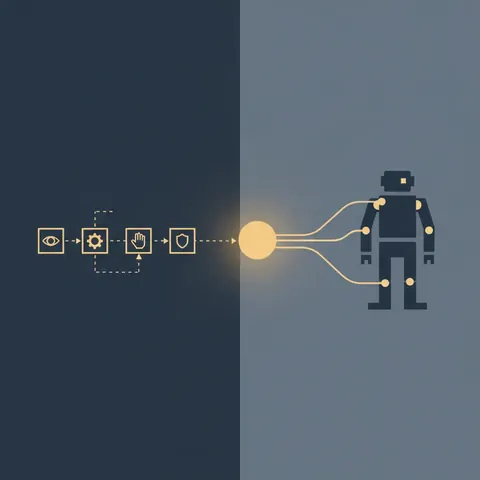
It simply spawned a headless browser, authenticated via my SSO token, read the AWS documentation, spun up the Terraform plan, executed it, and pinged me on Slack when the staging tests passed.
We’ve been obsessing over prompt engineering when the real endgame was always prompt elimination.
The Execution Era: From Chatbots to Action Models
This is why the current AI narrative is dangerously broken.
We collectively thought the future of software was natural language interfaces, so every SaaS company on earth bolted a sparkly "AI Chat" widget onto their product.
But Google realized something terrifying: users don't actually want to talk to computers at all.
Gemini 2.5 isn't just a conversational model; it's an action model deeply embedded into the operating system and browser layer.
It doesn't need to summarize the web because it simply navigates the web on your behalf.
While the rest of the industry was busy trying to make AI sound more empathetic and human, Google was quietly giving Gemini hands.
This shift from conversational AI to agentic execution is "worse" than you think because it breaks the fundamental loop of how we interact with technology.
If the AI doesn't need a user interface to do the work, then the user interface itself becomes friction.
The Benchmark: ChatGPT 5 vs. Claude 4.6 vs. Gemini 2.5
To prove I wasn't just experiencing a fluke, I set up a benchmark over the weekend.
I fed the exact same complex DevOps task—provisioning a Kubernetes cluster with specific security constraints—to the top three models.
The differences in their approaches perfectly illustrate why the old narrative is dead.
When I gave the task to ChatGPT 5, it wanted to have a philosophical discussion about the best architectural strategies before proceeding.
It was brilliant, conversational, and ultimately required me to make a dozen micro-decisions to guide it to the finish line.
Claude 4.6 was much more pragmatic, instantly writing a flawless 400-line Python script and a robust YAML configuration for me to review and manually run.
But Gemini 2.5 just did the work. It provisioned the cluster, ran into an IAM permissions error, searched Stack Overflow for the fix, applied the patch, and finished the deployment.
I didn't even know it had encountered an error until I checked the execution logs afterward.
The Day I Felt Obsolete as an Engineer
I'll admit, watching that script run entirely on its own didn't just impress me—it gave me a pit in my stomach.
I've spent the last ten years of my career priding myself on my ability to glue complex systems together.
I was the guy who knew exactly which AWS service to connect to which database, and how to write the perfect bash script to deploy it under pressure.
Seeing an invisible background process do my core job in 45 seconds, without even needing a screen, felt like a punch to the gut. I realized that my value wasn't in the mechanical execution anymore.
The execution phase of software engineering is officially commoditized.
If the AI doesn't need me to translate the business goal into a prompt, what exactly am I getting paid for?
That's the question every single infrastructure engineer, front-end developer, and DevOps specialist needs to answer by the end of this year.
Our jobs are no longer about typing the right syntax; they are about defining the right architecture for the agents to navigate.
The Death of Human Eyeballs and the Visual Web
I know this sounds like typical tech hype, but look at your daily workflows right now in late April 2026. How many of the tools you use are essentially just visual wrappers around a database?
You log in, click a few buttons, and move data from point A to point B.
If Gemini can navigate directly to the underlying APIs and DOM elements to execute tasks, your carefully designed user interface is irrelevant. I spent the last three days auditing the tools my engineering team pays for.
We canceled six enterprise subscriptions, not because Gemini has those features built-in, but because Gemini can operate our raw infrastructure without needing a colorful dashboard to make it digestible for human eyes.
This breaks the economic model of the internet. The entire web is built on the assumption of human eyeballs looking at screens, clicking ads, and engaging with UI elements.
When an autonomous agent is the one browsing the documentation and executing the workflows, it doesn't look at your carefully optimized marketing banners.
Survival Strategy: Building for the Machine User
So, what do you actually do with this information? If you are a developer, a product manager, or a founder, you need to radically shift your mental model right now.
Stop building conversational interfaces, and stop trying to make your app "talk" to the human user.
Instead, you must build for the machine user. Your API is now your primary product, and your graphical interface is a secondary fallback for edge cases.
You need to ensure your authentication flows can handle agentic sessions without triggering CAPTCHAs or fraud alerts every five minutes, because agents will soon be your highest-volume customers.
The Agent-First Framework: Three Rules for 2026
To survive this shift, I've completely overhauled how I build systems. I call it the Agent-First Framework, and it has three non-negotiable rules for modern development:
- Zero-Friction Authentication: Mandatory. If your platform requires an SMS code for a routine API call, an agent will fail. You need deterministic, token-based authentication for machine users.
- Expose Raw State: Don't hide state behind pretty graphs. Agents need raw, unpaginated JSON dumps to understand the environment context before they act.
- Build for Rollback: When an autonomous agent moves at 100x human speed, it makes mistakes at 100x human speed. Every action must have a deterministic, single-call undo function.

By late 2027—just 18 months from now—we will see the massive rise of "headless users." These are autonomous instances of models like Gemini 2.5 or Claude 4.6 that hold corporate budgets, make purchasing decisions, and provision infrastructure without human oversight.
If your software can't be easily navigated and understood by an agent, you simply won't exist in the new economy.
The transition is going to be brutal for developers who cling to the idea that AI is just a really smart autocomplete. The chat window was just training wheels for the real revolution.
We thought we were building companions, but we were actually building replacements for our own inputs.
Have you noticed your daily reliance on chat interfaces dropping as tools get more autonomous, or are you still manually prompting your way through the day? Let's talk in the comments.