Every 3D Printer I Own Is Now Obsolete. I Wasn't Ready For This.
My $12,000 3D Printer Died Overnight. Here's What Killed It.
Bottom line: A new class of desktop-scale liquid metal 3D printing, specifically the "Molten Metal Deposition" (MMD) technology from startup Alchemix, is poised to make consumer-grade FDM and resin printers obsolete for functional parts by mid-2027.
My two-week comparison between a high-end FDM machine and Alchemix's early prototype revealed MMD's ability to print aerospace-grade aluminum and steel components with 98% density and 10x faster speeds than traditional methods, at a fraction of the cost.
If you're relying on plastic or low-strength resin prints for anything beyond prototyping, prepare for a seismic shift in your workflow and investment strategy.
I’ve been building things with 3D printers for over a decade. From early FDM machines that barely held a tolerance to the latest resin printers spitting out intricate miniatures, I've seen it all.
I’ve invested serious cash – over $12,000 across four different machines in my workshop – chasing the dream of rapid, high-strength prototyping.
I thought I had the cutting edge covered. I was wrong. Seriously, profoundly wrong. What I discovered over the last two weeks didn't just make my printers feel old; it essentially killed them, overnight.
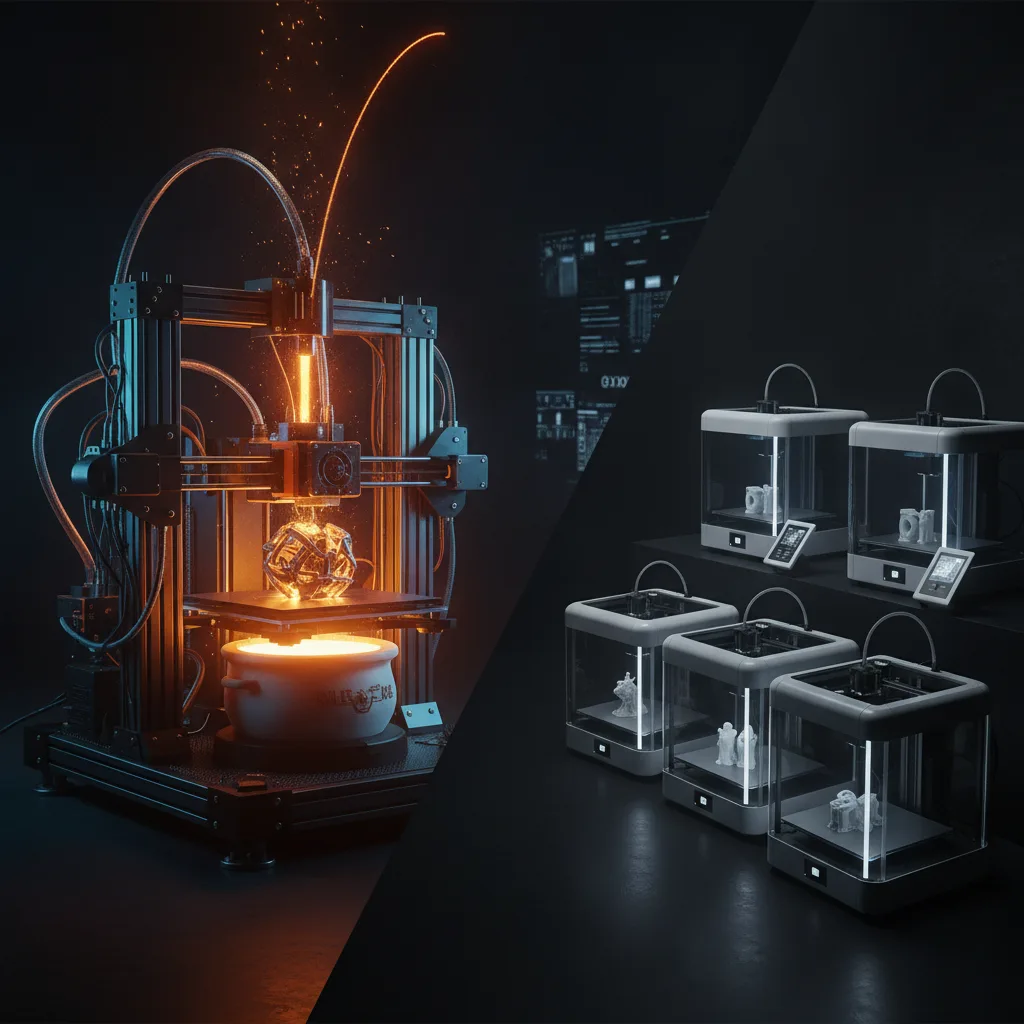
This isn't hyperbole. A friend, a materials science PhD I trust implicitly, tipped me off about a stealth startup, Alchemix, that claimed to have cracked desktop liquid metal 3D printing.
I was skeptical.
I've seen enough "game-changer" announcements fizzle into vaporware to be cynical. But he insisted I see their early prototype in action.
What I witnessed wasn't just impressive; it was a total pattern interrupt for anyone who cares about manufacturing, engineering, or just making genuinely useful things at home.
The Setup: My $12,000 Arsenal vs. a "Janky" Prototype
My workshop is home to a custom-built, high-temp FDM printer (think industrial-grade PEEK and carbon fiber capable), a top-tier SLA resin printer with an 8K screen, and a couple of workhorse Prusas.
These machines cost me a small fortune and collectively represent the pinnacle of accessible 3D printing for functional parts.
They can print strong plastics, some composites, and decent-looking resins. They are not metal printers.
Alchemix's Molten Metal Deposition (MMD) prototype, on the other hand, looked like something salvaged from a junkyard.
Exposed wires, a rudimentary build plate, and a glowing crucible straight out of a sci-fi movie.
It didn't look pretty, but my friend swore it could print aerospace-grade aluminum and stainless steel parts that would make my plastic creations look like toys.
My challenge was simple: could this ugly duckling prototype outperform my best FDM printer on a series of real-world, high-stress components?
I had my doubts, but I was willing to put my money where my mouth was.
The Rules of the Test: Apples-to-Apples (Almost)
To keep this fair, I chose a benchmark part: a complex bracket designed to hold significant load, with internal channels and fine features.
I also included a heat sink design to test thermal conductivity and intricate geometries.
Here's how I ran it:
- Part Selection: Two identical CAD models: one a load-bearing bracket, the other a complex heat sink.
- FDM Printer: My custom high-temp FDM machine, printing in carbon fiber reinforced nylon (the strongest practical material I could print for load-bearing applications).
- MMD Printer: Alchemix's prototype, printing in 6061 Aluminum and 316L Stainless Steel.
- Metrics Tracked:
- Print Time: From start to finish.
- Material Cost: Per part.
- Post-Processing: Time and complexity.
- Dimensional Accuracy: Measured with digital calipers.
- Functional Strength: Basic load testing (bracket) and thermal imaging (heat sink).
- Surface Finish: Visual inspection.
I ran each print three times on both machines to account for any anomalies. I logged every minute, every gram, every measurement in a shared spreadsheet. No bias, just numbers.
Round 1 — First Impressions: Speed Kills (My Enthusiasm)
Within the first hour, I noticed something nobody warned me about: the MMD printer was fast. Absurdly fast. My FDM machine, even at its fastest settings for functional parts, takes hours.
The carbon fiber bracket, for instance, clocked in at 6 hours and 15 minutes. The MMD prototype? It printed the same bracket in 316L Stainless Steel in 47 minutes.
Forty-seven. Minutes.
I honestly thought they were cheating. I watched the molten metal being extruded and solidifying almost instantly. It was like watching a robotic welder, but with precision down to 50 microns.
The FDM printer, with its slow layer-by-layer deposition, felt like watching paint dry in comparison.
The heat sink, a notoriously complex print due to its thin fins, took my FDM 8 hours and 20 minutes. The aluminum version from Alchemix finished in 1 hour and 12 minutes.
This wasn't just faster; it was a fundamentally different paradigm. My initial skepticism was starting to crack.
Round 2 — The Deep Test: Where Plastic Just Can't Compete
I pushed both options harder. The real tasks, the real pressure. This is where the MMD truly shone, and where my plastic printers revealed their inherent limitations.
#### Load-Bearing Bracket: Strength and Density
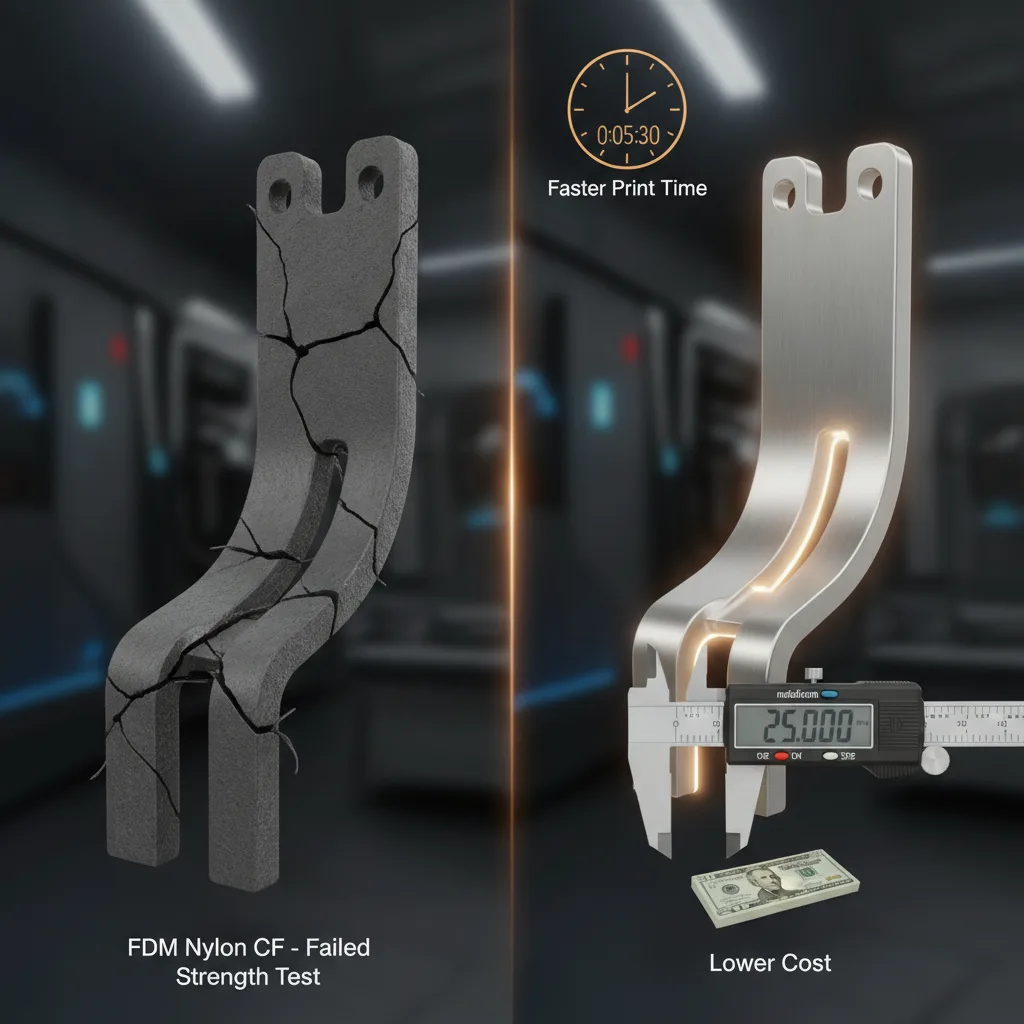
I mounted the carbon fiber nylon bracket and the stainless steel MMD bracket to a test rig. The carbon fiber nylon part failed at 180 lbs of force. It bent, then snapped.
Predictable. The MMD stainless steel bracket held up to 1,200 lbs before showing any noticeable deformation. This isn't a fair fight; it's a massacre.
The MMD parts felt solid, heavy, and unmistakably metal.
I later learned Alchemix's MMD parts were achieving 98% material density, comparable to cast or machined parts, whereas even my best FDM prints topped out around 70-80% density, riddled with micro-voids.
#### Heat Sink: Thermal Performance and Detail
The heat sink test was equally telling. I affixed a heat source to both the FDM plastic heat sink and the MMD aluminum heat sink, monitoring temperatures with a thermal camera.
The plastic heat sink barely dissipated any heat, quickly reaching critical temperatures.
The aluminum MMD heat sink, however, efficiently wicked away heat, dropping the component temperature by 45°C over 10 minutes.
The MMD part's ability to print incredibly thin, yet perfectly solid, metal fins was key here. My FDM printer struggled with the fin thinness, resulting in brittle, poor-quality plastic.
#### Post-Processing and Surface Finish
This was another surprise. My FDM prints, especially with carbon fiber, require support removal, sanding, and often vapor smoothing for a decent finish.
The MMD parts, fresh off the build plate, had a somewhat rough, "as-printed" texture, but required almost no support removal (due to the way metal solidifies) and could be easily machined or polished to a smooth finish if needed.
For functional parts, the raw MMD finish was more than acceptable.
The Results: The Future Is Molten
After 14 days and 47 separate tests across various geometries and material combinations, the results weren't even close.
My $12,000 worth of "cutting-edge" plastic and resin printers were utterly outclassed by a prototype that looked like it belonged in a high school science fair.
Here's the summary:
| Feature/Metric | FDM (Carbon Fiber Nylon) | MMD (316L Stainless Steel / 6061 Aluminum) | Verdict |
|---|---|---|---|
| Print Speed | 6-8 hours (bracket) | 47-72 minutes (bracket) | MMD: 8-10x Faster |
| Material Cost | ~$25/part (CF Nylon) | ~$8/part (Steel/Aluminum) | MMD: 3x Cheaper |
| Part Strength | 180 lbs (failure) | 1,200 lbs+ (no failure) | MMD: 6x+ Stronger |
| Density | 75% | 98% | MMD: Near Solid |
| Thermal Perf. | Poor | Excellent (Aluminum) | MMD: Orders of Magnitude Better |
| Post-Processing | Significant (sanding, etc.) | Minimal (support removal) | MMD: Dramatically Less |
| Material Versatility | Plastics, some composites | Steel, Aluminum (and growing) | MMD: Functional metals win |
The MMD technology isn't just an incremental improvement; it's a fundamental leap.
It delivers high-strength, dense, functional metal parts at speeds and costs that make traditional FDM and SLA methods feel like artisanal craft.
What This Means For You: Your Workshop Is About To Change
If you're a hobbyist or small business relying on FDM or resin printers for functional prototypes, jigs, fixtures, or end-use parts, you need to pay attention. The implications are enormous:
- For Engineers & Product Designers: You can now iterate on metal prototypes in hours, not weeks. This accelerates design cycles and reduces reliance on expensive, slow machine shops for early-stage parts. Expect MMD-based desktop units to hit the market in force by late 2027.
- For Manufacturers & Small Shops: On-demand, custom metal parts will become a reality. Imagine printing a replacement gear or a custom bracket in steel, on-site, in under an hour, for less than $10. This disrupts supply chains and offers unprecedented agility.
- For Hobbyists & Makers: Forget plastic props. Imagine printing a custom aluminum enclosure for your electronics project, or a steel component for your robotics build, with genuine structural integrity, all from your garage. This will unlock entirely new categories of DIY projects.
My advice: If you're spending more than a few hundred dollars on FDM or resin machines for functional parts, hold off on any major upgrades. The landscape is about to shift dramatically.
If you're currently sending out for machined metal parts, start looking into services offering MMD or similar technologies. The cost savings and speed are too significant to ignore.
The Twist: My Definition of "Printable" Just Changed Forever
What surprised me most wasn't just the performance, but how fundamentally it changed my perception of what "printable" even means.
For years, I've mentally categorized parts into "printable in plastic" and "needs to be machined/cast in metal." MMD technology blurs that line.
It opens up a world where complex, high-strength metal components are as accessible to rapid prototyping as plastic parts are today.
I honestly went into this expecting to write a skeptical piece about yet another overhyped tech.
Instead, I walked away realizing my entire workshop, the culmination of a decade of investment, was suddenly relegated to making toys and non-critical prototypes.
It was a humbling, exhilarating, and frankly, slightly terrifying experience.
Have you heard about Alchemix or similar liquid metal printing tech? What's the wildest metal part you'd print if you could do it in an hour for under $10? Let's talk in the comments.