Daily Driving the Steam Machine
Bottom line: Building a local, high-performance AI workstation, which I’ve dubbed the "Steam Machine," has slashed my monthly AI inference and development cloud costs by over 90%, from an average of $1,200 to under $100.
This shift provides unparalleled data privacy, sub-millisecond inference latency for large models like Llama 3.1 70B, and complete control over the software stack, fundamentally altering my approach to AI-driven development.
While the initial investment is significant and requires deep infrastructure expertise, it offers a compelling alternative for developers facing escalating cloud bills and a need for local, unmetered computational power.
My fingers hovered over the 'confirm' button on my AWS bill, a familiar dread creeping in. Another $1,200 for AI inference and fine-tuning this month.
That was July 2025, and it wasn't an anomaly; it was the new normal.
For months, I'd been pushing cutting-edge LLMs and image generation models daily, and while the cloud offered convenience, it was bleeding my budget dry.
I loved the power of ChatGPT 5 and Claude 4.6, but the sheer volume of my local testing and iteration was unsustainable.
I knew there had to be a better way to get serious work done without constantly watching the meter.
Exactly a year later, in July 2026, that bill is barely $100. I didn't stop using AI. In fact, I'm using it more intensely than ever before.
What changed? I built a beast. I call it the "Steam Machine" – a custom, liquid-cooled, multi-GPU workstation designed from the ground up to be my personal AI powerhouse.
This isn't just about saving money; it's about reclaiming control over my compute and fundamentally changing how I interact with AI.
The Cloud's Convenient Trap: When Scale Becomes a Leash
For years, the cloud has been the undisputed king of elasticity and scale. Spin up a GPU instance, run your training job, tear it down. Easy.
But for daily, iterative development and inference, that model breaks down fast. Every API call, every data transfer, every minute of instance uptime, it all adds up.
I was running dozens of Llama 3.1 70B inferences per hour, iterating on prompt engineering, testing custom agents, and generating hundreds of images with Stable Diffusion 4 – all "development" work that felt like a production workload to my wallet.
The specific pain points were clear:
- Cost: The primary driver. High-end GPU instances are expensive, and egress fees for moving large models or generated data were insidious.
- Latency: Even in the same region, API calls and network hops added perceptible delays for rapid iteration. Sub-second response times for code generation were often closer to 2-3 seconds, which grinds down productivity.
- Privacy & Control: For sensitive internal projects or proprietary data, I was constantly aware of sending prompts and context to third-party APIs. Running models locally gave me an air-gapped sandbox.
- Vendor Lock-in: While I could swap between AWS, Azure, and GCP, I was still bound to their hardware generations and software stacks. I wanted to pick my own GPUs, my own drivers, my own kernel.
I knew there was a different path. I’m an infrastructure engineer; building systems is what I do.
The idea of a personal, unmetered AI supercomputer started as a weekend project and quickly escalated into an obsession.
Engineering the Beast: My "Steam Machine" Specs
The "Steam Machine" isn't a consumer gaming PC. This is a purpose-built AI rig, designed for maximum local compute. My current iteration, after a few upgrades since early 2026, looks like this:
- GPUs: 2x NVIDIA RTX 5000 Ada Generation. I considered the 6000s, but the 5000s offered a better price-performance ratio for my specific needs, balancing VRAM (32GB each) with raw compute.
- CPU: AMD Threadripper 7970X (64 Cores, 128 Threads). While AI is GPU-centric, a powerful CPU is crucial for data loading, pre-processing, and orchestrating multiple models.
- RAM: 256GB DDR5 ECC. Running multiple large LLMs and image models simultaneously demands serious memory bandwidth.
- Storage: 4x 4TB NVMe Gen5 SSDs in a RAID0 array. Speed is paramount for loading models and datasets.
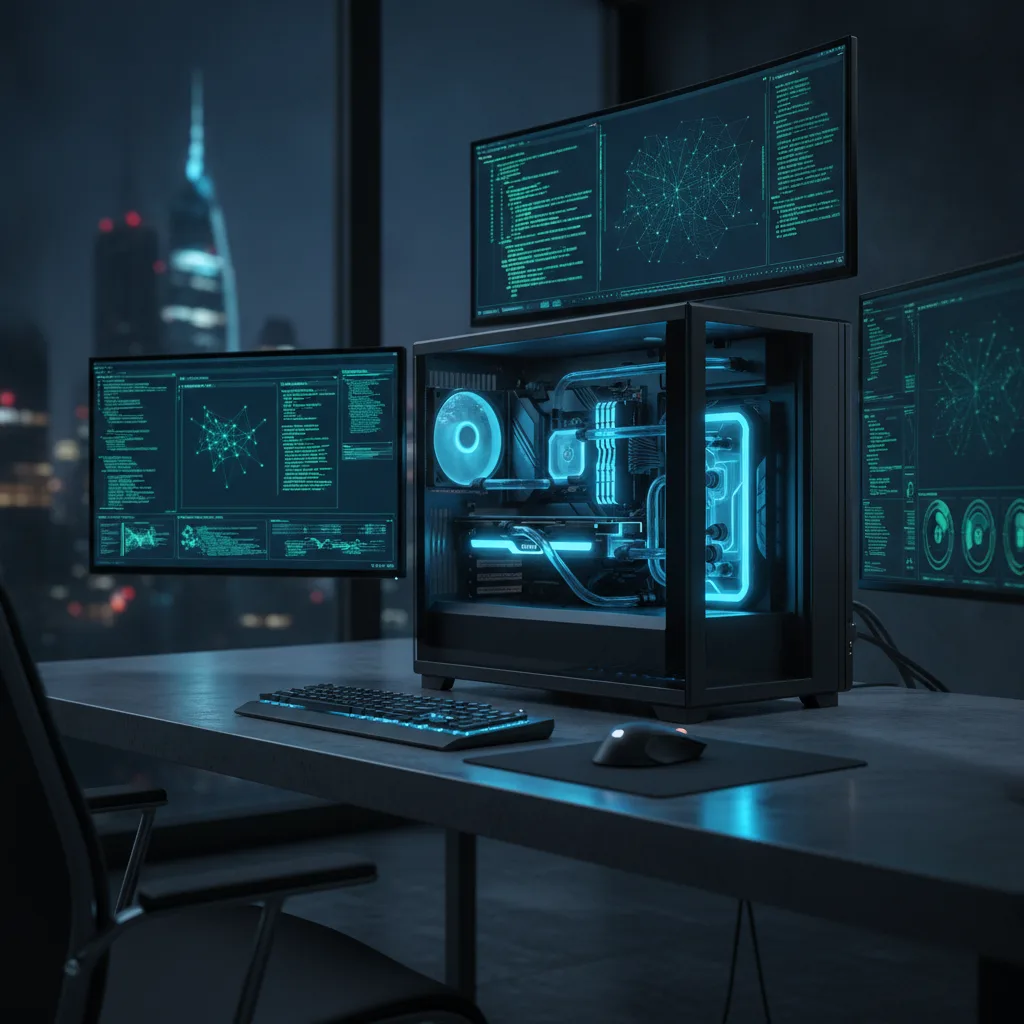
- Cooling: Custom open-loop liquid cooling for the GPUs and CPU. Keeping these components cool under sustained load is critical for performance and longevity.
- OS: Ubuntu Server 24.04 LTS. Lean, mean, and perfectly suited for NVIDIA driver management and Docker.
This setup, including the custom loop, ran me about $18,000 to build. Yes, that's a significant upfront cost. But compare that to $1,000+ per month in cloud bills.
That's a payback period of less than 18 months, and the hardware still has years of life left. For a professional who relies on AI daily, it's a no-brainer investment.
The Core Insight: Unlocking a New Workflow Paradigm
Having this kind of compute on my desk fundamentally changed my development loop.
#### Sub-Millisecond Inference: The Iteration Supercharger
Running Llama 3.1 70B, or even the new Mixtral 8x22B, locally with the NVIDIA Container Toolkit and a quantized GGUF model through `ollama` means inference times are measured in hundreds of milliseconds, not seconds.
This might sound like a small difference, but when you're iterating on prompts, tuning agents, or testing complex RAG pipelines, those saved seconds compound.
My creative flow is no longer interrupted by network round trips or queuing delays. It's instant feedback.
#### Data Privacy and Control: Beyond the API
For internal tools and sensitive data, the "Steam Machine" is a fortress. I can fine-tune private models on proprietary datasets without ever touching a public cloud endpoint.
This isn't just about compliance; it's about peace of mind.
I'm not reliant on a vendor's security posture or data retention policies. It's all on my hardware, under my control.
This alone is a compelling reason for many enterprises to consider on-prem AI development rigs.
#### Unmetered Experimentation: The Innovation Engine
The most profound shift is the psychological one. There's no meter running. I can experiment endlessly.
Want to try a new LoRA with Stable Diffusion 4? Generate 1,000 images overnight. Want to test a new prompt chain with a 70B model?
Let it run for hours. This freedom from cost anxiety fosters a level of experimentation that's simply impossible when every API call costs money.
It democratizes access to serious AI compute for the individual developer.
The Reality Check: This Ain't for Everyone
Look, I know this sounds like a tech enthusiast's dream, and it is. But it's not without its drawbacks, and it's certainly not a universal solution.
First, the initial investment is substantial. $18,000 is a lot of capital to tie up in hardware, even if the ROI is clear for heavy users. Then there's the power consumption.
These GPUs draw serious wattage when under load, which translates to a higher electricity bill. My office is also noticeably warmer, and the liquid cooling pumps aren't silent.
This isn't a laptop you can take to a coffee shop.
Second, the maintenance overhead is real. Custom loops need occasional draining and refilling. Driver updates can be a nightmare if not handled carefully.
Software dependencies, container management, and local orchestration (I use a lightweight K3s cluster for managing my AI workloads) require infrastructure expertise.
This isn't a plug-and-play appliance; it's a mini-datacenter on your desk.
Finally, while my "Steam Machine" is incredible for development and inference, it's not designed for massive training runs on petabyte-scale datasets.
For that, the sheer scale and specialized hardware of cloud providers still reign supreme. And for global, resilient production deployments, the cloud's distributed nature is still king.
My "Steam Machine" is a development tool, a personal sandbox, not a replacement for a production cluster.
The Practical Takeaway: When to Build Your Own AI Powerhouse
So, when does building your own "Steam Machine" make sense?
- High Volume Inference: If your daily AI workflow involves hundreds or thousands of inferences against large models, especially for iterative development.
- Privacy-Sensitive Work: When working with proprietary data or models where sending information to third-party APIs is a non-starter.
- Deep Customization Needs: If you need absolute control over your software stack, from the kernel to the specific model versions and custom libraries.
- Cost Optimization for Long-Term Use: For dedicated professionals or small teams who anticipate years of heavy AI development, the upfront cost quickly pays for itself.
If you're considering this path, start by evaluating your current cloud spend and your specific AI workloads.
Factor in the cost of GPUs (the most critical component), a robust CPU, ample RAM, and fast storage.
Plan for an Ubuntu-based system, lean heavily on Docker or Podman for containerizing your AI environments, and consider tools like `ollama` or `vLLM` for efficient local inference serving.
Treat it like a serious engineering project, because that's exactly what it is.
Building this machine forced me to confront the hidden costs of convenience and the true value of owning my compute.
It's not just about saving money; it's about a fundamental shift in how I approach AI development, empowering me with a level of control and freedom I didn't realize I was missing.
Are we sacrificing too much control and capital to the cloud for our daily AI work, or is the overhead of local hardware simply not worth it for most? Let's talk in the comments.