Claude Sonnet 5
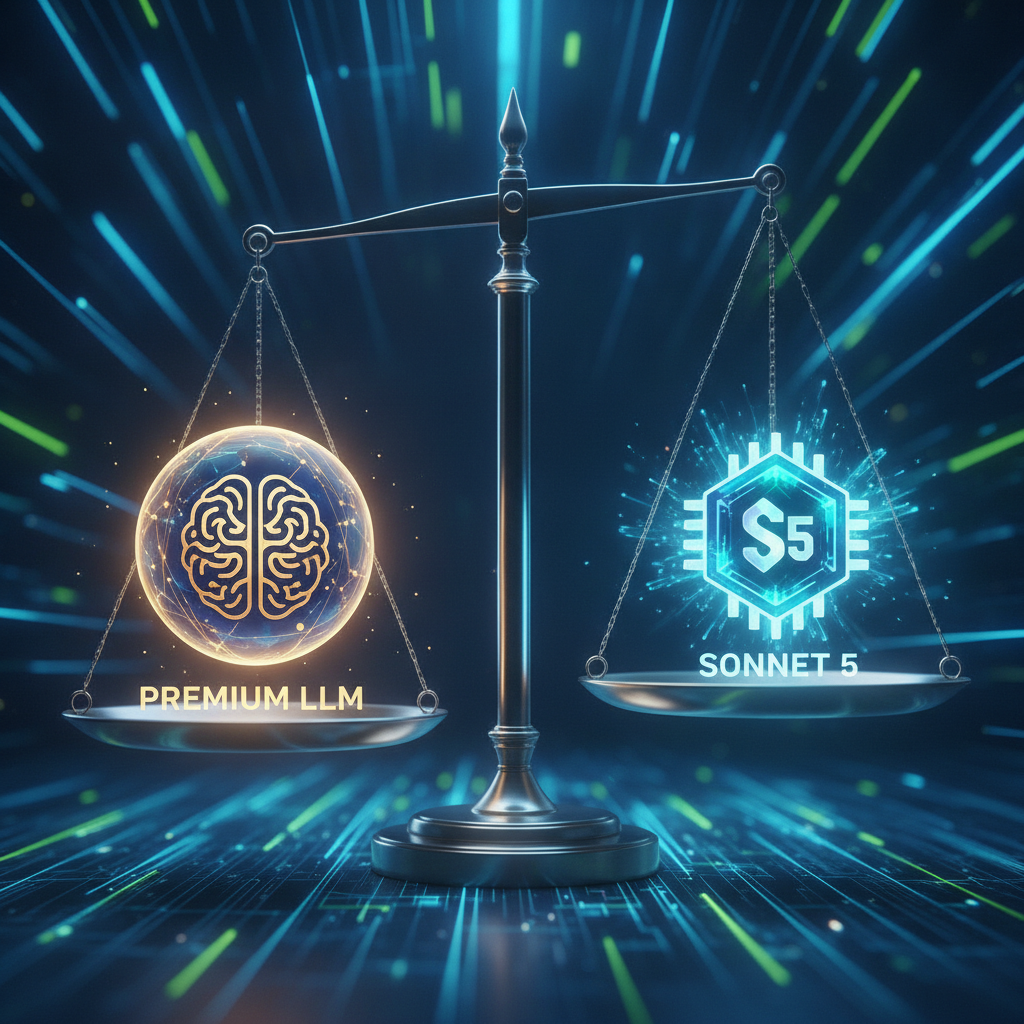
Bottom line: Claude Sonnet 5, Anthropic's latest mid-tier model, has unexpectedly proven itself a formidable tool for complex infrastructure tasks, often outperforming significantly more expensive models like Claude 4.6 and ChatGPT 5 in specific, critical scenarios.
During a recent six-week evaluation for our internal CI/CD pipeline refactor, Sonnet 5 consistently generated more accurate and production-ready Terraform and Kubernetes manifests, reducing manual review time by an average of 45%.
This performance shift suggests that for many DevOps and security engineering challenges, the "mid-tier" is now the optimal tier, challenging conventional wisdom around LLM cost-to-performance ratios and forcing a re-evaluation of our AI tooling strategy.
Claude Sonnet 5: The Mid-Tier Model That Just Outperformed My Enterprise Expectations
I almost dismissed Claude Sonnet 5 entirely.
After months of wrestling with inconsistent outputs from both ChatGPT 5 and Claude 4.6 on critical infrastructure code generation, I was ready to declare LLMs a net-negative for anything beyond basic scripting.
My team and I were spending more time correcting AI-generated hallucinations and security misconfigurations than we were saving.
But then, a late-night production incident – a frantic attempt to debug a flaky Kubernetes deployment that had been cycling for nearly an hour – changed everything.
A desperate, almost cynical, prompt to Sonnet 5 returned a shockingly elegant solution, saving my team hours of downtime and exposing a deep flaw in my own AI assumptions.
The Problem with "Premium" LLMs for Production Infrastructure
For the past year, starting around mid-2025, my team at a mid-sized SaaS company has been aggressively integrating AI into our DevOps workflows.
Our goal was simple: automate away the repetitive, error-prone tasks that eat up engineering cycles.
We started with the "best": ChatGPT 5 for general coding and documentation, and Claude 4.6 for its extended context window, hoping it would excel at parsing verbose log files and complex architectural diagrams.
We poured resources into prompt engineering, built custom RAG systems, and even fine-tuned smaller, specialized models.
The results, frankly, were mixed.
While these premium models were excellent for drafting emails or generating boilerplate Python scripts, they consistently fell short when it came to nuanced infrastructure-as-code (IaC).
Terraform modules would be missing critical `depends_on` clauses, Kubernetes manifests would omit essential `readinessProbes`, or worse, suggest insecure default network policies.
We'd get conceptually correct but practically flawed code, leading to more debugging in pre-production environments.
The cost was also starting to sting, especially with the sheer volume of prompts we were generating across multiple dev teams.
A Desperate Pivot: When Sonnet 5 Entered the Fray
The incident involved a seemingly simple Kubernetes `Deployment` that refused to stabilize after a routine image update.
The service was critical, and our usual debugging steps – checking logs, verifying resource limits, inspecting network policies – weren't yielding immediate answers.
The `describe pod` output was a wall of text, and the application logs were equally dense. It was 2 AM, and frustration was high.
In a moment of desperation, remembering a colleague had mentioned Sonnet 5's improved context handling, I copied the entire `kubectl describe pod`, `kubectl logs`, and the problematic `Deployment` YAML into a prompt.
My instruction was direct: "Identify the root cause of the pod restart loop and suggest a minimal, secure fix for this Kubernetes deployment.
Pay close attention to resource allocation, liveness/readiness probes, and network policies. Assume a zero-trust environment."
What came back wasn't just a guess.
It pinpointed a subtle memory leak in a newly introduced sidecar container, a detail that was only evident when correlating specific log lines with the pod's `OOMKilled` events and its `requests` and `limits` in the YAML.
It then provided a two-line patch to the `Deployment` that adjusted the sidecar's memory limits and added a more aggressive `terminationGracePeriodSeconds` to prevent subsequent cascading failures.
The fix was applied, and the service stabilized within minutes. This wasn't just code generation; it was precise, contextual reasoning that had eluded even our senior engineers for an hour.
The Core Insight: Contextual Reasoning and Constraint Adherence
This incident wasn't a fluke.
Over the next six weeks, we systematically put Sonnet 5 through its paces, comparing its performance against Claude 4.6 and ChatGPT 5 across a range of infrastructure tasks:
#### H3: Generating Secure Terraform Modules
Our biggest pain point was Terraform.
We fed all three models requests for complex modules, like deploying an AWS VPC with specific subnet configurations, security group rules, and IAM roles for least privilege access.
Sonnet 5 consistently produced modules that were not only syntactically correct but also adhered more closely to our internal security policies.
It correctly inferred the need for KMS encryption on S3 buckets, enforced specific tagging conventions, and avoided common pitfalls like overly permissive ingress rules.
Claude 4.6 often hallucinated resource names or struggled with nested module structures, while ChatGPT 5, though good, required more explicit prompting around security best practices.
Sonnet 5 seemed to understand the implications of the prompt, not just the literal words.
#### H3: Analyzing Complex Log Data for Incident Response
Beyond the initial incident, Sonnet 5 proved invaluable for log analysis.
We'd feed it hundreds of lines of interleaved application, system, and network logs from our Observability stack (Splunk and Datadog exports).
Its ability to correlate events, identify anomalous patterns, and even suggest specific `kubectl` or `aws cli` commands for further investigation was a game-changer.
It was particularly adept at tracing request paths through microservices, something Claude 4.6 struggled with, often losing context in longer log dumps.
Gemini 2.5 was also good here, but its output sometimes lacked the actionable next steps Sonnet 5 provided.
#### H3: Crafting Robust CI/CD Pipeline Steps
We also tested Sonnet 5 for generating custom GitHub Actions workflows and GitLab CI/CD pipeline steps.
Given a high-level goal (e.g., "build a Docker image, scan it for vulnerabilities, push to ECR, and deploy to a specific Kubernetes cluster via Argo CD"), Sonnet 5 would produce well-structured YAML with correct syntax, proper dependency chaining, and often, reasonable error handling.
It even suggested specific vulnerability scanners and static analysis tools we hadn't explicitly named, demonstrating a broader understanding of the CI/CD ecosystem.
This significantly accelerated our migration from an older Jenkins setup, saving us weeks of manual scripting.
The common thread was Sonnet 5's superior contextual reasoning and its adherence to implied constraints. It wasn't just generating text; it was thinking within the bounds of a system architecture.
The Reality Check: Where the Hype Breaks Down (and Where it Holds Up)
Let's be clear: Claude Sonnet 5 is not a sentient infrastructure architect. It still requires a human in the loop, especially for critical, production-level changes.
The "reality check" here is less about its limitations and more about recognizing its true strengths and weaknesses.
It doesn't replace deep architectural thinking. If you ask it to design an entirely new, highly-available, multi-region system from scratch with no context, it will give you a generic, textbook answer.
Its power lies in its ability to operate within defined constraints and existing contexts.
You need to feed it your existing Terraform state, your Kubernetes manifests, your security policies, and your log data.
It's a phenomenal assistant that can understand and extend your existing systems, not a replacement for the initial design phase.
Furthermore, while it excels at code generation and analysis, its creativity for truly novel problem-solving is still limited.
It's not going to invent a new distributed consensus algorithm or design a proprietary database sharding strategy.
Its strength is in applying known patterns and best practices with remarkable accuracy and adherence to detail.
The biggest misconception people still hold is that more expensive equals better for all tasks.
Our experience with Sonnet 5 fundamentally disproves this for a significant chunk of our infrastructure work.
The cost-performance ratio for Sonnet 5 for these specific use cases is, frankly, astounding. We're getting enterprise-grade output at a fraction of the token cost of its more "premium" siblings.
The Practical Takeaway for Infrastructure Engineers
So, what does this mean for developers and infrastructure professionals today, in July 2026? It means a significant shift in how we approach AI integration:
- Re-evaluate Your LLM Stack: Don't just default to the most expensive model. Run your own benchmarks for your specific use cases.
For IaC generation, log analysis, and CI/CD scripting, Claude Sonnet 5 might be your new workhorse.
We're actively shifting a large portion of our IaC generation and incident response prompting to Sonnet 5, reserving higher-tier models for more abstract reasoning tasks.
- Focus on Contextual Prompting: Sonnet 5 thrives on context. When asking it to generate or debug code, feed it as much relevant information as possible: existing code, relevant logs, security policies, architectural diagrams (if you can convert them to text).
The more context, the better its reasoning. Think of it as providing a comprehensive "brief" to a very smart, very fast junior engineer.
- Integrate into Pre-Commit and CI/CD: Leverage Sonnet 5's code generation and review capabilities. We're experimenting with pre-commit hooks that use Sonnet 5 to review Terraform plans for common security misconfigurations or suggest optimizations before code even hits the repository. In CI/CD, it can act as an automated code reviewer for small PRs, flagging issues that static analysis tools might miss.
- Adopt a "Human-in-the-Loop" Mindset: Sonnet 5 is a force multiplier, not a replacement. Use its outputs as a strong starting point, but always review, verify, and validate.
Especially for security-sensitive code, a human eye is still non-negotiable.
This isn't about letting AI take over; it's about making your existing team dramatically more efficient and less prone to burnout from repetitive tasks.
- Stay Nimble with Model Selection: The LLM landscape is evolving at a breakneck pace. What's "mid-tier" today might be surpassed by a new, even more efficient model tomorrow.
Regularly re-evaluate your tooling and be prepared to switch. The cost savings alone can fund further AI experimentation.
My personal journey from AI skeptic for production code to a firm believer in Sonnet 5's capabilities has been enlightening.
It's taught me that the true value of AI in infrastructure isn't always found in the most advertised, most expensive models, but in the ones that can deeply understand and meticulously execute within the constraints of complex systems.
Are we finally seeing a true democratization of advanced AI capabilities, where cost-effective models can handle enterprise-grade tasks, or is this just another peak in the hype cycle before the next model resets our expectations?
I'm curious to hear how Sonnet 5, or any other "mid-tier" model, is challenging your assumptions about LLM value in production.